
An Iron Will
Clive Richardson
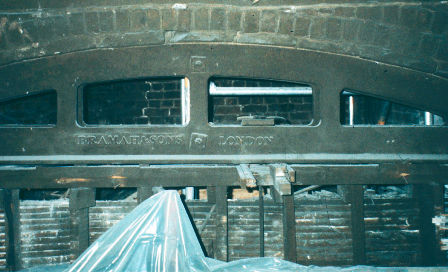 |
| A hog-backed cast-iron beam, with a pierced web. Here the relative tensile weakness of cast-iron was compensated for by putting more material at mid-span. |
During the 19th century, cast iron was commonly used in all sorts of structures. It was reliable for columns but treacherous for beams. Structures occasionally collapsed during or after construction and eventually cast iron was abandoned in favour of wrought iron and, latterly, mild steel. A few cast iron beams still fail today, and although we are not aware of every old building that contains cast iron, the legacy remains and we ignore it at our peril.
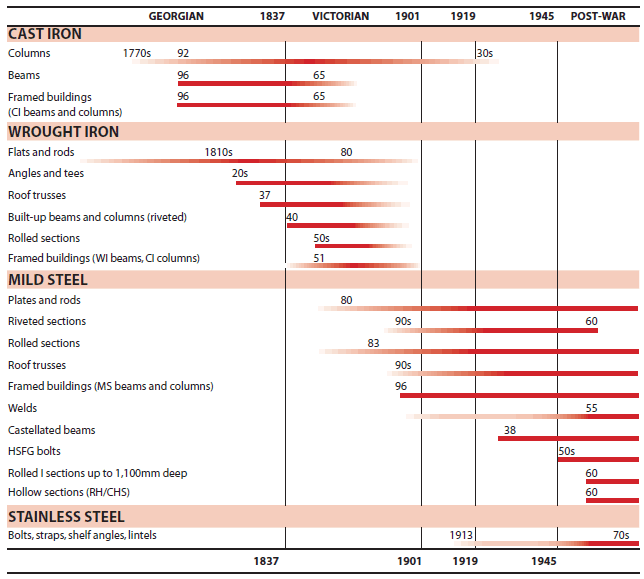
Small quantities of wrought iron were used in medieval construction, such as stone cramps and tie-bars, but widespread, high volume use of cast iron, wrought iron, and mild steel in buildings did not commence until the manufacturing developments of the Industrial Revolution. Of these three, cast iron was the first, being mass-produced from the 1790s (see timelines chart). Casting sizes were only limited by the practicalities of construction and the degree of decoration required.
 |
| Cast iron beams are found in large houses such as Hyde Park Gardens as well as industrial structures. |
Cast iron was cheap and strong in compression, which made it popular for columns after the 1770s when slender circular columns were used in several churches, until the 1900s when they were superseded by mild steel. Cast iron beams were less successful than columns. The tensile weakness of cast iron lead to the development of beams with extra material to take the tension (see typical sections diagram).
Concerns gradually mounted about the reliability of cast iron in tension. In 1847, some of the cast iron girders of Robert Stephenson's railway bridge over the River Dee at Chester collapsed. Five people were killed and 18 injured. The loss of life led to a Royal Commission of inquiry and to a greater use of wrought iron instead.
 |
|
| Timelines: knowing the age of a building can help in predicting the presence of cast iron beams |
Isambard Kingdom Brunel gave evidence to the Commission. He argued against rigid rules for bridge building and even called the investigating body ‘The Commission for Stopping Further Improvements in Bridge Building’. He believed that with proper care in eliminating non-homogeneous aspects and other imperfections, reliable iron-castings could be made ‘of almost any form and of 20 or 30 tons weight’. However, Brunel and many other engineers did not bargain for the variability of the tensile strength of cast iron and its low strength. Nor could they cater for the deceit of some unscrupulous foundries, whose employees would disguise poor castings with lead or Beaumont’s Egg; a mixture of beeswax, fiddler’s rosin, finest iron borings and lamp black.
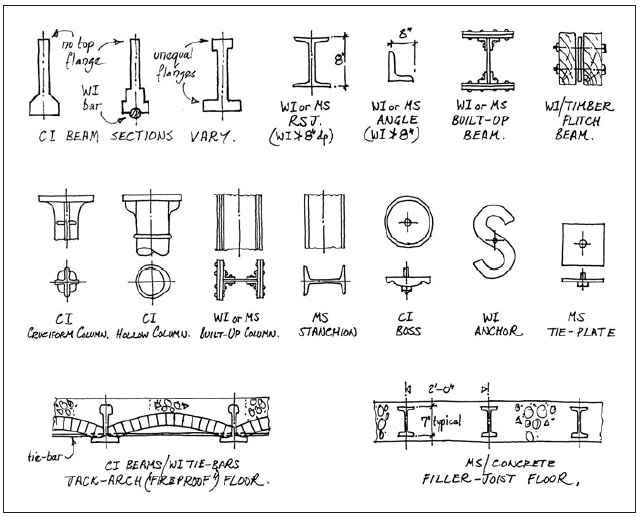 |
| Typical iron and steel structural components |
The collapse of cast iron beams was not reserved for bridges. Tom Swailes (1) has researched nine particular collapses from 1824 to 1869, ranging from mills, a prison, offices, and a malt barn to King’s College dining hall and Somerset House Terrace. But it was probably the Tay Bridge disaster of 1879 when 75 people died that sealed the matter, although there was no absolute knowledge of why the structure failed (2). In the early 19th century wrought iron became the second of the three metals to gain popularity. Being equally strong in tension and compression, wrought iron was good for beams, trusses, and tie-bars, while cast iron remained popular for columns as it was cheaper, as well as being stronger in compression (see comparative strengths table, below).
Thus a partnership arose between wrought iron beams and cast iron columns for framing buildings. In 1851, the three-storey Crystal Palace was erected with a diagonally braced frame of circular cast iron columns, riveted wrought iron lattice beams, and cast iron secondary lattice beams. In 1858-60, the Boat Store in Sheerness was the first multi-storey building with a portal frame (unbraced) in the world, with cast iron I-section columns and beams and riveted wrought iron plate girders.
| STRENGTHS ACCORDING TO THE LONDON BUILDING ACTS 1909 | ||||
| Material | Working stresses: Ton/in² |
|||
TENSION |
COMPRESSION |
SHEAR |
BEARING |
|
| Cast iron | 1.5 |
8.0 |
1.5 |
10.0 |
| Wrought iron | 5.0 |
5.0 |
4.0 |
7.0 |
| Mild steel | 7.5 |
7.5 |
5.5 |
11.0 |
Table 1: Comparative strengths of iron and steel
| CAST IRON | WROUGHT IRON | MILD STEEL |
| Surface rust | Delaminates | Rusts away |
| Brittle | Ductile | Ductile |
| Sandy surface | Hammered/smooth | Smooth surface |
| Mould lines | – | – |
| Monolithic sections (sometimes decorated) |
Riveted sections | Riveted sections |
| Unequal beam flanges | Equal flanges | Equal flanges |
Table 2: Distinguishing between materials can normally be achieved by visual inspection.
Mild steel was the last of the three metals to come into use, in the 1880s. At the turn of the century all three metals were in use, sometimes in the same building. By the First World War steel had supplanted cast and wrought iron because of its all-round strength, reliable quality and cheapness.
It is tempting to presume that 19th century cast iron beams in buildings which are still standing today must be safe as they have stood the test of time. This is probably true for those structures which are not showing signs of distress, whose loads have not increased, or whose materials have not relaxed or decayed. However, hidden weakening can still lead to sudden failure.
 |
|
| This cast iron beam snapped at midspan in 2002. | |
 |
|
| Innocent looking cracks at cast iron beam bearings on columns (arrowed) can lead to catastrophic failure. | |
 |
|
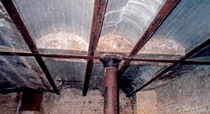
| A jack-arch floor, carried by a circular cast iron column. Note the monolithic splayed capital of the column, which can only be achieved by casting. | |
 |
|
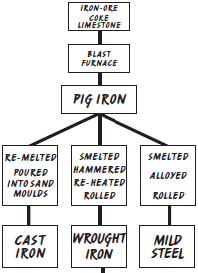
| Cast iron, wrought iron and mild steel have the same basic ingredients, but the high residual carbon content of cast iron makes it brittle and unreliable for use in beams. |
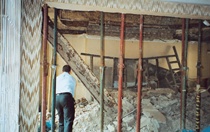
The c1836 roof terrace at 2 Hyde Park Gardens, London, a Grade II listed building, collapsed in 2002 into an unoccupied ground floor room (see top illustration, right). The cause was the failure of a 6.6 metre span cast iron beam supporting a brick jack-arch roof deck. An accretion of successive roof finishes had increased the load on the beam, and corrosion of the beam at its interface with the jack arches had reduced their composite strength. The beam snapped without warning near mid-span, exposing a casting flaw which had been filled with lead. Subsequent investigations revealed that several similar roof terraces of adjacent houses had been reconstructed many years previously.
So the legacy of cast iron is still with us today. Apart from where cast iron beams are visible, such as in railway station roofs, we can predict from a building's age, style, and floor spans the likelihood of their presence. There are always surprises, such as modest country mansions with timber floors, and the odd iron beam hidden within them.
Distinguishing cast iron from wrought iron and mild steel beams can generally be achieved by visual examination. Cast iron beams normally have unequal top and bottom flanges, or no top flanges at all. Sometimes beams are hog-backed or fish-bellied, or their flanges taper on plan, as illustrated in the table. Also bear in mind that cast iron rusts very little, cannot take rivets or welds, and can be cast with monolithic details that cannot be achieved by steel rolling mills, such as lugs, web-stiffeners, end-plates, and dovetail slots. Indeed the design of early joints between cast iron members imitated timber joints. Latterly, bolts were used.
Common defects include:
- fractured beam flanges at their column seats (see middle photo, above right)
- failure of ‘burning-on’ repairs
- disguised casting defects
- severed tie rods in jack-arch floors
- corrosion of beam/jack-arch interfaces.
The appraisal of cast iron is a specialist and exhaustive task for structural engineers. It is tempting to avoid appraisal by believing that a structure that has stood for 100 years or so without falling down will surely stand for another year yet... and then another, and so on to infinity. This is the infamous 100-year rule and it is, of course, highly misleading. If we are to ensure that our legacy of cast iron beams continues to serve us safely then an iron will is needed to apply a more rigorous approach: ultimately nothing short of specialist structural appraisal will do.
Recommended Reading
- C Richardson, The AJ Guide to Structural Surveys, Architectural Press, London, 1986
- M Bussell, Appraisal of Existing Iron and Steel Structures, Steel Construction Institute, Ascot, Berkshire, 1997
Notes
(1) T Swailes, '19th century "fireproof" buildings,
their strength and robustness', The Structural
Engineer, October 2003
(2) J Prebble, The High Girders, Pan Books, London, 1968