
Bathroom Fittings for Historic Houses
Jonathan Taylor
 |
|
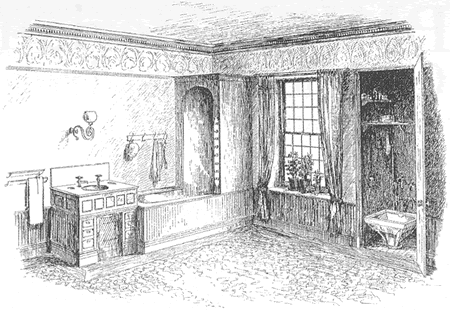
| A bathroom interior from the 1887 catalogue of Meyer-Sniffen Co Limited |
Bathrooms as we know them today are a relatively modern development. In the early 19th century water was fed to houses by lead pipes, sometimes with timber casings, which tended to leak leaving insufficient pressure for the water to reach much above ground level. Bathing took place either in front of the kitchen range or outside in the yard, or in the wealthier homes, in the bedroom. Baths were taken in large, portable tubs and jugs of water and bowls set on a wash stand sufficed as a wash basin, with the chamber pot under the bed.
Water closets, although outside, were comparatively sophisticated. The valve closet which flushed much as a modern one, was encased in timber to form a seat over the pan which contained water. A complicated valve mechanism released the water into a lower chamber when it was flushed. Others, such as the pan closet were rinsed with a jug of water by hand.
Major improvements in the supply of water occurred throughout the 19th century. First the development of steam pumping engines enabled pressure to be increased, followed by the introduction of cast iron mains in the 1820s. For the first time water had sufficient pressure to be piped to a tank in the attic of houses, allowing plumbed-in bathroom fittings. Most houses in Manchester and London were connected to a mains supply by the middle of the century, but many, particularly in the north of England were still sharing communal stand-pipes until well into the 20th century.
 |
||
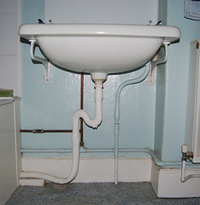
| Original lead pipework under an Edwardian bracket-supported wash basin | ||
 |
||
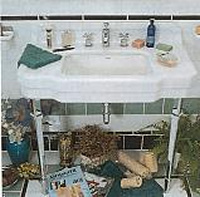
| Reproduction 1935 Thomas Crapper console basin (Photo: Original Bathrooms Ltd) |
Some stately homes, such as Phillipps House in Wiltshire, had bathing facilities in the late 18th century. However, the first bathrooms we would recognise – with a water closet, bath and wash basin – were converted from bedrooms in the houses of the wealthy from the 1840s. An early example survives at Longleat in Wiltshire, which includes a leadlined tub with vertical boards bound with iron hoops like an oval beer barrel, probably made for the 3rd Marchioness on the estate. Alongside it there is a valve closet, but otherwise the room looks like a bedroom.
House plans for even the more elegant houses of the mid-19th century show that most people still relied on a single outside closet, but by the early 1860s purpose-built rooms were being incorporated at first floor level in some new houses. The common plan-form of terraced houses emerged, incorporating a bathroom in an extension to the rear, with a separate water closet in a small room next to it opening off the landing. This arrangement continued throughout the period. In recent years these have often been incorporated into the bathroom to create a larger space.
From the start, these small, purpose-built bathrooms had a radically different character from the soft furnishings of the converted bedrooms of the past due to the problems caused by steam. They usually had tiled floors and walls, at least up to dado height, with varnished wallpapers above, or bare floorboards with varnished wall papers.
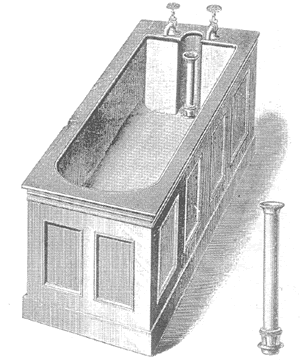
Wash basins followed the lines of early wash stands, set in marble tops with elegant cabinets below. Baths followed a similar pattern, with copper linings supported on a timber frame and enclosed by a cabinet. The combined bath and shower were particularly popular with a series of side sprays and shower options, controlled by taps on the side of the shower cabinet.
Cabinets became less common as the century progressed as they were considered to harbour dirt. Ceramic baths provided the first alternative, followed by enamelled cast iron baths with roll-tops and ball feet, which began to appear from around 1880 onwards. Wash basins began to be supported on brackets off the wall, or on fine legs. The pedestal support did not appear until much later.
RESTORATION AND CONSERVATION
Original bathroom fittings, including tiles, bath, basins and other sanitary ware are of great historic importance, contributing to the character and interest of historic buildings. Repair and restoration is almost always achievable with the right specialist advice. Where original basins and other sanitary ware are broken, it is even possible to have new fittings cast by specialist manufacturers to replicate the original.
 |
|
| The Pemberton Bath 'with patented "Rapid Transit" waste' from the catalogue of Meyer-Sniffen Co Limited |
Where original fittings are missing, it is possible to find 'period' bathroom fittings which are in keeping with the character of those fittings that do survive. Reproductions include some fine examples from the late Victorian period to the 1930s.
Salvaged fittings provide another popular alternative, but here caution is advisable. The high prices commanded for the finest antiques encourages the theft of originals, and historic houses left vacant during building works are occasionally ransacked for their chimney pieces and bathroom fittings in particular. Salvage yards which subscribe to the SALVO Code offer some assurance of provenance.
There are essentially two schools of thought on what is an appropriate addition to an historic building: some conservationists consider that all new additions should be distinctly modern so as not to confuse the history of its development; others take the view that additions should be 'in keeping' with the character of the original, and never of an earlier date. Provided that no alterations are made to important surviving features, either approach is generally accepted by the statutory authorities for a listed building.
However, features considered to be 'important' can include later features as well as the originals; and a particularly fine Edwardian interior scheme in a Georgian town house may be considered just as important as the original. Otherwise there is considerable flexibility and the choice of design will almost always be left to the owner's personal choice.