
Brick Arches
Window Head Details in Exterior Brick Walls
Jonathan Taylor
In most modern brick buildings, brickwork is supported across the openings in exterior walls by either reinforced concrete, reinforced brickwork or a steel lintel discreetly hidden by a skin of brickwork. Often the head of the opening is not expressed in any way, and even in traditionally-inspired architecture, brick arches are often facings applied across a cunningly designed lintel. This modern approach to the design of brickwork is radically different from traditional construction methods in which the lintel or arch was almost invariably expressed.
 |
||
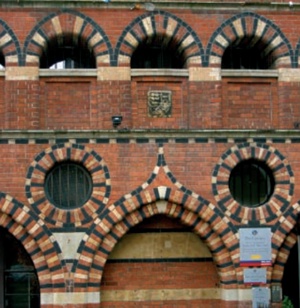
Polychrome brick arches at the Granary Building, Bristol (1869 by Ponton and Gough) |
||
 |
||
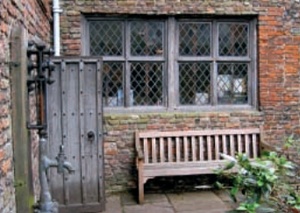
A rare example of an early window without either a lintel or an arch; the brickwork appears to be supported by the heavy timber mullioned window frame alone |
Even in the simplest, most functional building types, including humble terraces and warehouses, the lintels and arches over the doors and window openings were often elaborated, often subtly, but nevertheless providing an important element of detail in the façade. The addition of a substantial cill below the window and an obvious arch, lintel or cornice above, emphasised its height and elegance, reducing the visible gap between the window above. This vertical emphasis is a vital component in the rhythm of many 18th and 19th century terraces, establishing strong vertical arrangements across the horizontal lines of roofs and windows, string courses and street or garden features, contributing to the character of the street scene as well as to the character of the individual window or doorway. The importance of such details cannot be overstated: even the simplest segmental arch detail can have a significant impact on the visible height of the window, of far greater importance than the sum of its humble components might suggest.
LINTELS
The simplest way to support the brickwork above an opening is to use a lintel – a horizontal structural member. Stone and wood were commonly used for this purpose in the past. Stone, being relatively weak in tension, could only be used over narrow spans. However, this problem could be overcome by dividing wider windows into a number of ‘lights’ separated by stone posts or ‘mullions’.
This form of construction is typically associated with medieval architecture and the earliest windows to be glazed. Rough timber lintels are often seen in stone cottages, largely due to the current fashion for stripping these buildings of their render. However, they are less commonly seen in brick buildings. After the Fire of London, exterior structural timberwork was seen as a fire risk, and even the sash windows were pushed back in their window openings so that their sash boxes (the hollow boxes on either side which contained the weights) could be tucked neatly behind the outer skin of brickwork.
The emergence of mass-produced wrought iron beams following the industrial revolution enabled much larger openings to be created in brick walls. Typical applications include industrial buildings, stables and shopfronts, particularly of the Victorian period, when the beams were most commonly disguised by a painted timber fascia. In the architecture of shopfronts, this beam or ‘bressumer’ became an integral part of the complex designs which evolved in the late 18th and 19th centuries incorporating cornices, pilasters and stall risers. Blinds, shutters and window grilles were often incorporated into the space below the bressumer, above the window itself.
In the late 19th and early 20th century, terracotta was often used to provide decorative details such as window and door surrounds in brick buildings. Small, solid blocks of terracotta are essentially the same as moulded bricks. However, large blocks of terracotta which appear much like large blocks of carved stone in size and shape, were usually made from hollow pots moulded on the visible face only, and filled with concrete. In this form the terracotta often acted as infill and cladding around an iron frame.
Flat soffits could also be created by using a relieving arch infilled with brickwork below and with a small timber just above the window frame. This technique was commonly used where the brick façade was rendered or covered with stucco which enabled elaborate window surrounds to be made with cornices and moulded jambs (see Ian Constantinides' and Lynne Humphries' article on Exterior Stucco).
ARCHES
 |
|
 |
|
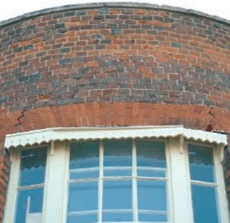
| Above: A broken segmental arch, illustrating the strength of this type of construction: for the arch to fail as it has, the bricks themselves had to crack (Photo: Charterbuild) |
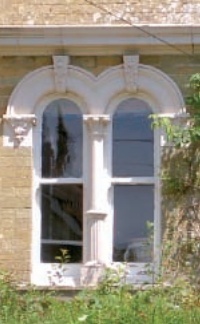
Although generally considered to be a Roman development, probably the earliest known use of arches to span openings was around 4000BC in Babylon. However, it was the Romans who really exploited the potential of the device as a structural element, and in the UK arches have been commonly used as a means of spanning windows and doorways in every period of architecture since then, with fine examples of Romanesque and Norman carved doorway arches in particular. The simplest form, the semicircular arch, gave way to more elaborate forms of arch including the pointed arch usually associated with gothic architecture and the later gothic revivals, and ultimately to the flat and segmental arches which emerged in the late 17th century.
An arch is composed of small elements such as bricks bonded in mortar. It works by transferring the load sideways and downwards, from the key stone at the centre to the jambs of the walls below. As the structure only works when completed, brick arches are usually constructed on a timber frame or former known as a ‘centring’ which is removed after the mortar has set sufficiently.
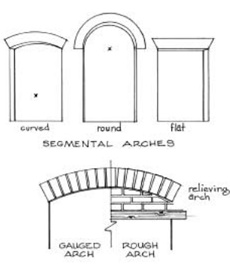
There are essentially two forms of arch construction: ‘segmental’ and ‘rough’. In the case of a segmental arch, the bricks or stone blocks are specially made so that they are tapered to the radius (or radii in the case of an arch with more than one centre), with parallel joints between. Being wider at the top than at the bottom, these ‘voussoirs’, as the units are called, cannot fall out. However, in the case of a rough arch, it is the mortar which is tapered, not the bricks, and the arch relies on the cohesion of the bricks and mortar for its strength. This form of construction was generally considered inferior to the specially tapered voussoirs, both structurally and aesthetically, and rough arches are usually hidden from sight behind render. (Beware when carrying out repair and conservation work. One of the symptoms of the dearth of skilled bricklayers today is that non-specialist builders often use this form of construction when repairing or replacing much finer work.)
The voussoirs of segmental brick arches could be made by cutting ordinary bricks on site with a bolster and chisel, finishing with a bricklayer’s axe or ‘scutch’. More accurate results could be achieved by using ‘specials’ manufactured to the shape required. Brick manufacturers produce these either by cutting the brick in its green state before firing, or by using a specially shaped mould. However, accuracy was limited as some distortion during drying and firing was almost inevitable.
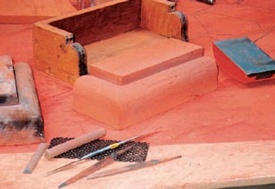
The late 17th and early 18th centuries were a high point in the evolution of brickwork. Manufacturing techniques improved, with blended clay, better moulding and more even firing which led to greater consistency in shape and size. One of the most interesting developments where arches are concerned was the introduction of gauged brickwork, a technique which was popularised by Sir Christopher Wren in particular. This form of brickwork was made using fine textured, soft clay bricks commonly called ‘rubbers’. For the tapered voussoir of an arch, a rubber was first shaped by rubbing on a flat plane of millstone grit until it accurately fitted a specially shaped wooden box, open at the top and on one or more sides. This enabled the exposed face to be cut to a complex profile if needed, incorporating the mouldings of the arch, using a bow saw, and any irregularities were then smoothed out. The whole arch was laid out on the floor on site to the required size as the components were made, to make sure that the all the components fitted together correctly, with evenly spaced joints.
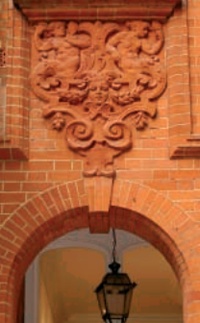
Gauged brickwork enabled the use of extremely fine joints, so that the joints did not disrupt the appearance of the fine mouldings. The technique was widely used in fine architecture of the Georgian and Victorian periods, and some of the finest examples can be seen in the elaborate brickwork of the Tudor Revival in the late 19th century (illustrated below).
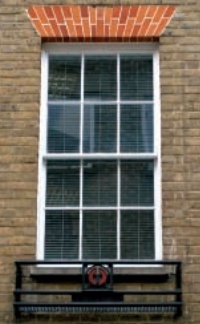
Plain gauged voussoirs were often bedded in pure lime putty, producing neat white radiating lines which emphasised the geometry of the arch. This effect was widely imitated using much cheaper ‘tuckpointed’ brickwork. For this technique, rough and cut brick arches were flush-pointed with a mortar of the same colour as the brick so that the two merged together to be almost indistinguishable. Then, while the mortar was still fresh, a thin line was struck neatly across the centre of the joint and filled with pure lime putty. Roughly shaped and distorted bricks thus acquired the neat edges of gauged brickwork. A by-product of the improvements in brick production at this time was the widespread use of segmental and flat arches.
 |
 |
 |
||
| Left: A late 19th century terracotta arch in Tisbury, Wiltshire. Centre: A typical flat segmental arch with red rubbers and lime putty joints, early 19th century. Right: Rubbed brick arches and reliefs adorning a terraced house in Collingham Gardens, London (c1880) |
||||
THREATS AND CHALLENGES
Arguably the greatest threats to the fine details which give buildings their character are complacency and ignorance. Repairs, when they are carried out, are often made using inappropriate techniques which actually cause further deterioration. Brick façades are sometimes painted over, obscuring the subtle variations in colour and texture which are so important to their character, and locking in moisture. Hard cement mortars are commonly used in place of the traditional, much softer lime mortars. Both alterations can cause the brickwork to deteriorate. Other typical causes of damage include the cleaning methods commonly used, rust damage caused by metal fixings, and frost damage following saturation by, for example, overflowing gutters.
Where window lintels and arches have failed, repairing the faults without reducing the loads can be counterproductive. By reinforcing the brickwork above the opening it is possible to convert the brickwork itself into a lintel, reducing the stress in the arch or lintel below. This can be achieved quite simply by introducing narrow stainless steel bars into the mortar joints above to span the width of the opening and repointing so that they are invisible externally. Some specialist companies have also developed the technique of introducing threaded stainless steel rods through the bricks themselves. These rods are then attached to plates on either side of the opening with nuts which can be tightened to post-tension them. The brickwork thus acts in compression, while the steel carries the tensile forces.
 |
||
| A replacement rubbed brick and some of the tools used to make it, including the open faced box and a carburundum block used for rubbing (photograph courtesy of Nimbus Conservation Ltd) |
Repointing should always be carried out using a mortar which matches the composition of the original. In older buildings this will usually mean using a lime mortar, often with a local sand or aggregate. These mortars are relatively porous and expand and contract to a degree which cannot be matched by modern cement mortars. Repointing with a hard cement mortar can introduce stresses across the face of the brickwork, causing the edges of the bricks to crack and crumble. They also lock moisture in, which can lead to frost damage and salt crystallisation, causing the brickwork to crumble.
As in so many aspects of historic buildings, it is important that the consultants and contractors used are all experienced in dealing with historic and traditional materials. It is not enough for a person to be a member of a professional body or trade association, if these vital features are to be understood and properly cared for.