
Caring for Communities
15 years of heritage lottery funding
Ian Morrison
 |
||
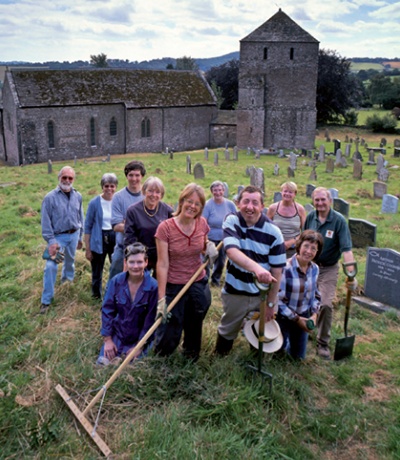
People from the village of Leintwardine in Herefordshire used a grant of £22,700 to help them transform the graveyard of their church, St Mary Magdalene, into a peaceful recreation space where people can learn about their history and the wildlife around them. (Photo: David Ward) |
This year [this article was written and published in 2009 - Ed] marks the 15th anniversary of the Heritage Lottery Fund (HLF) and there is much to celebrate. Since opening its doors for business in 1994, more than £368 million has been awarded to over 3,500 projects that have benefited Christian places of worship, with £302 million helping to conserve the fabric of around 2,500 cathedrals, churches and chapels throughout the United Kingdom. This represents the largest single investment in our country’s rich Christian heritage since the Victorian period.
Much of this money has been channelled
through the targeted Repairs for Places of
Worship grant programme, a UK-wide scheme
(run in partnership with English Heritage and
Historic Scotland) from which £18 million a
year is allocated for the most urgent structural
repairs, such as the fixing of leaking roofs
or the consolidation of loose masonry. But
it may be surprising to learn that more than
half the total amount of funding has come
from HLF’s general grant programmes,
Heritage Grants and Your Heritage, which
attract applications from across the heritage
sector, from national museums to local history
societies, from major heritage institutions to
small voluntary groups. The competition for
these funds is very high, particularly as the
total amount of money available has gradually
reduced in recent times to its present level of
£180 million a year. And yet, proportionally,
churches seem to do very well. Why is
this?
The historic and architectural significance of churches cannot be overstated. Of the 16,000 places of worship owned by the Church of England, over 12,000 are listed, and nearly half of all of the most important (Grade I) listed buildings in England are churches. Yet this is not the sole reason why they attract so much funding. Of equal importance is the place that churches occupy, both physically and spiritually, at the heart of our communities. There is a church or chapel in almost every village, ward or neighbourhood. They are often the most dominant element in the landscape, the focus for many civil and social activities, and they provide a powerful visual connection with our past. They are in some form or other accessible to everyone. In short, they offer wonderful opportunities for encouraging people to get involved with and learn about their heritage, and this is at the very core of what HLF is trying to achieve. When this kind of public engagement is combined with works to repair and conserve these wonderfully important historic buildings, the results are often spectacular.
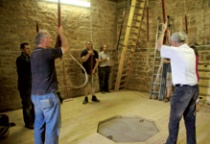
The project to restore and repair the bells at the Church of St Mary at Much Cowarne in Herefordshire is an excellent example. A disastrous fire in 1840 had destroyed the original bells, and although some were later replaced, the condition of the bell frame and the floors of the ringing chamber and belfry meant that even limited bell-ringing was hazardous. The parochial church council (PCC) sought to rectify this and launched a fundraising campaign in 2006 to repair and restore the bells. Crucially, it decided early on to use the restoration appeal to get local people more involved with its church. The project was far more than just a conservation and repair scheme: education packs and information leaflets were produced, a new church guide book was written, and a room on the ground floor of the tower was developed for use by both the local school and the local history group as an exhibition and meeting space. The project also sought to recruit and train up to ten volunteers from the community as a new generation of bell-ringers. This concerted attempt to engage people secured an HLF grant of £28,000. This money helped to pay for building and conservation works, including the repairs to the bells and the floors, as well as assisting with the production costs of the educational and promotional materials. The end result was that this autumn the full peal of six bells was rung at Much Cowarne for the first time in over 100 years, helping to celebrate the re-connection of the church with its community.
 |
|
| For the first time in more than 100 years the six bells of St Mary’s at Much Cowarne can now be safely rung in the traditional English style. (Photo: Terry Jefferies) |
The design of another HLF-supported project at St Andrew’s in South Warnborough, Hampshire, came out of a long review process undertaken by the PCC to understand how best it could develop its church to provide a centre for local people that combined worship with other community facilities, such as a crèche and meeting place. Here a grant of £45,000 covered around 40 per cent of the cost of building works, which included the separation, modernisation and refurbishment of the south aisle to provide a multi-purpose ‘Heritage Room’, and the construction of a new south porch that provides, among other things, toilet and baby-changing facilities. Selective pruning of trees in the churchyard helped light up the interior, creating a more pleasant and welcoming environment, while also improving the visual connection of the church with the village.
The result is a scheme that shows how it is possible to sensitively adapt a historic church to be used for more than just regular worship, giving it another purpose and an additional reason for sustaining it in the long-term. The outcomes were so good that South Warnborough won Country Life magazine’s Village Church for Village Life award for what the judges agreed was ‘an outstanding project that has involved the whole community, ensuring the future of their church as a focus for village life’.
Clearly, the coalescence of church and community is paramount. A significant number of HLF-supported projects have not involved capital building or conservation works at all, but have instead focused on activities designed to help strengthen the bonds between a church and the people who live nearby. The congregation of the Norman Church of St Michael and All Angels in Houghton-le-Spring, near Sunderland, set out a vision that seeks to preserve and enhance the church as a focus for social activity for the next 900 years. As part of a wider scheme to improve physical access and to provide community facilities, HLF was asked to support a project that focused on helping people become more engaged with their heritage.
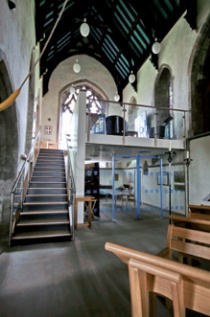
A £50,000 grant helped to establish a heritage resource centre in the north transept, including multimedia facilities designed to capture people’s attention and encourage them to find out more about the history of their church and town. The local history society and friends groups gathered together a variety of source material for the heritage centre, including photographs, oral history testimonies, parish records and other archives and artefacts. This collection was enhanced by the preparation of new learning materials, such as interpretation boards that describe the story behind the images in the stained glass windows and help to unlock the history of the font, the knight effigies and other monuments and fixtures.
Other projects have looked beyond their own historic walls for opportunities to connect with the community. A small project, appropriately called ‘God’s Acre’, at St Mary Magdalene in Leintwardine, Herefordshire, sought to promote the churchyard as a sacred place that was teeming with stories about people, history and natural heritage. A grant of £22,700 paid for wildlife surveys and ‘mini-beast safaris’ and provided materials for children to make stone-rubbings and record inscriptions on grave-stones, helping them uncover the history of local people. Improvements for disabled access and the provision of new oak benches, made by local craftsmen with design input from the children of the village school, encourage more people to use the churchyard for recreation, and information boards and leaflets give them the opportunity to discover more about their local history and the wildlife around them.
 |
|
| A £50,000 grant from the HLF helped to transform the north transept of the Church of St Michael and All Angels in Houghton-le-Spring into a heritage centre for the local community. (Photo: John Lambton) |
All of these projects have been funded through the HLF small grants programme, Your Heritage, and have achieved excellent results. Although quite different in nature, they have adopted a very similar approach to project development, which has helped them secure their funding. First and foremost, all of these schemes have heritage as their focus, whether this relates to the church itself or the history of the surrounding area, its people and wildlife. Second, and of equal importance, is the emphasis that is placed on helping people get involved with and learn about their heritage. This was the sole purpose of some of the projects already mentioned, but even the capital building projects had the provision of incorporating learning activities and resources in their core objectives. The benefits of this approach are obvious and far-reaching. Through their active involvement, people will gain knowledge and experience enjoyment, but they are also more likely to maintain an interest and care for their heritage. A church project that seeks to engage with a wide audience is likely to attract more people to look after the church building long after the actual project work has been completed. This is why HLF insists on the embedding of learning activities in every project that we support through our general grant programmes.
The third key issue to consider when planning a project is effective consultation with as many people as possible who have an interest in the church or churchyard. There is very little point in delivering a community meeting room, for example, if few people are going to use it. Equally, learning and participation activities that do not meet people’s needs or expectations are unlikely to be worthwhile. Only by gaining a proper understanding of the community’s requirements is it possible to be confident about achieving successful outcomes. All of these projects took time to consult widely, seeking not just the views of the existing congregation, but also engaging with schools, voluntary organisations and other social groups. As a consequence, they have delivered something that the community values and wants to invest in, and in doing so, each church continues to be a hub for social activity.
These projects, and many others like them, serve to counter-balance the downbeat reporting in the media about dwindling congregations and unsustainable church repair bills. Our experience is that churches have an enduring appeal; they are special places that people invariably want to keep and look after. Communities just need to be encouraged to get involved.