
New Carpets for Interiors
David Luckham
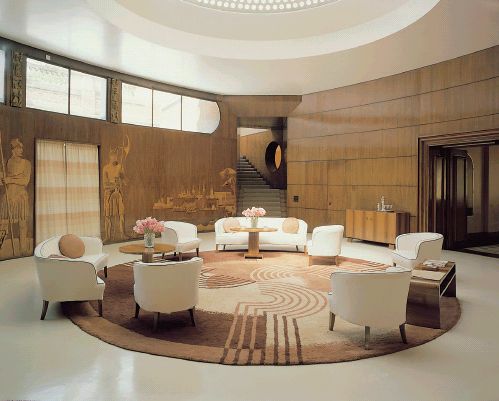
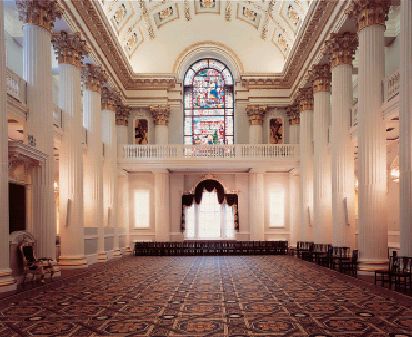
Picture, if you will, that most sublime of art deco interiors, Eltham Palace, without its Marian Dorn Donegal carpet reflecting the sheer style and opulence of the Courtauld era – or the Egyptian Hall at the Mansion House without its patterned Wilton carpet reflecting the room’s vibrant colours and architectural magnificence. Each of these carpets is a new introduction to its location. The first is a curatorially accurate re-make of the original (now in the Victoria and Albert Museum), the second is a new design to enhance the existing features of the room; both examples representing a functional yet aesthetically pleasing response to the problems of large visitor numbers in an historic setting.
The introduction of any new carpet into an historic interior is bound to make a considerable visual impact simply because of the proportionately large area involved. Too often a ‘safe’, insignificant carpet is chosen: its purpose being not to draw attention from the walls, ceiling and other decorative features. The effect, however, is to reduce the visual impact of those very features so that the interior becomes a shadow of its potential beauty. Not all carpets of course are intended for magnificent or elegant rooms. However, the importance of the choice of carpet in any location cannot be underestimated simply because the carpet provides a background to the features surrounding it and items placed upon it.
In situations where a curatorially accurate reproduction of a carpet is required, usually because the original has become fragile or has been destroyed, strict control must be exercised over the drawing, colour palette, yarn, construction, quality and finish: all of which vary considerably from culture to culture and from time to time. Where possible, the new carpet should be made in the same way, in the same materials and, ideally, in the same country as the original or, at least, under the supervision of experienced workers from that country or culture.
 |
|
| Eltham Palace entrance hall with the re-created 1930s Engstromer furniture and Dorn carpet (Photo: English Heritage Photo Library, photographer Jonathan Bailey) |
Inevitably, the question of cost arises and this type of work is seldom the cheapest option. However, carpets that are considered for reproduction form an integral part of their location and must be treated as of equal priority with other fittings and finishes such as plasterwork, gilding and hangings. If the cost is considered on a ‘whole life’ basis over the life of a carpet of high quality, it will be seen that creating a carpet of the quality of the original usually represents best value for money.
The production of an historic replica obviously starts with an historic, aesthetic and construction survey of the original. Once the facts are known, the process of replication can begin. Sometimes, the construction of the carpet is one that it is not possible to reproduce as the original skills and technology have been lost. Many carpet manufacturers have ceased to exist and their looms have been discarded. These cases pose an added challenge as it can be extremely difficult to recreate the very special character of the carpet using a different construction. Where mills of the appropriate type have survived it is important to use them, not only for historic authenticity and character, but also because many of them are struggling to survive, and their skills and technology may otherwise soon be lost.
Carpets can be dated by receipts, inventories and the colour palettes and construction methods of the originals. For example, sometimes construction methods like pre-printing the yarn were used for only a short period of time so their styles and colour palettes are limited and distinctive. Fortunately, other historical floor coverings such as India matting and English bull-rush matting are still available from their original sources. Even painted floor cloths are still obtainable although the caveats regarding design and colour palettes apply.
New designs of carpets for historic locations can, like the Mansion House carpets, be very successful but mistakes are easily made. It is vitally important that a close affinity exist between the new carpet and its surroundings and it should enhance, not dominate nor detract from, the features around it. This does not mean that it should be a shadowy element of the interior design but that it should adopt or reflect the aesthetics of the other features.
The construction of such a carpet can be expected to vary depending on the use of the area. New hand-knotted carpets can be designed to order as can Axminsters and narrow-width Wiltons. These traditionally constructed carpets have excellent wearing characteristics and keep their good looks over many years, providing they are properly maintained.
Many good quality ranges of commercial carpets work well in areas such as offices and retail areas however the choice should never be seen as an easy option but as a deliberate and carefully considered selection. In some cases, such as offices, shops or restaurants where the setting does not necessitate the introduction of fine carpet, other options can be very effective. Good quality woven nylon and printed tufted carpet can be less expensive and more practical and even carpet tiles may be appropriate under certain circumstances. However, for the carpet to be appropriate to even these spaces, the historic design and colour palette should be carefully considered. The shock of the new is not usually attractive or appropriate in an historic setting.
Protective floor coverings have an important role in all historic locations, be they protecting historic floors and carpets against the unwelcome introduction of dirt and grit, the ravages of a modern footfall considerably in excess of their historic usage, or the chicken masala stains left on a marble floor after a wedding.
 |
|
| The Egyptian Hall at the Mansion House (Photo: Laing Photographic Services) |
Even these utility floor coverings, be they carpets or matting, should be sympathetic to their surroundings like the well-mannered grey-green felt drugget on the main visitor route at Syon House, quietly protecting the famous scagliola floor without affecting the impact that the floor creates. The ubiquitous red runner can be unnecessarily intrusive, unsympathetic to every room it traverses, and there are better options in most situations. The choice of utility carpets needs to be as carefully considered as any other, as they welcome the visitor and often constitute the main visitor route. It must be remembered that, historically, druggets like these were removed when important visitors were expected, to enable the rooms to be seen to their best advantage. Appropriately designed druggets and barrier mattings can provide acceptable modern solutions.
Important as the carpets themselves are, fitting and maintenance are essential parts of any successful installation. Correct fitting and maintenance prolongs the life of any carpet and a little extra investment in these areas provides long term savings in both time and money. The methods of fitting vary according to the construction and contribute to the overall appearance of the carpet. For example, a 12 wide broadloom Wilton will not have the same character as an identically patterned 27 wide Wilton sewn together in the traditional manner. One is not better than the other: simply more appropriate to a specific location. Like the reduced number of looms however, the number of fitters trained in these traditional skills is also decreasing. Fitting details like border, especially on stairs and landings, can also change the historical character of an installation and determine whether the carpet can be moved regularly in order to prolong its life.
During the refurbishment of a building, particularly where there is a change of use, the purchase and installation of new carpet needs to be considered early in the process to display the building to its best advantage. All the decorative features need to work together to compliment each other fully. In this situation it is likely that an appropriate carpet can do more to enhance the interior than any of the other features can do singly. This is why carpet should not be regarded as just something to cover a bare floor as cheaply and quickly as possible. In this context carpet is often seen as the poor relation in a major contract: being added at the end and often under-funded. A more accurate, appropriate and better value specification can be proposed if it is taken out of the major contract which will also allow a more successful installation to be completed when the site is clear and clean.
The new carpet can reflect the age and style of the location, the past and present use of the building and, possibly, the family history and connections of the past or present owners. Different areas of the same building will, of course, dictate different choices of carpet.
In the case of a more protracted restoration of an historic building, a survey of the requirements for the floor coverings should provide proposals for both short term and long term investment and an holistic and planned approach to protection and maintenance enhances the performance of this investment.
The long and uninterrupted experience of owners and developers of historic properties in the United Kingdom, be they national organisations, government bodies, trusts, architects or individual owners is unparalleled anywhere in the world. Elsewhere, there is a growing awareness of ‘heritage’ and increasingly, UK expertise in the proper conservation and development of this area of activity is being valued.
Recommended Reading
-
C Gilbert et al, Country House Floors 1660-1850, Temple Newsam country house studies no 3, Leeds City Art Galleries, Leeds, 1987
-
SB Sherrill, Carpets and Rugs of Europe and America, Abbeville Press, New York, 1996
-
CEC Tattersall, A History of British Carpets, F Lewis Ltd, Benfleet, Essex, 1934
-
M Thompson, Woven in Kidderminster 1735-2000, David Voice Associates, Kidderminster, 2002
Glossary CARPET Wilton Drugget FLOOR CLOTH MATTING Rush matting
|