Access to Historic Church Buildings
Robin Kent
 |
|
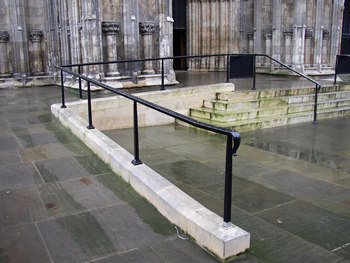
| Ramp solution at York Minster |
Mark 2.1-5 describes how a paraplegic was enabled to meet Jesus by means of a manual hoist installed through the adapted roof of a building, the earliest recorded access adjustment in a Christian context. While access for everyone to churches is both desirable and legally required under the Disability Discrimination Act 1995 (DDA), historic and listed church buildings, and those in conservation areas, require special sensitivity in undertaking such alterations to ensure that their historic value and significance is not reduced by well intentioned but unnecessarily disruptive improvements.
The DDA only requires ‘reasonable’ adjustments and most standards and regulations acknowledge that historic buildings should be treated with flexibility, and damaging physical interventions avoided. However, since the Government has said that the requirements of the DDA will be clarified by case law, and the law only became fully effective in October 2004, there is no firm guidance yet as to what is ‘reasonable’. Theoretically it is necessary to obtain a refusal of planning permission, listed building consent, faculty or equivalent, to establish a legal boundary to what is reasonable for historic church buildings; but with next year’s anticipated new Disability Discrimination Act making it a duty of all local Council departments to promote accessibility and inclusiveness, even this may prove a short lived certainty.
The Disability Rights Commission (DRC) has advised that adjustments that would ‘fundamentally alter the nature of the service’ are likely to be unreasonable and this could apply to some historic church buildings, for example where a candle-lit space with altar steps and echoes is liturgically essential. There is also an exemption for features approved under the Building Regulations since 1994, which need not be changed for 10 years after construction, so that churches which have ramps and toilets designed to previous standards may not need to improve them immediately. The DRC suggests several other factors which can be considered in assessing what is reasonable, including how effective a proposed adjustment is in preventing the disadvantage and how practical, in terms of the financial and other costs relative to the service provider’s size and resources, and the availability of grants or other assistance. The current level of access, amount already spent on improvements, and extent of any disruption that would be caused are also factors that can be taken into account. However, the fact remains that no church can be certain of complying with the DDA.
It is therefore all the more important to ensure that an access audit is carried out to de.ne barriers and provide a basis for any ‘reasonable steps’ that need to be taken. The audit should be carried out by an experienced professional, preferably a member of the National Register of Access Consultants, on the basis of BS 8300:2001. Historic church buildings should also be assessed, on the basis of BS 7913:1998, to highlight those features that cannot be altered or removed because of their historic value. Together, the audit and the assessment should provide the basis for the church’s access plan, setting out a reasoned strategy and action plan for phased improvements. As part of this, it is advisable to commission a conservation professional to advise on the impact of different options and on detailed design aspects.
The Disability Rights Commission ‘strongly recommends’ removing or altering physical barriers as the most inclusive approach. However, for historic church buildings, a range of options which do not involve costly alterations should first be considered, including management, communication and maintenance, alternative means of access and the provision of auxiliary aids. Only after these have been fully explored should alterations to historic fabric be considered.
 |
Management should include clear, developed policies and practices for dealing with the whole range of disabled people, whether church members, visitors or employees. Disability equality training should be a part of this and is becoming a normal feature of many organisations. A high level of disability awareness can overcome the majority of common access problems; if it includes special skills training such as in British Sign Language, that is all the better. Coupled with this is the need for clear communication. Notice boards and waymarking signs and labels, information leaflets, service sheets, hymn books and OHP screens should all be adapted to the needs of people with impaired sight or learning disabilities. Many people with impaired vision prefer large print upper and lower case sans serif lettering with good lighting and colour contrast. The RNIB can provide specific guidance and advice on tactile signs and maps and braille alternatives. An increasingly wide range of assistive technologies is available to aid communication. Sound reinforcement, inductive loops, radio or infra red can help people with impaired hearing and are increasingly viewed as standard in many churches. High levels of disability awareness can also help to ensure that maintenance is appropriate; for example, accessible toilets should not be used for storage, and furniture and book racks should be arranged so that wheelchair users and people with walking aids, such as sticks or walking frames, are not obstructed, while loose mats should be fixed down and frayed carpets replaced so that they do not cause trip hazards for people with visual impairments.
It is often possible to provide access for disabled people by alternative means and hence avoid making damaging alterations. Physical access may be available via other, more accessible entrances, circulation routes and facilities. Wherever possible, these should be independently accessible to disabled people without assistance, and as close as possible to the entrances or facilities used by everyone else. They should also remain available for use by all, not just for disabled people, to ensure that able-bodied people are not excluded. It may also be possible to provide alternative means of access by relocating some kinds of events to more accessible parts of the church building, or other, more accessible buildings. Where such alternative means of access cannot be provided, non-physical access may still be possible, for example electronically by means of audio or video relay to an accessible space, or by providing tapes or DVDs of services or meetings, that can be used at home, or even by uploading the information to the internet.
 |
|
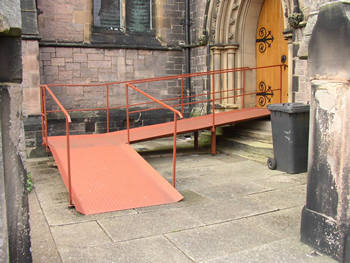
| An ugly temporary ramp |
An increasingly wide range of auxiliary aids is available, some of which will require consents if they are fitted in historic church buildings, which have the virtue of being generally reversible. Probably the most frequently used are portable ramps, which provide a temporary expedient but are unlikely to be a satisfactory long term solution. They should be proprietary rather than home-made, should comply with the maximum gradient for permanent ramps (1:12 for up to two metres) and should always be removed when not in use, so that they do not cause hazards for others using the steps. Mobile platform lifts are also available, but the need for evacuation in case of fire should be remembered. Stair climbers and evacuation chairs can be used in emergencies but require trained assistance and should not be used for routine access.
Where it is necessary to remove or alter physical features, access improvements should be added in a reversible way, with minimum alteration of historic fabric. Occasionally this may provide an opportunity to remove recent accretions where these are considered damaging to the character of the building.
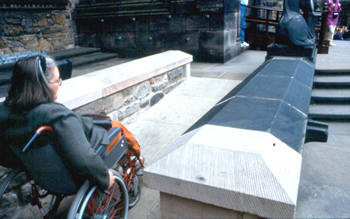
The most obvious and intrusive access adjustment to church buildings is probably the ramp to the main entrance. Temporary ramps which have become permanent features can be both unattractive and hazardous, and high quality permanent interventions are much better. If the rise is not great, it is often possible to raise the whole pavement to eliminate entrance steps. For greater rises, ramps should be designed to a maximum gradient of 1:15 for up to five metres, as this is likely to be negotiable by most wheelchair users without assistance. To avoid giving the entrance a lopsided appearance, ramps can often be hidden behind railings or low walls or curved to appear more ‘natural’ and less obtrusive, taking advantage of existing slopes and planting. Where it is not possible to reduce the visual impact of a ramped approach by such means, double ramps can preserve a symmetrical appearance and maintain the central hierarchy of the steps. If the design of a historic church building cannot be reconciled with an external ramp, it may be possible to form one inside or at an ‘alternative’ side or rear entrance, as described above.
Platform lifts may need to be considered where ramps cannot be accommodated. Although they are rapidly becoming more economic and less bulky, platform lifts are still best used internally, where they are easier to protect from the weather and vandalism and less visually obtrusive. Inclined platform lifts, step lifts, wheelchair step lifts and chair lifts tend to be very obtrusive, but may be useful in less conspicuous positions in larger buildings.
Historic doors are often wide and easily visible but can be cumbersome to use. Automatic door opening gear and glass vision panels in panelled doors can help many disabled people and others, and incidentally make the building more inviting. If the historic entrance doors cannot be altered, supplementary glazed doors can sometimes be fitted.
If a church building has a toilet (and it is to be expected that even historic church buildings today should have at least one) it should be usable by the widest range of people, including wheelchair users, and designed in accordance with the Good Loo Design Guide.
Pews can restrict circulation space and be very uncomfortable for many people, but may be hard to remove if they are part of the historic character of the building. Kneelers and cushions can help but ideally some of the pews should be removed and stored, to provide space in the worship area, both for wheelchairs and some chairs with arms. This may also benefit others, such as families with young children in pushchairs. Ideally some spaces should be provided at the front of the worship area where it is easiest to see and hear, as well as at the back.
Rapidly developing legislation means that even churches that have carried out an audit and made improvements should review their access planning at regular intervals, preferably as an integral part of quinquennial maintenance surveys. Many historic church buildings still fall far short, but the incident in Mark’s gospel encourages us to take a positive, as well as an innovative, approach.
NOTE This article is not a comprehensive guide: each historic church building will need separate consideration.
Recommended Reading
- Access Audits, Centre for Accessible Environments, 1999
- Access Plans, Heritage Lottery Fund
- Access to the Built Heritage, Technical Advice Note 7, Historic Scotland, 1996
- ADAPTations to Access Ability, ADAPT Trust, 1997
- BS 8300:2001 Design of buildings and their approaches to meet the needs of disabled people, BSI, 2001
- BS 7913:1998 Guide to the Principles of the Conservation of Historic Buildings, BSI, 1998
- BT Countryside for All Good Practice Guide, Fieldfare Trust, 1997
- Code of Practice: Rights of Access, Goods, Facilities and Services and Premises, DRC, 2002
- Easy Access to Historic Properties, English Heritage, 1995, revised 2004
- L Foster, Access to the Historic Environment: Meeting the Needs of Disabled People, Donhead, 1997
- Good Loo Design Guide, Centre for Accessible Environments, 2004
- R Kent, 'Disability Access Provisions', The Building Conservation Directory 1998, Cathedral Communications, 1998 (follow this link for updated online version)
- Overcoming physical barriers to access for disabled customers: a practical guide for smaller service providers, CAE, Disability Rights Commission (DRC), 2000
- Overcoming the Barriers, Cadw, 2002
- J Penton, ‘Accessibility audits’, Architects Journal, Dec 1997
- The Disability Discrimination Act 1995: Code of Practice: Rights of Access, Goods, Facilities, Services and Premises, DRC, 2002
OTHER INFORMATION
National
Register of Access Consultants provides list of qualified access consultants
available to carry out access audits. Contact the Register Manager:
Tel
020 7234 0434
www.nrac.org.uk
Disability
Rights Commission DRC Helpline, for free information about the Act:
Tel
08457 622633
www.drc-gb.org
Through
the Roof, for information on access to church buildings:
Tel 01372 749955
www.throughtheroof.org