
Church and Community
St Andrew's, Laverstock
Anthony Male
 |
||
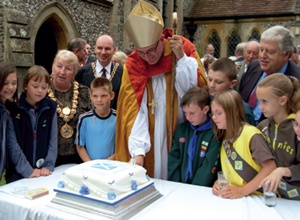
| The icing on the cake: St Andrew’s 150th anniversary celebrations drew the entire community together. |
No longer does the urn-shaped scroll knocker indicate that a doctor lives in the big house on the green. The blue light has been removed from what is now the Old Police House, and the only remnant of the post office is a modern post box with collections once a day. Even the phone box is under threat. This pattern will be all too familiar to rural communities throughout the UK. Many of the places where villagers traditionally gathered have closed or been converted to serve less sociable functions.
One building, however, is still identifiable as a place of communal meeting: the church. Most villages retain one, used for services perhaps twice a week and served by a priest, albeit one from the team ministry in the nearest town. Typically, the building is maintained by a small group of stalwarts who struggle heroically to keep the rain out while paying their dues to the diocese. Funding problems are acute, particularly for those churches that have dwindling congregations dominated by pensioners, and where a large part of the local community is estranged. However, the tide may be turning for those churches that are reaching out to attract younger worshippers. As wage-earners, they can afford to contribute more financially, and as the congregation is more broadly representative of the wider community, they can attract wider participation from others in the secular activities of the church.
THE CHURCH AND ITS CONTEXT
Laverstock may look, to the casual eye, like a modern suburb of Salisbury, but the village’s history has its beginnings in Saxon times. It retains a distinct identity due to the river valley and water meadows of the River Bourne which separate it from Salisbury proper. The village retains a shop and a pub as well as a church school. The resident population is less than 3,000 but more than a thousand pour into the village to attend the three senior schools that sit in a row beneath the escarpment of Laverstock Downs and the medieval estate of Clarendon.
 |
|
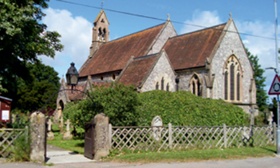
| The present church of St Andrew, Laverstock dates from the mid 19th century, but the fabric and the churchyard contain remnants of much earlier church buildings dating back to the Middle Ages. |
Laverstock’s church, St Andrew’s, is served by a rector from the adjoining parish. It is known that there have been churches situated within this churchyard since the 12th century and probably earlier, and visible remnants of earlier church buildings survive to the west of the present one. Originally a Royal Peculiar (and so under the jurisdiction of the monarch, not the bishops), the church was appropriated by Bishop Poore in the 13th century, and it was through Laverstock that Thomas Becket made his way from his rectory at Winterbourne to attend King Henry II at Clarendon Palace. However, the church that we now see was built between July 1857 and July 1858 to the designs of T H Wyatt, a prolific designer of churches in Wiltshire and Dorset in this period. The building incorporated parts of the porch, memorials and other elements from the earlier church, which was demolished.
CELEBRATING THE PAST, LOOKING TO THE FUTURE
To celebrate the 150th anniversary of its construction, the parochial church council set up a group to explore ways in which the church property could be used to bring greater benefit to the surrounding community.
 |
|
 |
|
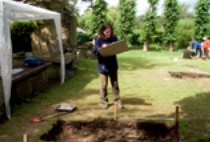
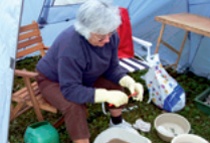
| The archaeological dig attracted the involvement |
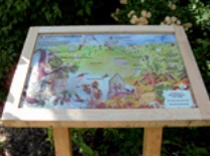
One of the first results was a wildlife day, with experts giving talks in the churchyard on its lichens and other plant life. The churchyard is fairly large, combining elements of the earlier churchyard with the area gifted for the building of the present church. Its old trees and partly cultivated wilderness provide a natural habitat for all manner of wildlife. The day included bird-watching and a riverside nature study on the bank of the River Bourne in an area attached to the church’s property. The day concluded with an evening bat watch.
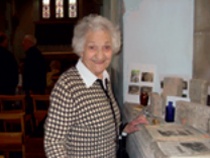
Another achievement was to set up a discovery group to investigate the history of the village. Every house in the parish was leafleted and residents were encouraged to contribute their own grass-roots histories of the village and their own houses. Monthly meetings were held at the church and the project culminated in a week-long exhibition in the church. The visitors book was signed by nearly 300 people and some enthusiasts paid several visits and spent hours poring over the gathered documents, images and old maps.
The community was also invited to take part in an archaeological dig in the churchyard supervised by professional archaeologists, including Alex Langlands and Libby Philpott, who both live nearby, Simon Rothy from University College Winchester, and Andrew Reynolds from University College London. The dig’s objective was to discover the medieval outline of the earlier church, and, if possible, of even earlier church structures. The response was excellent, despite occasional bad weather. The volunteers discovered sections of the foundations, vaulted tombs, ancient tile and painted plaster. Sections of the chancel arch and north wall were also identified, helping to map out the full extent of the original building. However, no evidence of Saxon fabric was found. Further work is to be carried out in the summer of 2009 to complete the picture.
To help stimulate interest in the dig and set it into historical context, the director of Salisbury Museum brought a number of finds from the museum that had been discovered at the site of the 12th century pottery kilns on the village downlands. A local historian and author, Ruth Newman, gave guided walks around the village.
The Sunday service celebrating the church’s
150th anniversary was presided over by the
Bishop of Ramsbury and incorporated a walk to
the old church site, followed by refreshments in
the churchyard.
 |
|
 |
|
| Top: A visitor enjoys one of the village history displays put together by the community for the week-long exhibition in the church. Above: A display painted by a local artist as part of the wildlife project illustrates the flora and fauna of St Andrew's churchyard. |
PUTTING THE HEART BACK INTO THE COMMUNITY
The whole enterprise was achieved without outside funding, and this feat provides a useful lesson both for St Andrew’s and for other small churches that may be feeling the pinch financially. All of the experts involved in our activities gave their time for free, and, although a donations bottle was always on hand, the events were available to all participants without charge. Clearly, interesting and well-attended events can be carried off with fairly modest budgets provided you can gather enough committed volunteers to pitch in and give up their time.
Most members of the community want their local church to be ready to use for weddings, funerals and christenings, and many continue to see it as a place to turn to in time of crisis. But a small and elderly congregation cannot alone supply the funds needed to maintain the church and its surroundings. It can be difficult to make church property accessible and relevant to everyone in the parish. With limited toilet and kitchen facilities there are practical restraints, too. Nevertheless, churches must find roles and uses that speak to a wider section of the local community if they are to survive.
Programmes of events like the one at St Andrew’s reinforce the community and the role of the church as a centre of village life, they promote learning and bring together people whose paths might not otherwise cross. In short, the rewards of encouraging people across the church threshold who wouldn’t usually attend far exceed any financial boost for the church coffers, welcome though that may be.