
Rebuilding a Church Spire
St Luke's, West Holloway, London
John Hoath
 |
|
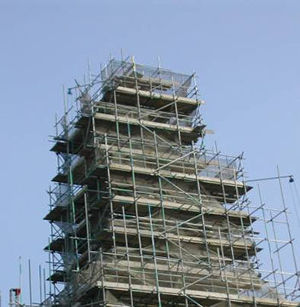
| Work in progess |
St Luke’s Church, situated in West Holloway, North London, is like many other ecclesiastical buildings constructed in the mid-19th century, built by pious, philanthropic and revivalist Victorians. Its style, which is by no means unique, seemingly dictated the choice of building materials, which clearly were in plentiful supply at the time. The juxtaposition of rough textured pale Kentish Ragstone panels and Bath stone dressings enhanced its smooth and correct Early English forms.
The historical use of Kentish Ragstone over many centuries, as seen in the Tower of London and more locally, the old Holloway Prison (1849-1852), as well as for innumerable Victorian churches, has left a legacy of problems, causing considerable anguish to modern stone conservators. There is no entirely satisfactory method of consolidation or suitable substitute stone for restoration purposes.
Although variations occur in spire construction techniques even where the same materials were used, the problems encountered when repairing this typical Victorian spire will be familiar to many over the next few decades, if they are not already.
WHAT ARE YOU PAYING FOR IN ROUTINE MAINTENANCE?
Work began on building
St Luke’s in 1859, with the land being donated by a Thomas Poynder who
owned a lot of what is now Lower Holloway. Local dignitaries donated £1,500,
and the church was consecrated in 1860.
During the Second World War, St Luke’s suffered serious bomb damage when in 1941 the north Transept took a direct hit and was completely demolished.
A programme of repairs and rebuilding was undertaken during the 1950s. This included the complete rebuilding of the North Transept in reconstituted stone, rebuilding of the spire cap and upper courses in Portland stone dressed to emulate ragstone walling. Further repairs carried out at this time included re-pointing, stone consolidation and repair with a hard cement mortar.
The ravages of time, the effects of pollution and the inappropriate use of cement rich mortars have all had an affect on the stonework, and in particular on the more exposed parts of the ragstone walling to the spire, tower and east chancel gable.
Five years ago, during the quinquennial survey by the church architect, Robert George, it was noticed that large pieces of ragstone masonry were falling into the church yard below. Steeplejacks then carried out a further, more detailed survey of the spire and removed any loose and friable stone. Other churches in the area had had similar problems in the past, and there is much evidence locally of decapitated church spires. The decision was taken to try and save St Luke’s spire and not consign it to the local salvage yard.
The Heritage Lottery Fund was approached with a bid for funding and, after an initial failed attempt, St Luke’s PCC were lucky enough to secure funding for the project.
Structures that weather beautifully in unpolluted or avid
locales become unsightly in sulphur-laden or humid air
(Lowenthal The Past is a Foreign Country)
Work on the project commenced early in 2002. It was programmed to take 34 weeks, eight of which would involve the erection of full access scaffolding to a height of 45 metres.
The scope of the masonry works included the replacement of 250 sq m of weathered Kentish Ragstone panels to the spire and tower; the replacement of 152 m of Bath stone ribs to the spire; the repair and consolidation of remaining areas of retained ragstone; masonry cleaning using the Jos system (a relatively gentle form of sand-blasting widely used in the conservation industry), re-pointing open joints with a softer and more porous mortar than used in previous repairs; minor stone repairs carried out as either ‘plastic’ repairs (which involves building out a worn stone with lime mortar) or indenting (essentially plastic repairs reinforced with slips of tile); and shelter coating (the application of a coat of limewash to consolidate and protect the stone).
Universal Stone Ltd, the appointed principal masonry contractor, commenced survey work once full scaffold access was achieved. It soon became apparent that the ragstone panels on the spire were in worse condition than expected. It had been assumed that the external face of the ragstone was a veneer laid in front of a brick backing with perhaps a bonding stone placed at intervals for additional stability. Indeed the replacement stone was originally to be confined to removal of the external masonry only. However, the very coarse nature of ragstone and method of cutting and dressing this tough and intractable stone obviously dictates the final shape of the stone, thus determining the construction method. In this case it was found that the walling was bonded randomly with brick infill placed appropriately as a backing. In some places all of the stone blocks projected through the brickwork, making it impossible to remove the stone facing without destroying the integrity of the brickwork.
The discovery of this type of construction called for a complete rethink on how the masonry of the spire was to be dismantled and rebuilt. Scaffolding access to the spire internally was not originally planned for, however, once the decision was taken to dismantle the spire masonry completely, an internal scaffolding was erected.
Consultation then took place between the project architect, structural engineer and Universal Stone and the decision was reached to dismantle and rebuild the spire from the top down. In order to carry out this work efficiently whilst still maintaining the structural integrity of the spire it was decided to take down and rebuild small areas at a time, inserting pre-cast concrete lintels on the internal face to give support to the masonry above during the re-construction of lower sections.
DISMANTLING AND RE-BUILDING THE SPIRE MASONRY
Ragstone and brick
backing was taken down in 1.5-2 metre sections, starting from the top,
in panels, between the ribs. Care was taken to remove only two panels
at any one time diagonally opposite each other. This was necessary in
order to maintain the structural integrity of the spire. Once the mortar
had set (over a period of five days), adjacent panels could be dismantled.
Rebuilding, which immediately followed the dismantling, involved first inserting a concrete lintel at the base of the dismantled panel, supported on the quoined rib stone; secondly, a temporary timber support was wedged into position on the external face. Immediately above this arrangement a specially cut ragstone bonding stone was placed and the walling was rebuilt above.
Once the mortar had finally set, a process much influenced by the choice of mortar and in particular the lime used as a binder within the mortar, the panel immediately below could be removed and rebuilt up-to the underside of the temporary support. The temporary support could now be removed and ragstone infilled in its place. In this manner it was possible to dismantle and rebuild the spire completely from the top down, without compromising the structure or removing large amounts of walling at any one time.
Approximately 20 per cent of the stone was salvaged and re-used on the lower part of the tower, where masonry replacement was confined to small areas.
CHOICE OF MATERIALS
 |
|
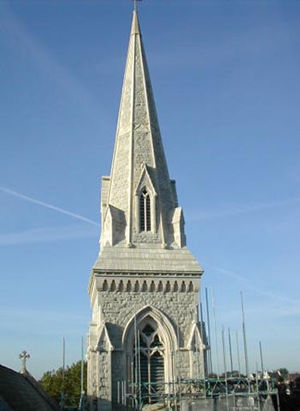
| The rebuilt tower |
A great deal of care was taken at the outset of this project to ensure that a suitable source of materials could be found. The choice of quarry for ragstone supply was of particular importance bearing in mind the quantity that was required.
The sourcing of replacement Kentish Ragstone has been fraught with difficulty for many years, especially since many quarries have closed. Those quarries that do survive mainly produce stone for ballast, and cannot be relied on to produce building stone in any quantity due to the method of extraction. Also, the converting of ragstone block into usable building stone requires a level of skill, experience and dexterity now largely lost. To obtain suitable ragstone for restoration and repair work, Universal Stone now has two of its own stonemasons working in one of the surviving quarries.
The materials used in the mortar for bedding, backing and re-pointing purposes also required investigation. It was clear from analysis of the original historic mortar that an extremely coarse aggregate was used together with a binder that had some hydraulic properties.
Bearing in mind a number of criteria, including the extreme exposure of the masonry to the spire, the need to achieve a reasonably rapid set to the mortar, and the need for the jointing to have an exposed aggregate finish, it was decided to use a natural hydraulic lime-based mortar gauged with aggregates of a variety of particle sizes. The mortar mix proved to be extremely successful.
The rebuilding work, substantially completed over the summer months of 2002, was a good example of how a team of professionals and practitioners worked together to bring about the successful completion of a unique project. In the past, the difficulties encountered in procuring sufficient replacement stone of acceptable quality, coupled with the lack of confidence a would-be client may have in commissioning such a project meant that all too often the work was either patched up or was substandard.
The rebuilding of the spire at St Luke’s is a testament to what can be achieved, cost effectively whilst employing the overriding principles of integrity, honesty and with replacing materials in a 'like-for-like' manner.
Now resplendent with its newly commissioned cross on the top of the spire, St Luke’s can look forward to continued support from its local congregation who can now feel safe in the knowledge that their spire will remain standing, hopefully, for another 150 years.