
Church Wardens and Church Fabric
Sara Crofts
 |
|
| Matterdale Church, Cumbria, which dates from 1573 |
Church wardens are elected annually by their parish and appointed by their bishop to represent the laity and to cooperate with the incumbent to care for the church and its community. They are primarily expected to encourage the parishioners in the practice of true religion and to promote unity and peace among them. However, their responsibilities also extend to the maintenance of the fabric of the church and its contents. It is this aspect of the church warden’s role that will be explored here.
RESPONSIBILITIES OF THE CHURCH WARDEN
The church warden, together with the parish priest, is required to make sure that the various record books concerning the property of the church are kept up to date. These are:
- the terrier – a list of land belonging to the church
- the inventory – a list of all the items belonging to the church
- the log book – a detailed record of all the alterations, additions and repairs carried out in relation to the church, its land and its contents.
The terrier and the inventory are now published together as the ‘church property register’ and should be submitted to the parochial church council (PCC) annually, along with the logbook and a statement confirming the accuracy of the documents.
Church wardens must also prepare an annual written report on the fabric, fixtures, fittings and furniture of the church. The report should summarise all the maintenance and repairs carried out or proposed during the past year as well as any plans to carry out further work in the coming year. This report is presented to the PCC so that they can amend it, if necessary, before the final version is presented to the annual parochial church meeting.
In terms of planning any necessary maintenance or repair works, church wardens will generally turn to the quinquennial inspection report prepared by their professional advisor (either an architect or building surveyor), who is chosen from the diocesan list of approved inspectors. This mandatory five-yearly survey involves a thorough examination of all aspects of the building fabric. Any defects identified by the inspecting architect or surveyor are recorded in a standardised report along with recommendations for prioritising any necessary repairs. It is important that church wardens make sure that they understand these recommendations so that they can take appropriate action to remedy any faults.
Although the quinquennial inspection is generally frequent enough to identify problems before significant damage occurs, the system works best if the professional inspections are supplemented by less formal yearly inspections carried out by those responsible for the building.
WHY HISTORIC FABRIC AND FITTINGS REQUIRE SPECIAL TREATMENT
 |
|
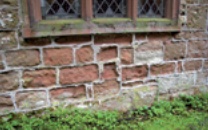
| The cement mortar used to repoint this old wall is causing the masonry to deteriorate more quickly. | |
 |
|
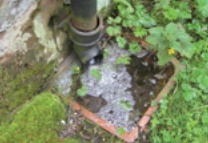
| Gullies should be checked for blockages and rodded if necessary. |
In order to look after a historic building effectively it is important to understand how it was constructed. There are many differences between older buildings with their thick masonry walls and modern buildings, which are often constructed with cavity walls built of bricks or concrete blocks. Caring for older buildings appropriately requires an understanding of how these differences affect the issue of maintenance and in particular the choice of materials for repairs. A key point is to specify materials that are sympathetic to the building and compatible with its construction. This will generally mean using traditional materials such as lime mortars and plasters when dealing with ancient parish churches.
While it may be tempting to use modern materials on old buildings this is not recommended. Modern materials do not ‘breathe’ in the way that traditional materials do and there is a serious risk that introducing new materials might have a negative impact on the performance of the building fabric. The use of impervious or waterproof materials, even as part of a diligent maintenance or repair programme, can potentially make problems worse rather than better (see left, top illustration).
Care is also needed when looking after the objects and artefacts kept inside church buildings. Cleaning should be approached with sensitivity and caution in order to avoid damaging the historic fabric and should never attempt to make things appear new. It is far better to try to retain the historic patina of an object by leaving ingrained dust, dirt and staining well alone. For this reason proprietary cleaners should be avoided as they may contain ingredients considered too harsh or aggressive for older surfaces. If necessary, advice on caring for especially fragile or valuable objects should be obtained from an accredited conservator.
STAVE OFF DECAY BY DAILY CARE
The best way to tackle the long term care of church buildings is to concentrate on regular preventive maintenance. Historic buildings are constructed from natural materials which have a finite life span and will eventually begin to decay. For some materials, such as stone and brick, the decay process may be very slow but for others, such as thatch and lead, the process may be much quicker. At its simplest, maintenance is really just a way of slowing down this rate of decay by keeping the fabric of a building in good condition. By spending a little bit of time and effort (and perhaps money) on maintenance every year it may even be possible to avoid the rather more difficult challenge of remedying major defects caused by leaking roofs or broken rainwater goods.
GOOD PRACTICE
 |
|
 |
|
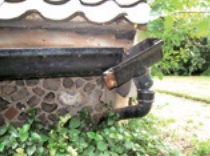
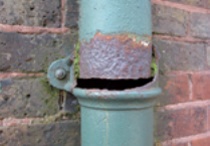
| A blocked or broken gutter will quickly lead to problems elsewhere. |
Planned annual maintenance inspections need
to be carried out in a careful and organised way
as they take time to perform properly, and they
should not be rushed. Church wardens should
aim to complete a full visual inspection at least
once during the year but it is always worthwhile
checking vulnerable areas after heavy rain or
snowfall. Storm damage to roof coverings and
metal flashings may provide a route for water
penetration into the building and needs to be
addressed as quickly as possible.
The easiest way to go about inspecting
a church building is to begin by preparing a
checklist identifying all the elements of the building that need to be inspected, perhaps
using the same format as the quinquennial
inspection report. The inspection does not
have to be carried out in a single day but might
be tackled one section at a time. Ideally, the
external part should be carried out during
or immediately after heavy rainfall, as this
will highlight whether rainwater goods are
functioning properly or not. Many people find
it easiest to inspect each face of the building
in turn, starting by looking up at the roof and
working downwards. Binoculars are a useful
aide as they enable the examination of high-level
areas inside and out even where physical access
is limited. However, if parts of the building are
inaccessible it is worth considering whether
professional help should be sought. And, if
the inspection throws up matters of concern,
it would be sensible to seek advice from the
parish’s architect or building surveyor.
COMMON PROBLEMS
The most common maintenance problems found in church buildings relate to water. Water from a leaking roof, a broken gutter or a heating pipe can do a considerable amount of damage and will very quickly start to break down mortar and plaster and encourage rot in timber. Good preventive maintenance is therefore mostly concerned with keeping water out of the building and disposing of it as swiftly and efficiently as possible.
Defective rainwater goods
Church wardens should ensure that all
gutters are securely fixed and positioned so
that they direct water towards the outlet.
Signs of soil being washed away at ground
level or splashes of soil on the base of the
walls can be an indication that the water is
not being caught by the gutter. Damp stains
on masonry are also a clear sign that there
is a problem that requires attention.
The fixings for downpipes and gutters should also be checked as they can work loose or become corroded. Staining or algae around joints are clues that the connection may be faulty. Keeping the paintwork in good condition will minimise the likelihood of corrosion occurring but any signs of movement or corrosion should be dealt with before further damage occurs.
Gulleys can also be a problem area so it is worthwhile checking whether the water from the downpipes is discharging into the gulley correctly and not spilling over the ground. The condition of the gulley gratings or grilles should also be examined to make sure that debris cannot fall into the gulley and cause a blockage.
 |
|
 |
|
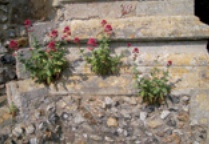
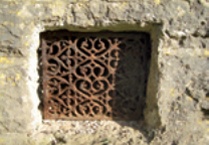
| Top: Plant roots can cause damage to masonry and mortar or block gutters and gulleys. Above: Air bricks allow air to circulate under pew platforms and should be kept clear. |
Blocked valley and parapet gutters
Valley and parapet gutters frequently become
clogged with leaves or other debris including
tennis balls, drinks cans, crisp bags, twigs,
nests and even dead birds. Seeds blown by the
wind can quickly establish themselves in small
amounts of silt and, once established, grass
and plant roots can cause extensive damage to
masonry as well as impeding the flow of water
away from the building. Valley and parapet
gutters therefore need to be inspected and cleared of accumulated debris on a regular basis
to ensure the effective discharge of rainwater
and to prevent overflowing.
Slipped tiles or slates
Not all colour changes, minor cracks or
delamination (flaking) mean that the roof
is in poor repair, but debris on the ground
from broken slates and tiles might indicate
a problem. Missing or dislodged slates and
tiles should therefore be reinstated before
damage occurs to roof timbers or ceilings.
This is a straightforward task but will require a
contractor who has the appropriate equipment
to allow safe access to the roof slope. Large areas of moss may
also need to be removed as the moss can
harbour moisture and cause slates and tiles to
deteriorate more quickly. Ridge and hip tiles provide protection to
the vulnerable areas where different roof slopes
meet. They can become dislodged by high winds
or stormy conditions so it is vital to check for
missing sections, which should be replaced
without delay. Ridge and hip tiles are often
pointed with mortar to provide further weather
protection. This mortar will eventually fail and
drop out due to the exposed location so areas
of missing pointing should be repaired, as water
will quickly penetrate any gaps.
Plants
Plants may enhance the appearance of buildings,
but shrubs, trees and climbers such as ivy can
damage walls or block gutters (see right, top illustration).
Furthermore, if plants and shrubs are allowed
to grow against the base of the wall this also
tends to prevent the masonry drying out
properly. Plant growth should therefore be
cleared away from the area around the base of
the building and in particular from any ground
gutters or drainage channels. The roots of plants
and grasses can damage the integrity of such
channels and impair their ability to carry water
swiftly away from the building.
Air bricks and ventilators
Air bricks and ventilators are used to circulate
air through the voids under timber floors or
pew platforms (see right, bottom illustration). If they become
blocked, there will be less air movement under
the floor, which may eventually encourage rot
in the floor joists and floorboards. It is therefore
important to ensure that air bricks are kept
clear. If air bricks or ventilators are broken,
matching replacements can be obtained.
FINDING THE RIGHT PROFESSIONALS, CONTRACTORS AND CONSERVATORS
 |
|
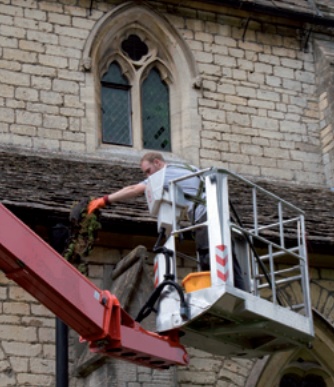
| Forrester Access clearing gutters at Priory Church of the Annunciation, Inchbrook for GutterClear. (Photo: Jonathan Taylor) |
Getting the right advice is not always easy but guidance on selecting professionals and craftspeople is available from local diocesan advisory committee secretaries, the Society for the Protection of Ancient Buildings, the Institute of Conservation, the Church Buildings Council and publications like The Building Conservation Directory. In addition, it is important to visit previously completed projects and to take up references before choosing a professional or craftsperson.
Asking the following questions can also aid the decision-making process:
- Does your chosen professional or craftsperson have the necessary skills, knowledge and experience?
- Does your chosen professional or craftsperson belong to the appropriate professional bodies?
- Is your chosen professional or craftsperson accredited if this is necessary for the proposed work?
- Have you taken advice from your denominational body, spoken to colleagues and followed up references?
- Have you visited recently completed projects to see their work for yourself?
- Do you have a full understanding of the services being offered and matters such as timetabling and payment?
LEARNING TO READ THE BUILDING
The role of church warden is challenging but also rewarding and although there may be much to learn about the care of historic buildings there are also a great many resources available to make the job a little easier. Learning to spot potential problems at an early stage is vital but church wardens should first and foremost take the time to understand their buildings better. Only then will they be able to make the right decisions about the proper care and maintenance of the church and its contents.
~~~
Recommended Reading
- Christopher Brereton, The Repair of Historic Buildings: Advice on Principles and Methods, English Heritage, London, 1991
- Peter Burman (ed), Treasures on Earth, Donhead, Shaftesbury, 1993
- Mark Child, Discovering Church Architecture: A Glossary of Terms, Shire Publications, Aylesbury, 1976
- Thomas Cocke (ed), The Churchyards Handbook (4th edition), Church House Publishing, London, 2001
- The Council for the Care of Churches, A Guide to Church Inspection and Repair, Church House Publishing, London, 2006
- Patricia Dirsztay, Church Furnishings: A National Association of Decorative and Fine Arts Societies Guide, Routledge, London, 2001
- Faith in Maintenance, The Good Maintenance Guide, SPAB, 2008
- Graham Jeffery, The Churchwarden’s Year:
A Calendar of Church Maintenance,
Church House Publishing, London, 1994 - Graham Jeffery, Handle with Prayer: Church
Cleaner’s Notebook, Church House
Publishing, London, 1992
Useful websites
Guidance on maintaining places of worship:
www.spabfim.org.uk
www.maintainyourchurch.org.uk
www.churchcare.co.uk
Guidance on looking after artefacts and finding conservators:
www.conservationregister.com
Guidance on understanding historic buildings:
Guidance on health and safety matters: