
Cleaning Brickwork and Terracotta
Getting it Right
Nicola Ashurst
 |
|
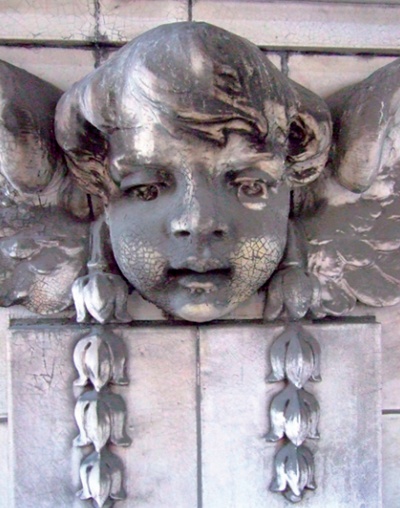
Brick and terracotta are among the most complex materials to clean. Thick soiling to the surface of this Carraraware cherub was removed by steam cleaning followed by an alkaline gel and a hydrofluoric acid-based gel. However, soiling within the crazing to the glaze could not be removed safely. |
All building cleaning projects require a period during which the nature of the masonry, the type of soiling and the relationship between the two are investigated and thoroughly understood. Where brickwork and terracotta are concerned, the effect of weathering on both the units and their joints is a fundamental part of this understanding, and specialist professional input may well be required. While both these materials are fired clay units, they have very different properties and sensitivities as regards cleaning.
On both materials:
- atmospheric soiling is not water soluble
- abrasive cleaning is frequently damaging and generally best avoided
- cleaning chemicals must be used at low strength, applied neatly, left for short dwell times and thoroughly rinsed at non-damaging pressures.
Cleaning of these materials can be done safely and well provided the ‘homework’ period is thorough.
In situ trials are an important part of pre-cleaning assessments. They should be used to eliminate inappropriate cleaning processes and to fine tune parameters for the correct use of the selected procedures. The trials should be sufficiently thorough for a detailed specification to be prepared.
A key factor in successful cleaning is the skill and experience of the specialist contractor. Previous experience should be on traditional brickwork or terracotta. The starting point is understanding the material.
BRICKWORK
The term brickwork describes fired clay units which have a bewildering variation of constituents and properties. While bricks are made mainly from clay earth and fired in kilns, the variety of clay types, manufacturing and firing processes is vast, affecting not only their colour and surface texture, but also their performance and the way they respond to cleaning.
Bricks in historic and traditional walls vary from ‘red rubbers’, which can be carved with a finger nail, to highly fired and vitrified blue bricks, and from roughly textured stocks to shiny glazed bricks. Even within a single brick, variations in surface texture and hardness will be found which may prevent the safe use of abrasive cleaning, or reduce the pressure at which water jets can be used safely. Porosity also varies, and high absorbency may eliminate or stringently define the parameters of a chemical cleaning regime.
Most brick types are also susceptible to impact damage and hence are readily damaged by abrasive cleaning. Some have a ‘fire skin’, a shallow surface layer of densely packed particles, and this must never be affected by cleaning processes. Careful consideration should also be given to the effect of the cleaning process on the mortar, as traditional brickwork pointing mortars, which were based on soft mixes of lime and sand, are usually even softer than the bricks themselves.
 |
 |
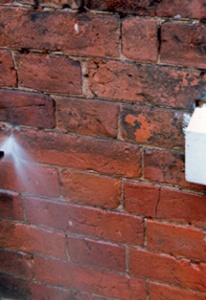 |
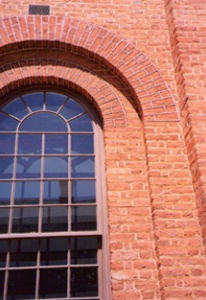
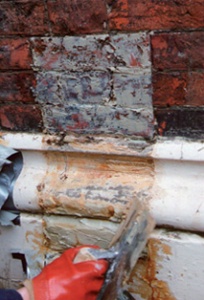
| Left: Georgian brickwork of the Mint Building, Sydney: the soft, porous and variable textures of the bricks and mortar could not be subjected to abrasive cleaning without causing irreparable damage. Centre: An alkaline clay poultice has enabled its active ingredient to be held to the surface of this porous brickwork, controlling the amount entering the pores. Cleaning also involved a regime of hot water washing and a low strength hydrofluoric acid-based chemical application. Right: This brickwork test area was completed with a short period of nebulous water washing and an application of a low strength hydrofluoric acid-based gel, seen here in the final stages of low pressure water rinsing, one of the most vital stages of successful chemical cleaning. | ||
CLEANING METHODS
Any cleaning method on brickwork involving water alone will only remove loosely adherent dirt, unless excessively high pressures are used, as water cannot break the siliceous bond by which soiling adheres. The same applies to the use of non-ionic soaps. Damage can take place if associated brushing is undertaken using brushes with bristles which are too harsh, too coarse or used too vigorously.
Abrasive cleaning systems are usually inappropriate on historic brickwork due to the nature and characteristics of the brickwork, even when undertaken extremely carefully. This is because these methods are unable to deal with the multitude of variations that can be present in a brick wall. Abrasive cleaning is particularly inappropriate for the removal of paint or graffiti on brickwork.
Chemical cleaning is generally the most suitable approach as it is able to accommodate variations in texture, condition and hardness, and it is undoubtedly the best method for the removal of paint. For heavy soiling, cleaning can involve an alkali-based degreasant followed by an agent containing hydrofluoric acid or, if soiling is lighter, by the acidic agent alone. The brick surfaces must be thoroughly pre-wetted to limit the activity of cleaning agents to the surface. Thorough rinsing of the surface with is also critical.
Cleaning chemicals borne in a thixotropic gel or a poultice are preferred to liquid cleaners as their thicker consistency limits absorption. Clay-based alkaline poultices are particularly effective in this regard especially where a longer dwell time is necessary. Lime-based mortars are more highly absorbent and softer than the surrounding brick units: the strengths of chemicals, the length of dwell times, pre-wet and rinse water pressures must be kept low to avoid damage to the mortar
BRICKWORK CHARACTERISTICS TO BE AWARE OF
MORTAR JOINTS
|
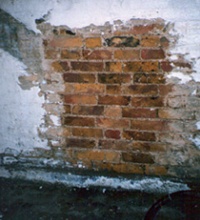 |
Steam and non-solvent paint stripper
have been used
to remove paint
limewash and distemper from this
brickwork. The water was applied
through a rotating
nozzle. |
|
 |
|
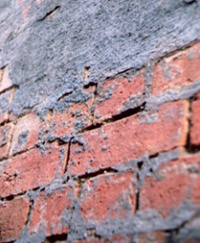
Brick surfaces have been removed
and lime mortar
stripped from joints
by this attempt to remove a
cementitious coating by abrasive
cleaning. |
Periods of saturation associated with water washing, chemical cleaning or wet abrasive cleaning can lead to the emergence of efflorescence. Inherent salts within the brick surface are dissolved and brought to the surface during the drying-out process. The efflorescence should be dry-brushed or vacuumed from the wall surface, taking care to ensure the salts are collected and not allowed to redeposit elsewhere on the masonry.
TERRACOTTA AND FAIENCE
Terracotta and faience are fired clay products. The term ‘terracotta’ usually refers to blocks and slabs with plain clay surfaces; ‘faience’ usually denotes the presence of a fired glaze on the exposed surface.
In the UK two different processes have been used for making terracotta and faience: hand pressing or slip-moulding. For hand-pressed blocks, moist, firm clay which incorporates granules of pre-fired clay (grog) are pressed by hand into the rear of plaster moulds. When the mould is released the clay is still soft enough to accept complete reshaping and surface finishing. For slip-moulding a clay slurry is poured between the walls of plaster moulds. When released from the moulds, the poured clay is much firmer than hand-pressed clay and will only accept a limited amount of surface finishing. After drying, the blocks are then fired at 1,100-1,200°C.
In England, terracotta was manufactured and used by the Romans, although little survives from that period. Most common are examples from the late 19th and early 20th centuries, although a few notable examples survive from the late 15th and early 16th centuries when Sutton Place (1523-27) and Hampton Court (c1520) were constructed. The terracotta of these buildings is distinctly different in external character, and at times in durability, from terracotta’s more standardised manufacture of 1840-1910. Prominent 19th-century buildings constructed of terracotta are the Henry Cole Wing of the Victoria and Albert Museum (1866), the Royal Albert Hall (1867-81) and the Natural History Museum (1880-1905). Coadestone is a proprietary off-white form of terracotta fired at approximately 1,000°C, to form a vitrified and highly durable material. Carraraware, a glossy white form of faience, was thought to resemble Carrara marble because of its white glaze.
 |
 |
|
|
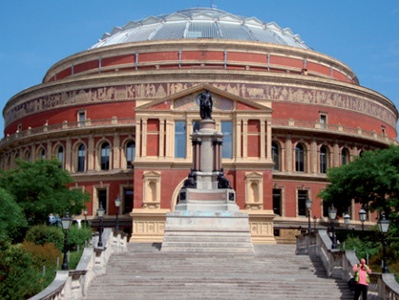
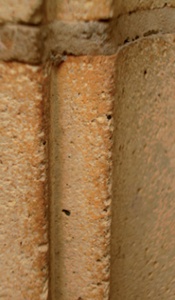
Abrasive cleaning of the Royal Albert Hall in the 1970s removed the original surface of the unglazed terracotta. Evidence of the original marmalade colour can be found in several locations (above right). |
||
SOILING AND CLEANING SENSITIVITIES
Both glazed and unglazed terracotta surfaces soil most heavily in areas of heaviest water saturation. Soiling is commonly concentrated at the edges of blocks in the vicinity of mortar joints. As with brickwork, much of the soiling is not water-soluble and cannot be removed using water alone. While the soiling may be intense in blackness, it is usually a very thin layer which is tenaciously adherent. Encrustations may build up in protected areas and soiling may develop within the fine cracks (or ‘crazing’) in glazes.
The surfaces of terracotta and faience are amongst the easiest traditional masonry materials to clean incorrectly. Serious problems can be caused by abrasive cleaning methods, acid and alkali cleaning methods, and mechanical cleaning methods including metal brushes. However, surfaces can be successfully cleaned using chemical cleaning methods if the products are used at the right consistency, for short dwell times and at the lowest concentrations possible, applied to small areas and under a high level of continuing supervision.
A thin fire skin is sometimes present on blocks which were not fired at a high temperature. It is particularly sensitive to both chemical and abrasive cleaning. Blocks which were fired at longer and higher temperatures do not have fire skins but are nevertheless prone to impact damage from, for example, abrasive cleaning. Applied glazes are thin, vitreous, transparent or coloured coatings with a glassy consistency. All these surfaces are sensitive to damage by abrasive cleaning, and the characteristic irregularities in surface colouring produced in the kiln can easily be removed by even the finest, lowest impact abrasive process.
APPROPRIATE CLEANING METHODS
The chemical cleaning of unglazed terracotta and faience surfaces relies on hydrofluoric acid to break down the silicates. Until recently this technique had a poor reputation in the UK, mainly due to the use of proprietary products which were too strong, of the wrong consistency or used for excessively long dwell times. Poor cleaning management has also been the cause of much residual streaking.
Chemical cleaning of glazed surfaces sometimes requires the use of an alkali degreaser prior to the acid cleaning product. Good results can be gained with low concentrations of both active ingredients. On unglazed surfaces, their efficiency is greatly improved by agitation during the determined dwell time and/or localised scrubbing using plastic pot scourers.
Streaking can be avoided by the application of cleaning agents with sponges, or carefully agitating the surfaces to prevent the formation of runs during the dwell time. The use of thixotropic agents also assists in preventing streaking. Chemical cleaning agents are best applied to small work areas from the bottom upwards. The upward-facing or water-saturated surfaces of terracotta facades are usually the most heavily soiled and typically require a second application.
 |
 |
||
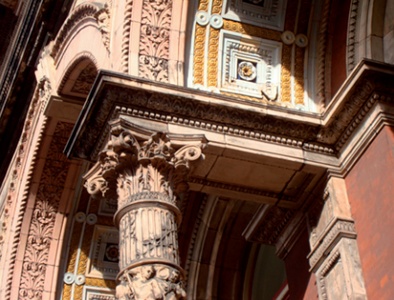
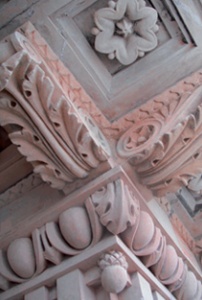
| Above left: The Henry Cole Building at the Victoria and Albert Museum, London dates from 1866 and is constructed of unglazed and glazed terracotta produced by several manufacturers. Each required a slightly different cleaning specification when the west elevation was cleaned in 2010. Steam, nebulous water and chemical gels were selected after an extensive period of trials. Above right: The wide variety of colours to the original terracotta of the Henry Cole Building, revealed during its recent cleaning, reflects the different clays and firing temperatures. Dark soiling had also hidden much of the detailing. (Photo: by courtesy of the Victoria and Albert Museum) | |||
On glazed surfaces, the use of water (hot or cold), detergent, natural or nylon bristle brushes or plastic pot scourers are often effective, providing a non-damaging way of removing excessive soiling. Acidic chemical cleaners containing hydrofluoric acid may also be appropriate, but they inevitably dissolve an extremely small proportion of the glaze. These must be applied evenly and with considerable care to avoid leaving a streaked, etched or dulled surface.
Cleaning of glazed and unglazed surfaces with non-ionic detergent in warm water and plastic pot scourers will only be successful in removing superficial or loosely adherent soiling. Glazed surfaces soil when particulate matter becomes embedded within fractures within the glaze. This is impossible to remove. Glazed units are most heavily soiled in the vicinity of joints. This can sometimes be removed by non-ionic detergent in warm water applied with plastic pot scourers and ‘elbow grease’. If this is not successful, it may be necessary to use alkaline agents.
To conclude, the successful cleaning of external brickwork and terracotta depends on well-trained and experienced operatives and near-constant supervision. A specification, no matter how good it is, will remain words on paper unless good workmanship is available to translate it into good practice.
~~~
Recommended Reading
- N Ashurst, Cleaning Historic Buildings Volumes 1 and 2, Donhead, London, 1994
- British Standards Institution BS 8221-1:2000 Code of practice for cleaning and surface repair of buildings: Cleaning of natural stones, brick, terracotta and concrete
- ND Berryman and SM Tindall, Terra Cotta: Preservation of an Historic Building Material, Landmarks Preservation Council of Illinois, USA, 1984
- T Bidwell, The Conservation of Brick Buildings, Brick Development Association, London, 1977
- Brick Development Association, Building Note 2: Cleaning of Brickwork, BDA, London, 1982
- BRE Good Repair Guides: GRG 24 Repointing external brickwork walls, 1999 and GRG 27 Cleaning external walls of buildings, 2000 (Part 1 Cleaning methods, Part 2 Removing dirt and stains)
- BRE Information Papers: 9/99 Cleaning exterior masonry: pre-treatment assessment of a stone building and 10/99 Cleaning exterior masonry: assessing cleaning of a brick-built church
- RW Brunskill, Brick Building in Britain, Victor Gollancz Ltd, London, 1990
- N Lloyd, A History of English Brickwork, Antique Collectors’ Club, London, 1983
- MJ Stratton, ‘Shining Through the Smog: Terracotta and Faience’, in Good and Proper Materials: The Fabric of London Since the Great Fire, Hermione Hobhouse and Ann Saunders (eds), RCHME in association with the London Topographical Society, London, 1989
- MJ Stratton, The Technical Revival, Victor Gollancz, London, 1991
- Survey of Bedfordshire, Brickmaking: A History and Gazetteer, Bedfordshire County Council, 1979
- J Warren, Conservation of Brick, Butterworth Heinemann, Oxford, 1999