
The Construction Skills Certification Scheme
and the built heritage sector
Seamus Hanna
 |
|||
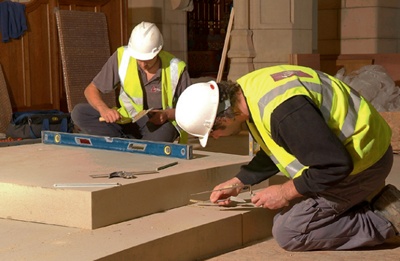
| Lime mortar pointing of a new plinth stone for the Bishop’s Chair, St Anne’s Cathedral, Leeds (Photo: William Anelay Ltd) |
The Construction Skills Certification Scheme (CSCS) is the competence card scheme for the construction industry. It was established in 1995 and there are currently over 1.5 million CSCS card holders representing 352 occupations.
From an employer’s perspective, having a CSCS carded workforce demonstrates to clients that the company has the skills and competency that the job demands, something that can mean the difference between winning and losing a contract. For clients and their representatives, the scheme provides a simple means to check that everyone working on their project possesses the appropriate skills and health and safety awareness to undertake their work competently and safely.
As the built heritage sector is part of the construction industry, it is not exempt from the industry drive for a fully qualified, competent and safety-aware workforce. Increasingly, anyone undertaking conservation, repair, maintenance or restoration on historic sites is required by clients or contractors to show an appropriate CSCS card.
English Heritage is taking the lead in England by requiring that all contractors undertaking conservation, repair and maintenance on its 400-plus properties and sites encourage their craftspeople to hold or be working towards the CSCS Heritage Skills Card. The intention is that this will become a requirement as soon as the number of cardholders reaches a viable level. In Wales, Cadw has also endorsed the requirement that craftspeople undertaking conservation, repair, maintenance and restoration on heritage sites and pre-1919 buildings should be working towards the CSCS Heritage Skills Card. It is expected that other heritage bodies and organisations with responsibility for historic buildings will follow this approach. Without a relevant CSCS card, access to site-based conservation projects may be denied.
HERITAGE SKILLS CARD: CRAFTSPEOPLE
The CSCS Heritage Skills Card has been available since September 2008. The card was developed jointly by CSCS and the National Heritage Training Group (NHTG) in response to NHTG research report findings which showed that around two-thirds of those who work on pre-1919 buildings do not have the right skills to do so. Typically, this is because the vast majority of work on the six million pre-1919 buildings in the UK is undertaken by general builders who move between new-build and repair and maintenance projects, often using inappropriate methods and materials on traditionally constructed historic buildings.
The CSCS Heritage Skills Card is available as a gold, advanced craft card. This currently covers the traditional building skills craft occupations of brickwork, carpentry and joinery, craft masonry, earth walling, painting and decorating, plastering (solid and fibrous), roof slating and tiling, specialist leadwork, stonemasonry, stone carving, thatching, and wall and floor tiling.
 |
 |
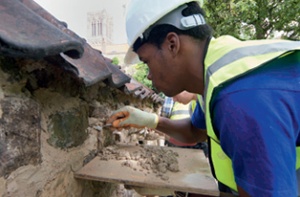
| Prince’s Foundation Building Crafts Apprentices repairing masonry walling (Photo: The Prince’s Foundation for the Built Environment) | Richard Hill of Bonsers Building Restoration and Conservation with his CSCS Heritage Skills Stonemasonry Card (Photo: Cathie Clarke) |
A list of the competencies for this occupation and an application form are available online at www.cscs.uk.com/occupations (type ‘heritage skills’ in the search box and scroll down to find the appropriate card). The individual is required to complete a health and safety touch-screen test. The card is valid for five years and is renewable upon application providing the CSCS health and safety requirements are met.
Construction Related Occupations (CRO) cards are also available for traditional building skills such as architectural ironwork, heritage glazing and dry stone walling. These normally exist where there is no recognised National Vocational Qualification (NVQ) to map the required competency for a CSCS card.
For craftspeople working on pre-1919 buildings in Northern Ireland, a heritage skills endorsement has been developed by the Construction Skills Register (CSR) in conjunction with the NHTG (for more information on the CSR, please see the website of the Construction Employers Federation of Northern Ireland). The endorsement is available for bricklaying, carpentry and joinery, craft masonry, painting and decorating, roof slating and tiling, stonemasonry, stone carving and wall and floor tiling.
OTHER CONSERVATION OR HERITAGE-SPECIFIC CARDS
CSCS cards are available for Building Site Manager (Conservation), Construction Site Manager (Conservation), Conservation Consultant and Conservation Controller. These individuals must provide evidence of a conservation NVQ/SVQ Level 4 or 5 in a relevant occupation and also pass a managerial and professional health and safety touch-screen test. The card is valid for five years and is renewable upon application providing the CSCS health and safety requirements are met.
A list of the competencies applying to these cards is available on the CSCS website at www.cscs.uk.com/occupations. Application forms can be downloaded at www.cscs.uk.com/application.
PROFESSIONALLY QUALIFIED PERSON (PQP) CARD
 |
||
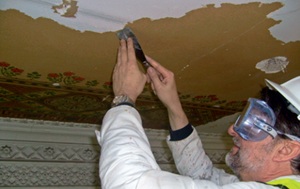
| Removing emulsion over-painting to reveal a historic paint scheme at St Pancras Chambers, London (Photo: Angel Interiors Limited) |
The PQP card is applicable to professionals such as architects, surveyors and engineers who attend site but are not site-based. It is achieved via a professional membership route and if the professional body is on the approved CSCS list the applicant must complete the application form and provide evidence of their professional institution membership grade and membership number. They must also pass a managerial and professional health and safety touch-screen test. The card is valid for five years and is renewable upon application, providing the CSCS health and safety requirements are met. For full details on the above cards, visit www.cscs.uk.com.
SECURING THE FUTURE
All repair and maintenance work to traditional buildings requires the right blend of skills, knowledge and experience. The CSCS built heritage sector cards allow all those working in the sector, from craftspeople to building professionals, to demonstrate their competency. Clients, heritage organisations and funding bodies should demand this evidence of competency and the right skills for the job. This will drive uptake of the cards among contractors and craftspeople as well as improving consistency, reducing the risk of damage or accidents and increasing quality management. Having the right people for the job will also help to maintain the nation’s built heritage stock in a sustainable and sympathetic way.
Further Information
- ConstructionSkills: www.cskills.org
- Construction Skills Certification Scheme: www.cscs.uk.com
- National Heritage Training Group: www.nhtg.org.uk
- Details of Northern Ireland’s Construction Skills Register are available on the website of the Construction Employers Federation of Northern Ireland: www.cefni.co.uk