
Design & Access Statements
New requirement for planning and listed building consent applications
Chris Burford-Bradshaw
 |
|
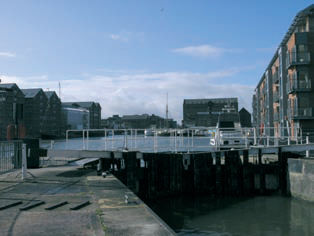
| New flats and historic warehouse conversions at Gloucester Docks |
Earlier this year the Department for Culture Media and Sport introduced various changes to the existing development control system. Possibly the most far reaching of these is the need for most planning applications and for applications for listed building consent, to be accompanied by a design and access statement. This requirement came into force in England on 10 August 2006.
Design and access statements, or DASs as they are already inevitably being labelled, have been introduced as part of the government's response to the level of criticism attracted by development, and as part of its wider policy of 'inclusivity'. DASs are intended to explain the design process, taking into account the local context of the building or site, and otherwise to justify the proposed scheme. A DAS will form part of an application, and will therefore be sent to all of the consultees.
DASs are required to accompany both full and outline planning applications except where applications relate to the following:
- Changes of use (where no building alterations are involved
- Engineering operations
- Mining operations
- Developments incidental to existing residential uses, including extensions, provided that they are outside conservation areas and other 'designated' areas - that is to say, areas of outstanding natural beauty, national parks, sites of special scientific interest, The Broads and world heritage sites
- Adverts
- Tree preservation order consents
- Hazardous substances consents. Where both a planning application and an application for listed building consent are being submitted in respect of a proposal, only a single DAS is required.
IMPROVING DESIGN OR IMPROVING PAPERWORK?
The Church of England already has a requirement for statements of significance and need to accompany petitions to alter a listed church building, and in the secular world designers accustomed to dealing with large development schemes may also be familiar with preparing and submitting design statements as part of planning applications. Indeed, the latter have already met with criticism from architects who see them as unnecessary and unhelpful. The government's view is that DASs are simply formalising what is being done anyway. In some cases this is clearly true, but in many others, and especially in smaller schemes, the driving force behind the design may well be issues other than those which the DAS initiative attempts to promote: well developed, appropriate design that takes account of its local context.
The requirement begs the question whether 'good design' can really be defined and, if so, who should be the judge? Clearly there are many subjective issues involved. The government's intention seems to be to encourage designers to undertake a more structured thought process and to engage in more constructive dialogue with local communities and other interested parties. Such aims seem utopian, and it will be interesting to consider whether the general perception of design and development has changed significantly in a few years time.
LISTED BUILDINGS
DASs submitted as part of listed building consent (LBC) applications will replace the 'justification statements' currently used to accompany some LBC applications. Generally they should be similar to those prepared for planning applications, except that DASs for LBC applications will not need to include information on the use of the building or the proposed landscaping. They should, however, include reference to how the requirements of PPG15, paragraph 3.5 have been satisfied. This is the paragraph which outlines the general issues relevant to the consideration of all LBC applications, including the importance of the building and its setting, and the extent to which the proposal would benefit the community through regeneration or the enhancement of its environment.
PREPARING A DAS
Little guidance regarding the preparation of DASs is currently available. Different local authorities will no doubt be developing their own guidance, quality criteria and check lists. Significant variations between authorities are therefore entirely likely. However, right or wrong, the requirement for a DAS is now upon us, and it is worth noting that applications will not be registered unless accompanied by a properly prepared DAS. The preparation of these documents may well have significant implications on projects both in terms of timescale and cost. The jury is still out on the effect on quality.
Recommended Reading
- Design and Access Statements: How to write, read and use them, CABE, London 2006 (available online at: designcouncil.org.uk/our-work/skills-learning/resources/design-and-access-statements-how-write-read-and-use-them)