
Fifty Years of the Friends of Friendless Churches
Matthew Saunders
 |
|
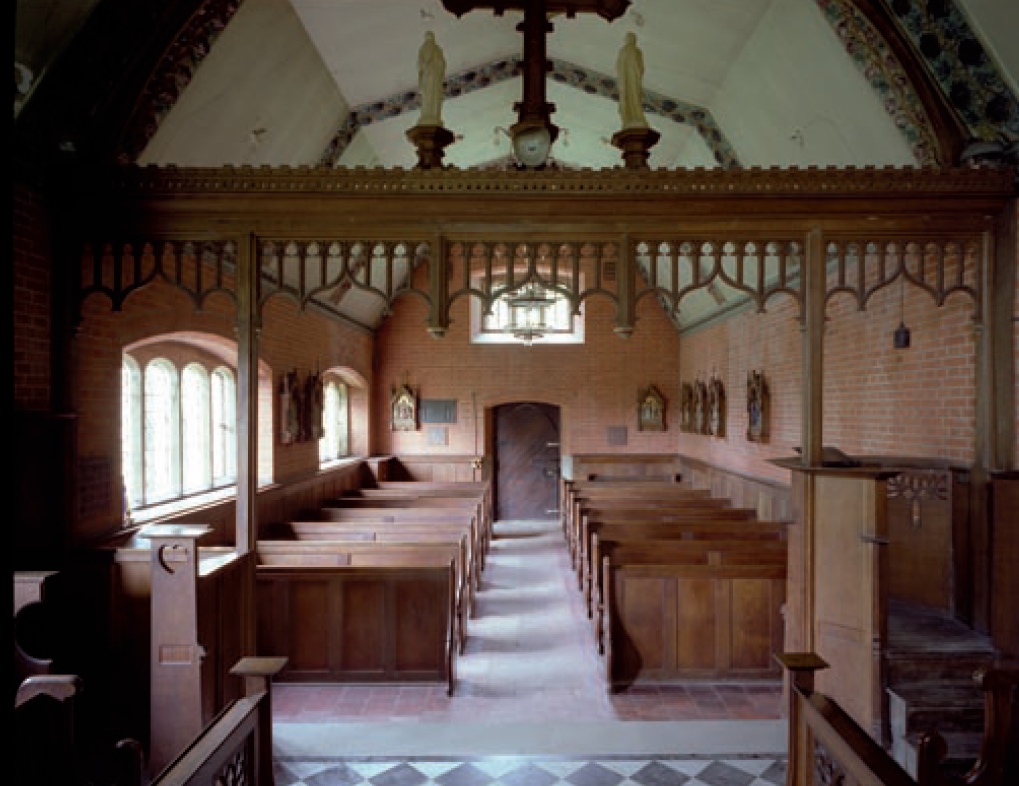
| Interior of the chapel of St John the Baptist, Matlock Bath in Derbyshire (Photo: Simon Harpur) |
The Friends of Friendless Churches was established at a meeting held on 3 July 1957 in Committee Room 13 of the House of Commons, a room booked for the purpose by Roy Jenkins, lifelong family friend and admirer of the founder, Ivor Bulmer-Thomas. The name was both a homage to ‘Le Club pour Sans Club’ of Paris and, later, an inspiration for those seeking a title for the Friends of the Earth. Ivor was already well known as one of the principal founders of the Historic Churches Preservation Trust, established in 1952, and it was following Archbishop Fisher’s determination that HCPT funds should only go on churches ‘in use’ that Ivor set up The Friends.
The title tells it all. In the first decade of the new organisation there were campaigns for particular churches, notably St Mary at Quay, Ipswich, St Peter’s Wolfamcote in Warwickshire, Holnest in Dorset and, the first church repaired with Friends’ funds, that at Willingale Spain in Essex. But all the time Ivor felt the future lay with a new formal body paid for by the Church and State. This was The Redundant Churches Fund (now The Churches Conservation Trust) which came into being in 1968 and for which Ivor was the logical choice as its first chairman.
However, if he expected the Friends to wither on the vine he was to be disappointed. This was partly because neither the chairman nor the trustees of the RCF had control over which churches were to be vested. This resided, as it still does, with the Church Commissioners. Ivor found that he was not master of his own shop and in view of particular controversies he came to the view that the Friends should not only continue but take into care some from among the Salon des Refusés rejected for the RCF by the Commissioners. The first such vesting was the residual 18th-century tower at Lightcliffe near Halifax in 1974. The riding of these two horses by the same man required phenomenal stamina, but this was a man who needed only five hours sleep a night. His chairmanship of the RCF was not renewed after two terms but Ivor was the active Honorary Director of the Friends until his death at the age of 88 in 1993. By that stage his prodigious professional career was over. He had been an MP and Minister under Attlee, an athlete (narrowly missing being picked for the national athletics team for the 1928 Olympics), a journalist (being deputy editor of The Daily Telegraph) and a writer (on subjects as diverse as Greek mathematics; Lord Gladstone, the son of the Prime Minister; and St Paul). The Friends became the dominant passion of his life.
 |
|
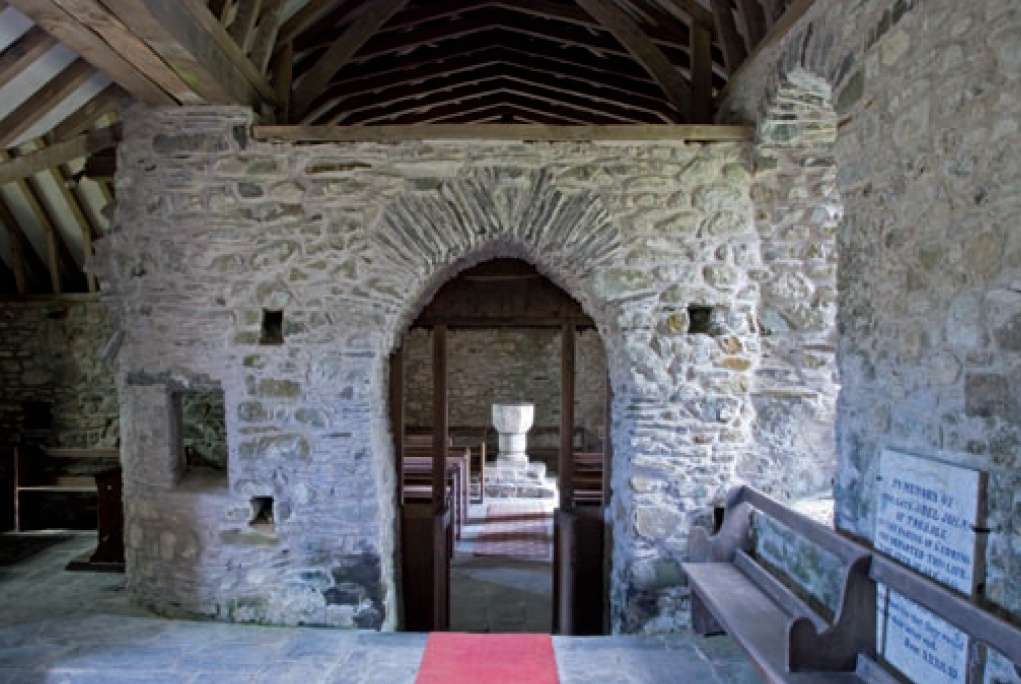
| St Teilo, Llandeloy in Pembrokeshire, reconstructed in delicate Romantic Arts and Crafts by Coates-Carter in 1928 |
Despite the politics that surrounded their respective births, the Friends and the RCF (CCT) have always enjoyed an excellent relationship. The cross fertilisation has been tangible: one former director and one former secretary of the CCT, Catherine Cullis and John Bowles respectively, are long-serving trustees of the Friends, while when the post of Field Officer in Wales was established in 1999 the obvious first incumbent was Christopher Dalton, whom Ivor as RCF Chairman had appointed to the identical position in England. And although from 1974 major vestings with the Friends were buildings turned down for the RCF by the Church Commissioners (Hardmead in Buckinghamshire, Mundon and Wickham Bishops in Essex for example), the Friends have been able to define themselves in more recent years by expanding into areas where the CCT is disbarred.
FRIENDS IN WALES
Firstly, there is Wales. Since 1999 the Friends have been recognised as the equivalent across the border of the CCT. Working to an annual budget of £100,000 (£70,000 from Cadw, £30,000 from the Church in Wales), we have been able to take into care redundant Anglican churches too important to be demolished or converted. Half of our 38 holdings are now Welsh.
 |
||
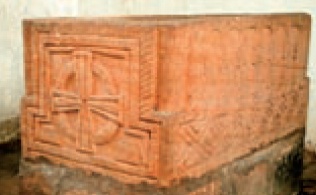
| The pre-Norman altar at St Peulan, Llanbeulan,
Anglesey (Photo: Ray Edgar) |
The second point of difference with the CCT is that we can take on the private chapel. The CCT is limited to those places of worship which were once part of the parochial system, serving a public parish. I suspect that the private chapel is going to rise up the conservation agenda in future years, whether it be attached to almshouses, convent, hospital, prison or country house. So far we have just two – Ayshford, walkable from Tiverton Parkway Station in Devon, and the chapel of St John the Baptist clinging to a cliff face at Matlock Bath in Derbyshire. The first was built in the 15th century for the Sanford family whose monuments dominate it, as does the striking proto art deco glass of 1848 by John Toms. Matlock was paid for in 1897 by Mrs Louisa Harris who had it built in the grounds of her house over a lofty retaining wall arched over a ‘holy well’. She chose as her architect (Sir) Guy Dawber whose parents are buried in the grounds of the parish church, and he brought together a talented team to realise her dream: Louis Davies for the glass, John Cooke for the altarpiece, and George Bankart for the plasterwork on the barrel vault. There are little birds in delicate relief captured in frozen flight among vines and roses which are applied as if in straps (Bankart’s The Art of the Plasterer (Batsford,1908) remains the classic on every professional’s bookshelf). Both chapels are kept locked but both have keyholders (see below).
There is a third body which looks after redundant places of worship in England, but again there is a strong logic to the differentiation from the Friends. This is the Historic Chapels Trust. Essentially its purpose is to take into care the non-Anglican, mostly nonconformist, chapels but also Catholic churches and, if ever the need arises, the synagogue. In theory, the Friends’ remit is comprehensive and we can take into care any historic place of worship. Indeed we have one example of nonconformity – the Strict and Particular Baptist Chapel of 1792 at Waddesdon Hill, near Aylesbury in Buckinghamshire. The charmingly simple Grade II* interior contains gallery, handpainted monuments, a complete immersion baptismal tank and a heated room where those just baptised could towel themselves down. However, we only have Waddesdon because at the time of vesting the HCT did not exist.
BEFRIENDED CHURCHES
 |
|
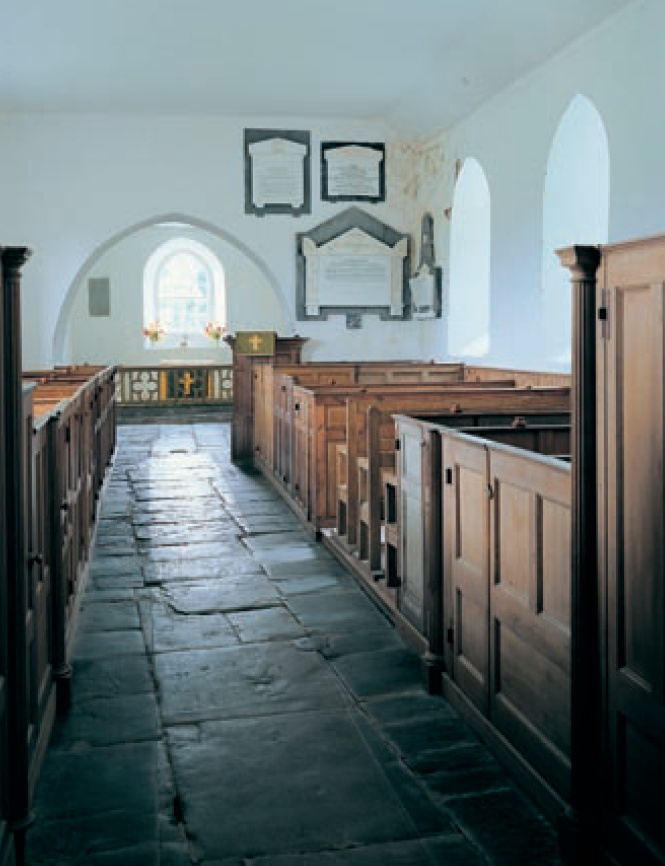
| St David, Manordeifi, near Llechryd in Pembrokeshire, with its open-back benches for the poor, and lofty box pews for the rich, complete with private fireplaces inside |
The principal determinant of whether the Friends expand or not is going to be resources solely, but also the rationale of taking into care buildings which others cannot save. This will encompass ‘outstanding’ Anglican churches in Wales; private chapels or others outside the parochial system; and former parish churches in England judged not vestable with the CCT but too damn good to hand over to the demolition man or those who would throw out the fittings for an unworthy conversion. Our newest vesting in England is the romantically sited Llancillo in Herefordshire, one of those churches the Victorians forgot, nestling in a churchyard marked by a medieval preaching cross.
Our website (see below) lists and illustrates all the churches we now own. The majority is kept open during the day but for those that are not, if you ring, email or write, we can let you have the name of the keyholder. In an order that had better be alphabetical so as not to give the game away on personal favourites, they include:
St Mary Magdalene, Boveney, on the banks of the Thames in Buckinghamshire, approached either through the wandering cattle on Dorney Common or along the towpath from Windsor; a building where English Heritage has come to the rescue with grant aid on the £200,000 scheme to conserve the double storey timber-framed tower and which will be acting again as a friend in need for works to the roof that we are undertaking in 2007–8.
St Mark, Brithdir, near Dolgellau in Gwynedd, one of the very few churches by Henry Wilson and built by the grieving memory of the chaplain and founder of St Mark’s Church, Florence.
St Mary, Derwen near Corwen in Clwyd, with a rood screen of the 15th century that still dominates the interior (and is depicted in Pevsner).
St Mary, Eastwell near Ashford in Kent, supposedly the burial place of the bastard son of Richard III and one of only three ruins we own (the others being South Huish in the South Hams in Devon, and the former chapel to the castle at Urishay in Herefordshire).
St Peulan, Llanbeulan, Anglesey, the surprise location of what could be an exceptionally rare pre-Norman altar.
St Teilo, Llandeloy in Pembrokeshire, reconstructed in delicate Romantic Arts and Crafts by Coates-Carter in 1928.
St Ellwy at Llanelieu, near Talgarth in Powys, where the great screen (depicted in Pevsner) still retains the blood-rich red of the original paint.
St Baglan, Llanfaglan, near Caernarfon in Gwynedd, a site so old that incised stones of the 5th and 6th centuries are reused.
St Mary the Virgin, Llanfair Kilgeddin in Monmouthshire, rebuilt by J D Sedding but now nationally celebrated for the sgraffito plasterwork inside carried out over one hot summer in the late 1880s by Heywood Sumner.
St David, Manordeifi, near Llechryd in Pembrokeshire, still not as celebrated as it ought to be for the remarkable survival of eight sets of late Georgian railings to monuments in the churchyard and a delightful internal display of the rigidity of 18th-century social hierarchy – with open back benches for the poor and lofty box pews for the rich picked out with Tuscan columns at their corners and private fireplaces inside.
St Mary, Mundon, near Maldon in Essex, which we have had to close at present while we address the chronic instability, particularly of the 18th-century chancel, again with a vital English Heritage grant.
St Cynhaern, Ynyscynhaern in Gwynedd, where external modesty bordering on utility conceals a complete late Georgian estate church of 1832 with original three-decker pulpit, organ gallery with chamber organ, and the names of the farms painted onto the pews to show who paid for what and who sat where.
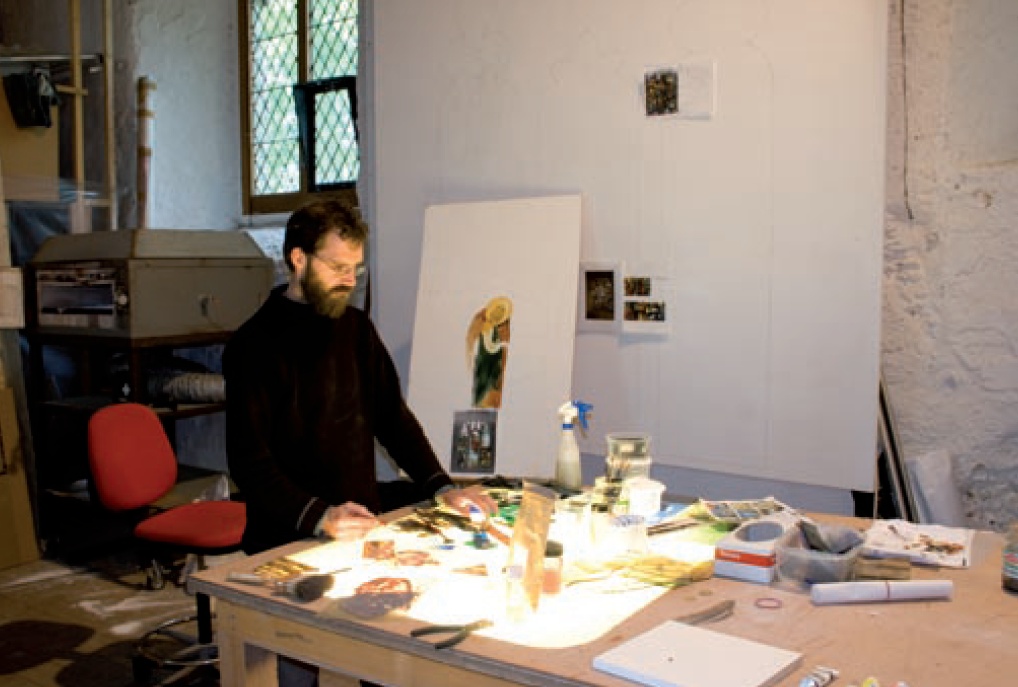 |
|
| Benjamin Finn making stained glass in his studio at Wickham Bishops church (Photo: David Stanford) |
Two of the churches, Wickham Bishops in Essex and Spernall in Warwickshire, have artists as tenants: Benjamin Finn and Nicholas Jones respectively. We normally allow the churches to speak for themselves but in both cases we inherited what was largely a shell and Ben and Nick have not only deterred vandalism by their presence but have contributed towards the capital costs of repair and been there to explain the building to visitors. Nicholas produces art in a variety of media, whilst Ben is now a well-established stained-glass artist of the Naturalist school. In others of our buildings we rely not just on one tenant but a whole bevy of locals coming together as a specific group of Friends to the church in question. So often we find that our simple act of stepping in, saving the building and agreeing to bear the capital cost of repair, has stimulated and revived interest within the village. At Papworth St Agnes in Cambridgeshire the local tally of events in 2006 included the use of the building for a Harvest Festival supper, a wedding reception, a display of wood turning, a village barbecue and a fund-raising dinner dance. Much of this was helped, it has to be said, by the sale of the pews by the Diocese when it still had it in mind to demolish. At Wood Walton in the old Huntingdonshire, clearly visible alone in its field to those using the East Coast main line, the local Friends compile a regular newsletter, have commissioned a new cast-iron bench for the churchyard, which they have also tamed, organise open days and keep a watching eye against the vandal and the bell thief. The churches may come to us friendless but in the best of the partnerships the activity that goes on within and around them would not disgrace many a church ‘in use’.
In terms of organisation, the Friends could hardly be leaner. All the costs of administration are borne by the Ancient Monuments Society with which the Friends have been in a working partnership since 1993. The Friends offer a modest subsidy but for that they get a City office (in St Ann’s Vestry Hall designed by Sir Banister Fletcher in 1905) with all the mod cons of IT. They also get the services of Matthew Saunders as Honorary Director and Caroline Carr as Assistant Director, each of them doubling as Secretary and Assistant Secretary of the AMS. The governing bodies and finances remain strictly separate although there is a joint membership scheme (one subscription gets one into both) and a joint newsletter issued three times a year.
Once the trustees of the Friends have finished discussing how to save the inheritance of the past, the end of the agenda also gives them a chance to embellish it. For two decades we have been in charge of the Cottam Will Trust, now worth well over £500,000 in capital value. This was left, via the Public Trustee, to the Society by Father Cottam (died 1943) who provided money to facilitate ‘the purchase of objects of beauty to be placed in ancient Gothic churches for the furtherance of religion’. We have been able to offer substantial grants, as with that for the new west window at Worksop Priory, but it has not always proved easy to elicit good quality applications. There is more about the Cottam Will Trust on the Friends of Friendless Churches website.