
Strength Grading Historic Timbers
David Yeomans
 |
|
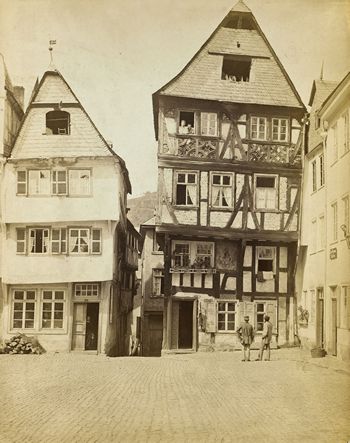
| Old timber-framed buildings at Boppard, Rheinland-Pfalz, Germany (courtesy of the Conway Collection, Courtauld Institute) |
The strength of a timber, whether new or historic, depends on its species and the effects of certain growth characteristics. In particular, knots and shakes (splits along the grain which occur as the timber dries) and the slope of its grain reduce its strength – the ideal timber has straight grain with no knots or drying shakes. Strength grading involves assessing the effect of these features.
For structural purposes new timber is supplied in ‘strength classes’ that determine the allowable working stresses. As the strength class depends on both the species and the grade of the piece, design engineers may specify the required strength class of the timber, leaving it to the supplier to select a species and grade to meet that specification. In all there are 16 strength classes set by the European standard BS EN 519, ranging from C14, the lowest softwood strength class through to D70 the strongest hardwood strength class.
Of course, where old and historic timbers are to be retained, the conservator is not in a position to select timber of the appropriate strength class: the existing timbers must be assessed to determine their strength, particularly where alterations are likely to impose new loadings, or where the timbers have been affected by deterioration. Although the strength class and grading system is not ideal for assessing existing historic timbers, it forms the basis of standard practice today and needs to be adapted to suit.
ASSESSMENT METHODS
Different methods are used to strength grade hardwoods and softwoods. Oak, as a temperate hardwood, is divided into four grades which, in increasing order of strength, are TH2, THB, TH1 and THA. (Grades THA and THB are only available in cross section sizes with no dimension less than 100 mm and cross section areas greater than 20,000 sq mm.) The coppiced oak used for rafters, wall studs and floor joists of early timber framed buildings was grown in such a way that the timber has fairly straight grain and is free from knots. It is therefore likely to achieve a high grade – TH1 or THA. However, larger timbers will contain knots, and these, and the associated disturbance of grain, reduce the stresses that the timber can safely take. The larger the knot or knot cluster as a proportion of the cross section, the weaker the timber will be. The appearance of these features on the surface of the timber is used to assess their structural effect. Both the position and the size of the knot as a proportion of the face dimension are taken into account. Each grade limits the knot width as a proportion of the face width, while knots towards the centre of a piece have less effect than those towards a stressed edge and so may be larger.
Slope of grain is also limited within each grade, but this is not a particular problem except in small timbers that have been sawn out of much larger pieces where the slope of grain can be excessive.
This method for grading new timbers can also be applied to timbers in standing buildings. One limitation is that the upper surface of a beam, and so the knots within it, might be concealed by the floor above. While hardwoods and softwoods used to be graded in the same way, softwoods are much more difficult to assess, and a different method of grading has now been introduced for them. This, the knot area ratio method, assesses the size of the knot as a proportion of the cross-sectional area of the timber and grades the timber into two structural grades; GS (general structural use) and the stronger SS (special structural use) grades. The method depends upon being able to envisage the knot within the timber. Because the knot is where the branch of the tree grows from the pith, the grader needs to be able to see the end of the piece to locate the pith. This is rarely possible once timber is built in, so existing timbers cannot generally be graded in this way.
STRENGTH CLASSES OF SOME COMMON SOFTWOODS |
||||||
Strength
Class: |
C14 |
C16 |
C18 |
C22 |
C24 |
C27 |
Weaker ←––––––––––––––––––––→ Stronger |
||||||
| British pine | ||||||
| Douglas fir (imported) | GS | SS | ||||
| Redwood/whitewood | Grades | Grades | ||||
| Caribbean pitch pine | ||||||
One possible solution is to return to the former grading method (see British Standard Code of Practice CP 112) and its associated allowable stresses. However, it is useful to consider the likely grades that might be found in practice.
Softwoods in historic buildings first came from Baltic countries and later from North America. In both cases they would have been from first growth forests with larger trees than from present managed woodlands. Moreover, the sections were often larger than those used today. Where, for example, old commercial buildings with large timbers are being converted, it is likely that the knots in these timbers will be a relatively small proportion of the cross sectional area. Currently, strength class C16 contains the largest number of species at GS grade, so this is a sensible grade to use in design, avoiding the need to go to the higher SS grade within which some species will achieve strength class C24. However, it is probably unreasonably conservative to assume C16 for historic timbers: a larger proportion will probably achieve C24.
Lastly, consider the real effect of these ‘stress reducing’ features. Drying shakes seldom have any significant effect on the strength of the piece. Filling these with epoxy resin, sometimes seen in historic buildings, is of doubtful value: the shakes would have to be particularly deep and unfortunately located for the resin to have much effect. More importantly, the position of knots and other features should be taken into account because they have less significance where the stress is lower. Where one can both see the position of the knots and assess the likely stresses, the required strength and actual strengths can be compared.