Heritage Inspired
Developing faith site tourism in South Yorkshire
Sarah Arthur
 |
||
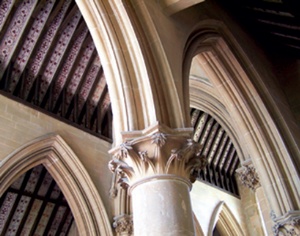
| Fine floral carving at St John the Evangelist, Cadeby |
Churches, chapels, mosques, gurdwaras, synagogues and other faith sites are treasure houses of our shared history. They harbour ancient stone and timber carvings, wall paintings, green men, gargoyles and dripstone heads, stained glass and other riches.
Very few pre-Victorian sites are built in the style of one architectural period, and their history can be traced through their jigsaw of architectural styles. Faith sites are the guardians of community heritage; churchyards in particular are a veritable ‘who’s who’ of a local area. They are also the guardians of traditions and rites that have typically been practised for generations.
Many people are unaware of the wealth of history on their doorsteps but interest in local history and heritage has never been greater and local history groups and societies are flourishing. The potential for heritage faith sites to facilitate interest and involvement in local heritage, and therefore in local community, is limited only by imagination.
There are around 10,000 faith sites of medieval origin in the UK. They were all built as places of worship, but no two are the same. Each offers a new experience and repeat visits often reveal new secrets. Perhaps this is why visiting heritage faith sites is one of the most popular pastimes in the country and why the sites attract so many foreign visitors. Four of the top five historic sites visited in the year 2000 were churches. There is clearly an enormous potential for faith sites to attract visitors and for those visits to be made enjoyable and worthwhile.
THE PROJECT
Heritage Inspired works with heritage faith sites across South Yorkshire. These include 208 listed faith buildings and more than 400 non-listed buildings. There are five buildings in the care of The Churches Conservation Trust and two English Heritage sites. The project works with all faiths equally, and values rich cultural and social heritage as highly as fine architectural heritage.
Heritage Inspired remains unique: it is the only project of its kind in the country, being totally independent and grant funded. It is run by three members of staff and a volunteer steering group. The project is funded by grants and donations, with core funding from the Heritage Lottery Fund. It has grown steadily from working with just two churches in 1998 and is now considered to be a national leader in the field of faith site tourism. Members of staff carry out consultation work, and have helped to set up similar projects across the UK, endeavouring to ensure that these achieve sustainable, long-term success.
Essentially, Heritage Inspired contributes to the awareness, knowledge and understanding of South Yorkshire’s rich heritage (architectural, cultural and social) both among local people and visitors. Through activities and events, the project aims to increase access to this heritage and provide interactive experiences with it. Of course, there are specific targets to meet to satisfy funders, but there is also scope to support volunteers to pursue aspects of their heritage which are of interest to them. This may include interest in a particular monument, period of history, or means of promoting the heritage, such as an event or website. For example, volunteers from Maltby St Bartholomew worked with Heritage Inspired to stage a ‘Green Men & Garlands’ festival, including work with local schools and decorating the church as a forest, to celebrate their link with the Celtic place of worship that once stood there.
All the activities and events depend heavily on the many dedicated volunteers who get involved at each site. They may be members of the congregation, members of local history groups, neighbours or school children. They are united by their eagerness to create a warm welcome for visitors, and without them projects like Heritage Inspired couldn’t hope to succeed.
INITIAL DEVELOPMENT
South Yorkshire is largely rural, a ‘green and pleasant land’ with some outstanding villages and towns, and some stunning medieval churches and other fascinating faith buildings set in countryside as beautiful as any in the country.
Hard hit by the collapse of most of its heavy industry, some still think of it as a grimy, industrial area. But with a new international airport in Doncaster, a new structure for tourism management, and an increase in the number of significant visitor attractions, South Yorkshire is beginning to realise its tourism potential.
Heritage Inspired has grown over ten years from smaller projects, and learned from its successes and failures along the way. In 1998, the Vicar of Rotherham, Richard Atkinson (now the Archdeacon of Leicester), recognised that both Rotherham Minster and the rare medieval Chapel on the Bridge were receiving a number of visitors purely related to the heritage of the two buildings. He recognised that these visitors were not always able to access the information they were looking for, or sometimes even the buildings themselves.
 |
||
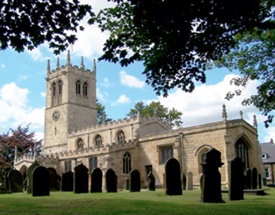
| St Peter’s Church, Conisbrough, which is probably of 8th century origin |
He worked with the local borough council to secure Single Regeneration Budget funding for a 12 month interpretation project at both buildings. The grant included funding for a part-time tourism development worker, the first such paid post in the country. After a successful six months it became clear that a great deal more could be done, and that other churches wanted to become involved. Rotherham Churches Tourism Initiative (RCTI) was born, and received funding from Yorkshire Forward (a regional development agency) to expand the project to cover specific areas of the rural south of the borough and to extend its activities to include events and volunteer training.
The project was very successful, carrying out interpretation projects, organising events and training volunteers. RCTI also worked hard to develop relationships between churches and other organisations (including the local authority’s tourism and heritage departments), having recognised from an early stage that the project would not continue indefinitely and that churches should work with organisations that could provide long-term help. RCTI also discovered that although clergy support was vital it was far more important to get congregation members and local people enthused, as again they would be the ones to continue the work in the long term.
The success of RCTI helped attract a large grant from the Heritage Lottery Fund. This enabled RCTI to work across the whole of Rotherham and bring all partner sites up to a common level of interpretation and involvement in events and other activities informed by the successes of the earlier project. RCTI also started work with buildings from other denominations and faiths. As with all the funding received, RCTI ensured that the majority of the grant and resulting visitor spend and business investment stayed in Rotherham, and used local businesses and services wherever possible. In 2006, with the successful completion of this project approaching, RCTI was being contacted regularly by faith sites across South Yorkshire and was asked by the Heritage Lottery Fund to look at the possibilities for continuing its work.
RCTI spent months examining what had been successful during the previous eight years, and distilled this down into a realistic and achievable set of aims and objectives for the all-new Heritage Inspired. These are focused on generating benefits for visitors, local people and, of course, the partner sites. They include publicity, interpretation, heritage trails and volunteer training. Heritage Inspired relies on much more of the drive for work coming from partners themselves, which gives them ownership of the project and publications or events. Since funding doesn’t last forever, this also means that the project should be sustainable.
REGIONAL SUCCESSES
Heritage faith tourism projects can be found across the UK. During the past ten years there has been a variety of organisations involved in this sphere, including dioceses, tourist boards, independent groups and, of course, the Churches Tourism Association. Much excellent work has been done, from the Cascade Project in Lincolnshire to Suffolk Churches Open Week (which this year saw an impressive 388 churches open) and the Churches Tourism Network Wales. In Yorkshire alone there have been projects in each of the four sub-regions.
 |
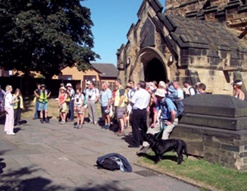 |
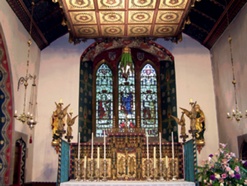
| Above left: St Wilfrid’s, Cantley, where Sir Ninian Comper recreated the atmosphere of an English medieval parish church with his elaborate decoration, rood screens, reredos and other furnishings. Above right: Wath All Saints, Wath upon Dearne. Many country churches are on well established walking routes. | |
Again, much of the work has been done by volunteers (volunteer Diocesan tourism officers can be found in most areas) with grant funding used for projects, events and activities. Heritage Inspired has perhaps been more successful than most at receiving continued grant funding for core organisation costs as well as activity costs. This is partly due to a close and productive relationship with core funders, but is essentially down to continued forward planning and a policy of keeping something in reserve.
Since 1998 the Churches Tourism Association (CTA) has been a forum for organisations, projects, churches and individuals in this field. The CTA annual conference is an opportunity to learn from each other, access information, gain support and network. CTA also administers a comprehensive website with lots of ideas and examples of projects from across the UK.
Faith site heritage tourism is becoming more mainstream. In 1998 when RCTI attended the first CTA conference, employing paid members of staff was considered a bold new move. Now there are similar posts across the country, and Heritage Inspired has three staff. In June of this year the General Synod of the Church of England backed a call for every diocese to explore the potential of church tourism. Hopefully, one of the major benefits of this decision will be increased financial and other support for current and future volunteers.
THE SHAPE OF SUCCESS
After ten years work in the heritage faith tourism field, what are Heritage Inspired’s objectives? What attracts visitors, and what makes for an enjoyable visit to a heritage faith site? What issues and ideas should sites opening to the public consider? What could or should projects like Heritage Inspired provide?
 |
||
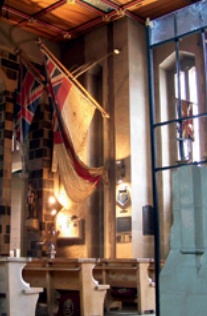
| St George’s Chapel, Sheffield Cathedral, commemorates the now disbanded York and Lancaster Regiment; it’s discarded swords and bayonets are a symbol of fragile peace. |
- The main aim is to encourage all heritage faith sites to be open as much as possible. Many do not have the capacity to be open all the time, but there may be times when they could be open with little extra effort (for example, when cleaners are scheduled to be on site). It is important that all open days are given plenty of publicity so that sites and volunteers feel their contribution is worthwhile and worth repeating.
- Events are an excellent way of attracting large numbers of people of all ages. Visitors not only enjoy the events but learn from them as well. Many churches already organise events, but they can also take part in events organised by other sites and organisations (such as the national Heritage Open Days held every September). Again, publicity is the key and it should be attractive and widespread.
- All heritage sites need some interpretation of the building and its past. Visitors appreciate a free leaflet, written in plain English, showing a plan of the building with marked areas to visit. Some sites could go further, providing (or selling) a full colour guidebook, or by producing display banners, interpretative panels and even audio tours.
- All sites should carry out a full survey of their heritage, including a photographic record. This is useful not only when writing interpretive material or giving guided tours but also for insurance purposes.
- Publicising opening times, events and activities is vital. This could include leaflets for tourist information centres, heritage trails, a regularly updated website or a newsletter.
- It is important to attract and involve local people as well as visitors from outside the area. One way to do this is to offer heritage talks or courses in local areas, focusing on fine heritage faith sites. Heritage Inspired has found that these attract many thousands of visitors each year who come to the talks and then visit the sites themselves.
- It is very important that churches and their volunteers are ready for visitors. Heritage Inspired has developed three core training workshops for volunteers. They are ‘Creating the Welcome’, ‘Interpreting your Site for Visitors’ and ‘First Response First Aid’. They are available to groups across the UK for a small fee.
- There are plenty of people out there who can help. Most local authorities have tourism departments whose staff are more than happy to work with heritage faith sites as visitor attractions. It is well worth taking advantage of any help they can give, which might include funding, publicity, and representation at trade shows.
SUSTAINABLE BENEFITS
Sustainability is a big issue: funding, sadly, doesn’t last forever. Forward planning is essential and the end of a project is always in sight. Heritage Inspired works hard to support individual churches and encourage volunteers to gain as much experience as possible. Involving volunteers in all aspects of the work carried out leaves them better prepared to continue the work alone.
Sustainability, of course, is not just a problem for Heritage Inspired, it is an issue for similar organisations and projects across the UK, as well as for individual churches and volunteers. With the recent decision of the General Synod of the Church of England mentioned above, and with expected debates and resolutions within other denominations and faiths, there should be more support for tourism heritage projects at faith sites.
With the recent blossoming of interest in the ‘local’ (whether it’s local produce, local history and traditions, or the current ‘holiday at home’ trend) there should also be more support available from tourism organisations and staff for heritage faith sites and their volunteers. Success, however, will be dependent on defining and achieving mutual aims and objectives.
The UK has a wonderful heritage of faith buildings peppered across the countryside and nestling in our towns. By working together we can make them accessible for local people and visitors alike.