
The Re-use of Industrial Buildings
Robin Nugent
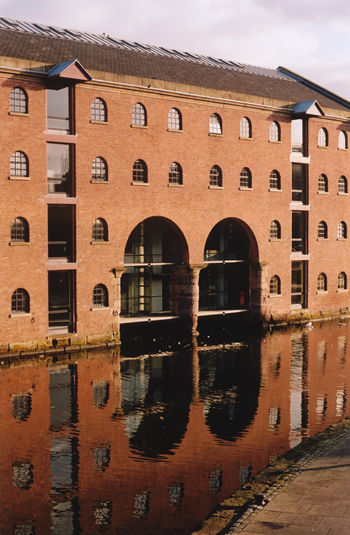 |
|
In recent years much of the built infrastructure associated with the UK’s traditional industries has fallen into disuse. Sometimes this has come about because companies have transferred manufacturing activity overseas to take advantage of lower costs there. In other cases industrial activity has moved to new purpose-built structures in order to meet process changes, to conform to modern working practices or to meet regulatory requirements. Whatever the reason, many companies have left behind a large stock of redundant buildings – some old, some much less so – which has declined rapidly through lack of maintenance, dragging areas of our towns and cities into dereliction.
Current central and local government planning and fiscal policies are increasingly directed towards re-using such sites and buildings in order to help fulfil the broad political objective of redeveloping ‘brownfield’ sites in preference to greenfield ones. The fact that brownfield sites have already had a use often means that they possess a cultural history. Older buildings or the complex of buildings may already have been listed or scheduled as ancient monuments, or the site itself protected by another designation. Conservation officers and inspectors increasingly require that the significance of such sites be assessed in accordance with the Planning Policy Guidance, PPG15 and PPG16. And such an assessment is not to be limited to below-ground archaeology. Above-ground archaeology can be of equal or greater importance, since it may provide a record of architectural, industrial or some other form of human activity.
The great masters of Renaissance art employed dissection, anatomical study and draughtsmanship as a way of gaining a proper understanding of their subject matter. Today’s designers can also benefit from taking a scientific approach to their work if they are to make the best use of existing buildings and sites. All too often an imperfect understanding of how structures perform and, most importantly, how they can be adapted in ways which recognise their cultural significance results in poor proposals, conflict with the conservation authorities, and time and money being wasted.
The initial task should be to assess the cultural significance of the site and its buildings. This may reside in their architectural form or spaces; in the materials or structural systems used in their construction; or in the industrial processes carried out within them. Any of these may have led to a designation in recognition of historical or architectural importance. This is achieved by a desk-based assessment, (produced from researching archives and other sources), which can sometimes reveal an unexpected wealth of information, including the original constructional drawings. The local conservation officer or librarian can often give guidance to sources.
The assessment will provide the brief for the next stage, which should include a field evaluation of the buildings and the site, identifying and recording the various buildings, the materials employed in their construction and any architectural or historically important features and fittings.
Based on these ‘desk’ and ‘field’ assessments a report or ‘conservation plan’ should be produced that provides an objective statement of facts that can be accepted by all parties. This can be used as a basis to agree what is significant and what is not about the site and buildings, preferably as the starting point of the design process. This document will benefit all parties. For the designer, it will be as much a part of the brief as the schedule of accommodation, giving an indication of those areas where the existing fabric should be retained and others where a bolder approach can be taken. For the client, it will be a source of information on the cultural significance of the site, which can be a valuable component of the marketing and it will provide the conservation officer and the Inspector with the information to take informed decisions on the design and on the degree of impact or intervention that is acceptable.
Most traditional industrial buildings were over-built, in that they used materials of greater strength or in greater quantity than was necessary. This means that today they can frequently be adapted successfully to new uses. For example, when seeking to convert a building to a residential use the generous storey heights often provide the designer with the opportunity to introduce duplex units with minimal intrusion. Subdivision will alter the nature of the architectural space, but industrial buildings usually have a simple bay that is repeated, and by preserving one bay, perhaps using it for vertical circulation, it is possible to provide an exemplum of the building’s original design and use.
The introduction of new elements such as openings, ventilators, airbricks or terminals, is likely to have an effect on a building’s character and must therefore be taken into close account. Moreover, the subdivision of existing openings can damage its design or proportions which may be the very features that led the building to be listed in the first place. Or it may have been the architectural space or the fittings which were considered notable. If so, their retention should make it possible to conserve the history of the place and, perhaps, something of the people who worked there and the industrial processes which took place. This is the design-led approach being adopted for the conversion of a former military base in South East London, where the new inhabitants will become the guardians of its history. The display of artefacts and of some of the site’s former products, such as steam hammer bases, gun barrels, and the redeployment of cannon balls as bollards, along with the retention of fire notices, keyboards and cast iron heaters, will ensure that the Royal Arsenal’s history is not lost.