
Protecting Lead Roofs from Theft
Jon Livesey
 |
|||
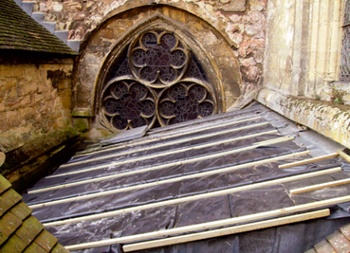
| Lead was stripped from the roof of Tewkesbury Abbey’s East End Chapel in 2007 (Photo: Ecclesiastical Insurance) |
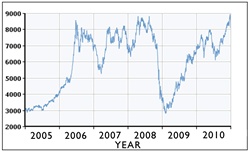
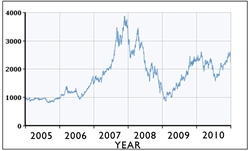
Most people are aware that the theft of lead and other metals is rising dramatically in response to a similar rise in the value of scrap. Indeed, metal theft is the fastest growing crime in the UK. This rise is driven by strong consumption from emerging markets, mainly China. The UK exported 8,000 tonnes of recyclable metal to China in 1997. By 2005 this figure had risen to an astonishing 324,000 tonnes. As the graphs below show, lead and copper prices are also on the rise again.
Business analysts foresee continued strong demand and high values despite the economic downturn. Unsurprisingly, this is a worldwide problem and it has given rise to some highly ambitious and well organised thefts including the case of an entire bridge stolen for scrap in the Ukraine and, closer to home, the theft of two 7ft propellers, made for the Royal Yacht Britannia, from Leith docks. The implications of these crimes can be far-reaching. Metal theft affects railway lines, communications infrastructure and electricity sub-stations.
Theft of historic lead currently accounts for only about 5 per cent of metal theft in the UK but it remains an extremely serious and costly problem. Specialist insurer Ecclesiastical reports that in 2003 it paid only ten claims costing £20,000. In both 2007 and 2008 there were around 2,500 claims costing £9 million per year. In 2009 more than 900 claims were paid, costing more than £2 million. In the first six months of 2010 Ecclesiastical has already received 945 claims with an estimated cost of over £2.1 million.
In 2009 Ecclesiastical introduced cover limits for churches: £5,000 for replacement metal and £5,000 for subsequent damage costs (for example, water damage). An average metal theft claim costs a few thousand pounds, so the limit is enough to cover the average claim. What it doesn’t cover is extreme cases or churches targeted repeatedly and those suffering very large thefts. Clearly, these thefts must be prevented so security protection, police support and local community vigilance need to be the way forward.
A CRIME WITH A HISTORY
| Price of copper | ||
 |
||
| Price of lead | ||
 |
||
| Both graphs © London Metal Exchange |
This problem is not new; lead theft stretches at least as far back as Roman times. In the 18th century, legislation was introduced that declared the theft and possession of such metals a crime, not only targeting the thieves but also the receivers of stolen metals.(1)
More recently, in 1964 the Scrap Metal Dealers Act was introduced to improve regulation of the scrap metal trade. The current magnitude of the problem and the potentially disastrous impact on national infrastructure has focused police attention on the issue. For the British Transport Police, cable theft from the railway network is now second only to terrorism in its list of priorities.
A number of recent multi-agency operations have successfully recovered large amounts of stolen material and resulted in the arrest of metal thieves and dealers. Despite national recognition, however, these operations have been few and localised. There is a real danger that current and forthcoming budget cuts will impede the development of a sustainable approach to tackling metal theft nationally.
IDENTITY MARKING
Perhaps the best hope for curtailing lead theft, especially for those churches that can only afford to install basic security measures, lies with initiatives to make the crime less attractive. In particular, identity marking the lead is critical as it increases the level of risk for both the thieves and any dealer who subsequently handles it. As part of a wider strategy to combat lead theft, identity marking should reduce lead theft in the long term.
A number of commercially available products and systems uniquely identify items so that if they are stolen and recovered they can be traced back to their owner. Lead can be embossed across its entire surface by specialists such as Stepway, or A ‘DNA’ marking solution may be applied to the surface. Smartwater (Smartwater Technology Limited), for example, has been widely marketed and its use has been successful in securing convictions. A marking material can also be applied as a grease which means that the thief is likely to become marked, enabling him or her to be linked with the crime-scene. Because of its cost, it is normally applied only to those areas where access is most likely. Two companies provide this type of product, Selectamark Security Systems (SelectaDNA) and RedWeb Technologies (RedDNA).
CRIME PREVENTION
Before considering expensive security measures, it is important to consider all basic crime prevention techniques. These techniques are unlikely to discourage the more audacious metal thieves, but they generally target sites where the likely haul is worth the effort. Churches with small amounts of lead are likely to attract the less sophisticated thieves who are more easily deterred, so make life as difficult as possible for them. The following techniques are most effective when used in combination.
- Contact the local crime prevention team and ensure they are aware of your circumstances and the value of any metals on the site. Check whether or not the area is a metal theft hotspot.
- Keep gates locked and restrict vehicle access. Consider installing telescopic bollards, or similar devices. Remove any easy means of transporting stolen metal, such as wheelbarrows and wheelie bins, to a secure storage area.
- Maximise surveillance levels, for example by cutting back tall trees.
- Install lighting. Fittings should be inaccessible and/or vandal resistant. But avoid lighting areas that are secluded as this might make it easier for thieves to operate. It could also encourage youths to congregate, attracting antisocial behaviour.
- Encourage members of the local community to keep an eye on the building and to report any suspicious activity to the police (particularly the unexpected arrival of workmen).
- Removing any means of access for thieves to roofs, such as water butts, waste bins and tall trees located in close proximity to the building and ensure ladders are stored in a secure place.
- Consider planting beds of dense prickly bushes or trees, for example to reinforce existing boundaries. Use wide, low beds where it is important to retain good views. Climbing or rambling roses for example might be appropriate over taller walls.
- Conduct regular checks of roofs so that lead theft is detected at the earliest opportunity rather than when rainwater enters the building causing further losses.
- Apply anti-climb paint to drain pipes and roof guttering to restrict access to roofing. The paint should not be applied below a height of 2m, and warning notices should be displayed.
Once the most appropriate measures for the site have been put in place, security systems should be considered. These fall into three categories: intruder detection, CCTV and physical protection.
INTRUDER DETECTION
Where there is an active local community, the sirens and flashing lights of an ordinary intruder detection system should, once activated, be sufficient to scare off most intruders. However, where churches are remote or the community in the immediate vicinity is disinterested, the alarm will be ignored and the emboldened thieves will take their chances. It is essential that an alarm triggers a response as quickly as possible but do be aware that if members of the church are asked to fulfil this role, they might be putting themselves at risk. Make sure that there are strict procedures to investigate safely and call the police for support. Where budget allows, a company accredited by the National Security Inspectorate (www.nsi.org.uk) should be used to respond.
It is vital to minimise the risk of false alarms. The use of inappropriate devices can lead to frequent false alarms, undermining the credibility of the system and potentially causing response to fall off to the point where a genuine attack is likely to be ignored, or the system is switched off.
Choosing the right type of detection can be complicated:
- the configuration of most church roofs rules out simple installations
- animals and environmental conditions can cause false alarms
- more reliable systems are likely to require more devices
- the appearance of some system components is unlikely to be in keeping with a historic church building
- if devices are positioned to suit the installer rather than the specific demands of the site and its context, the system will be compromised.
 |
||
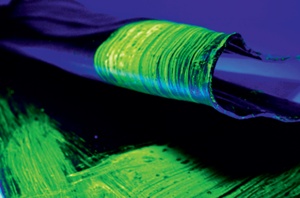
| A piece of lead flashing marked with SmartWater, a security marking liquid only visible under UV light. Smartwater contains a unique forensic code that allows items to be traced back to their owners (Photo: SmartWater Technology Limited) |
There is no universal answer, in each case the system and the context must be carefully considered to achieve the best outcomes. So, what are the options? The external passive infrared detector (PIR) is probably the most widely used because it is easily installed and flexible in terms of the detection area it can be set up to cover. The problem is that the detection area is often too wide and poorly defined, and the PIR can also be triggered by animals, sunlight and sometimes wind. Nevertheless, PIR can be effective at protecting small, specific areas. One company (E-Bound AVX Ltd) has also developed a system that uses sequential confirmation to minimise the risk of false alarms from roof areas. This means that two devices looking at different zones must be triggered to create a confirmed alarm (the system therefore needs up to twice the number of detectors). This approach is standard in internal detection systems and has dramatically reduced false alarm rates.
More reliable than PIR is the active infrared detector (AIR). This consists of a transmitter and receiver and a series of active infrared light beams between them that, if interrupted, triggers an alarm. As well as requiring twice as many devices, these tend to be larger than PIRs and need to be able to ‘see’ each other (so difficult roof shapes create limitations). The cost of AIR is also significantly greater than PIR. It is worth considering using a combination of devices with AIR on long, clear runs and PIR in difficult corners.
Buried cable or fence protection type systems can also be adapted to protect lead roofs. They use a variety of detection techniques including vibration, pressure and electromagnetic pulses, each linked to software analysers to eliminate false alarms from weather or animals. The cable, typically 5mm in diameter, is laid in a continuous loop around the roof, concentrating on vulnerable areas to ensure there is sufficient cable to prevent it being stepped over. It can be laid either on or under the lead, depending on the detection technology, and would be virtually invisible to casual view and to the intruder. While such systems offer low false alarm rates, there is a cost premium. Installation could cost as much as a CCTV system, but some church roofs could not accommodate CCTV for aesthetic reasons.
CCTV
To significantly improve protection, any of the above technologies could be linked to a CCTV system. This should be remotely monitored, so that all activations can be checked before contacting the police or a key-holder. The system could be linked to on-site loudspeakers so that the operator can warn the thieves that the police are on their way.
The cost of installing sufficient detection and surveillance equipment to monitor an entire roof might well be beyond the dreams, never mind the budget, of many small churches. Nevertheless, it is no longer sufficient to put up a few cameras and hope they have a deterrent effect or will serve to identify lead thieves: any captured images are likely to be grainy and dark. They may show the thieves at work, but they are unlikely to be sufficient to identify the culprits and secure a conviction. There is very little point installing cameras in such circumstances without some form of monitoring. Indeed, if the system and response procedures are carefully thought through, even low-budget internet-enabled cameras have some potential when properly monitored by members of the congregation.
 |
||
| The results of lead theft from the Grade I Ionic Temple in the grounds of Chiswick House, London in June 2008 |
One promising development is a system called Wireless Watchman. The system incorporates detectors with cameras and infrared lighting combined in a single unit, a remote monitoring service and guard response. This type of system uses the video image to provide information about the alarm activation, thus confirming an alarm, rather than good quality images of the whole event. Crucially, the theft is detected immediately, and a response is despatched. Other similar systems are available from other suppliers.
At some churches, particularly those with a single access road, CCTV can be used to survey the approaches, recording the number plates of visiting vehicles rather than peppering the entire church roof with cameras. The captured information could be enough for police to trace known criminals.
One final point on CCTV; it is important to be aware that images of people are covered by the Data Protection Act, as is information about people which is derived from images, such as vehicle registration numbers. To understand your responsibilities under the act, see the CCTV Code of Practice (2008), which is available on the website of the Information Commissioner’s Office (www.ico.gov.uk).
In summary, poorly conceived alarm systems will serve little if any purpose, and will probably end up being switched off. However, a carefully considered use of available technology tailored to your church and the responses you have available, should provide a reliable system that helps to prevent lead theft.
SECURE FIXING
LedLok is a company that secures lead sheet against theft using special fixings, which secure the sheet to the roof but allow natural thermal movement. The specialist fixings and hidden anti-theft bars are suitable for flat, pitched and vertical surfaces, and they can be fitted at any time to existing, new or replacement roofs. After English Heritage expressed some initial concerns about the appearance of the fixings, the design was modified and should be acceptable in all but the most sensitive locations.
Alternatively, if sheet lead is being replaced, consider having it fixed using hollow rather than wood-core rolls. The copper fixings used to secure them make the sheets more difficult to remove.
On its own, a significant barrier to quick removal will frustrate thieves and probably encourage them to look elsewhere. But it is the combination of these measures with surveillance or alarm systems that gives the best chance that the thieves will leave the site quickly, never to return.
Notes
(1) For more information on the history of lead theft and efforts past and present to combat it, see L Bennett, ‘Assets under attack: metal theft, the built environment and the dark side of the global recycling market’, Environmental Law and Management, 20, Sheffield Hallam University, 2008.