
Applying for Listed Building Consent
Clive England
Primary legislation is provided in England and Wales by the Town & Country Planning Act 1990 and the Planning (Listed Buildings and Conservation Areas) Act 1990 (referred to here as the Listed Buildings Act). Elsewhere, primary legislation is provided by the Town & Country Planning (Scotland) Act 1997 the Planning (Listed Buildings and Conservation Areas) (Scotland) Act 1997, and the Planning (Northern Ireland) Order 1991. These set out the legal requirements for the control of development and alterations which affect listed buildings, and the framework by which control is maintained. All have been significantly amended in the last two or three years, but those amendments do not greatly affect heritage issues. Important guidance (for England) is contained in PPG15: Planning and the Historic Environment.
Listed building consent is required for any works to listed buildings which may affect their character as buildings of special architectural or historic interest, including partial or complete demolition, extension or alterations (internal or external) of a listed building, or any object or structure within or fixed to the exterior of a listed building or within the curtilege of the building which, although not fixed to the building, forms part of the property. Carrying out such works without consent is an offence, punishable by a fine or term of imprisonment.
IMPLEMENTATION
In terms of the requirements for making the application, the legislation simply states that:
'Such an application shall be made in such form as the authority may require and shall contain:
(a) sufficient particulars to identify the building to which it relates, including a plan
(b) such other plans and drawings as are necessary to describe the works which are the subject of the application, and
(c) such other particulars as may be required by the authority.'
PPG15 provides further guidance:
'B.3 Applications must be made in triplicate on a form issued by the local authority. Section 10(2) of the Act requires that they include sufficient particulars, including a plan, to identify the building in question and such other plans and drawings as are necessary to describe the works for which consent is sought. For all but the simplest work this should normally mean measured drawings of all floor plans and external or internal elevations affected by the work proposed. There should be two sets of such drawings showing the structure before work and the altered structure or new development to replace it after the proposed work. The inclusion of photographs can be particularly helpful - of all elevations in demolition cases, or of the part of the building affected (interior or exterior) in alteration and extension cases. The Act empowers an authority to seek such particulars as it requires and an authority should certainly seek any particulars necessary to ensure that it has a full understanding of the impact of a proposal on the character of the building in question. An authority should not accept an application for consideration until it has sufficient information to provide such understanding.'
This leaves the detailed requirements of the application very much to the discretion of the local planning authority and the direct consequence of this is that each authority has developed its own unique application form. The forms should be studied carefully as they can contain small but significant variations in the information which is required and the way in which it is to be presented. For example, one authority may ask for a 'detailed' description of the work and another for a 'brief' description. Despite the reference in PPG15 to an application 'in triplicate', the number of copies required by individual local authorities varies from four to six, and possibly more widely. Guidance notes to the application forms also vary widely in style and content.
GENERAL GUIDANCE
Although this article is about the practicalities of completing an application for listed building consent, the work undertaken in advance of any application is the real key to its success or failure. No application, no matter how well presented, will succeed if the approach is fundamentally flawed. The higher the grade of the building, the greater the need for preapplication consultation, and the greater its scope. For a Grade I or Grade II* building, this would typically involve the local authority, the statutory heritage body (Cadw, English Heritage, or Historic Scotland) and one or more of the statutory consultees (confirmed in Circular 09/05 as: the Ancient Monuments Society, the Council for British Archaeology, the Society for the Protection of Ancient Buildings, the Victorian Society, the Georgian Group, and the Twentieth Century Society). At this stage it is far easier to resolve philosophical and practical issues than to do so once an application has been made.
Listed building consent is required for any work which affects the special character or interest of a listed building (for better or worse) so any work proposed must be carefully considered in the context of the building and of its history. Before developing any solutions to a particular brief or problem, it is essential to understand the building and what provides its character or special interest. This will enable appropriate decisions to be made and justification to be provided as part of the application.
The need for listed building consent for repairs is a grey area. Strictly speaking, 'like for like' repairs do not require consent but there is no precise definition and interpretations may vary. For example, the insertion of a number of matching tiles to repair a roof slope would normally be accepted as being 'like for like' but a proposal to replace a window with one matching it in every respect of detail and materials would usually require consent. A change of paint colour might well be perceived as affecting the character of the building, as might cleaning it. It is always important to establish contact with the local authority's conservation officer and the relevant statutory heritage body, and to discuss the proposals in advance of an application, particularly where there is doubt about whether particular work will require consent, or if the proposals involve alterations or additions.
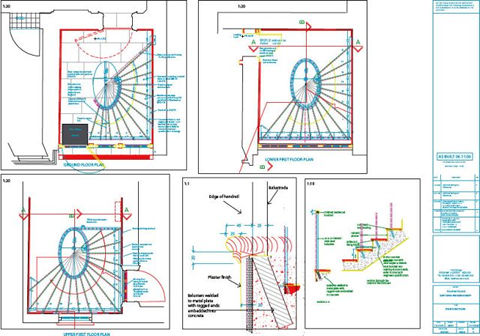
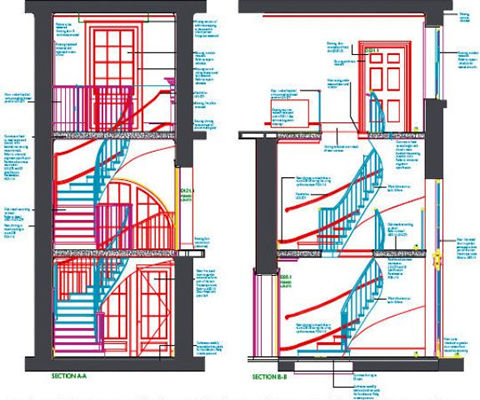
The information required in support of an application for listed building consent is considerably more detailed than that which would be required for a planning application, and sufficient time must be allowed for this. If an application for planning permission is also required, this would normally be submitted at the same time. Providing good quality, accurate, scaled drawings is central to any application. The drawing should show the building as existing and as proposed. These should be separate drawings to enable the changes to be clearly understood. The drawings should include plans, sections and elevations as appropriate to the work. It is helpful to provide photographs of the affected areas, clearly labelled to identify the location and viewpoint.
Ideally, the information submitted as part of an application for listed building consent would include a full set of detailed drawings and a specification. In practice this is seldom possible and the best guidance is simply to submit as much as is feasible at the time that the application is made. It is often the case that a specific area is identified as being of particular sensitivity and that additional detail is provided about this area alone at the time of the application. In the case of repairs, the written specification of materials and workmanship assumes a greater importance as there may be rather less drawn information.
More detailed drawings of specific elements, such as new joinery, should ideally be provided as part of the application. If this is not feasible at that point, provided that the remainder of the application contains sufficient information, a condition is likely to be attached to the consent requiring the submission and approval of more detailed drawings prior to the commencement of work.
Where historic fabric is concerned, it may be impossible to determine the details of some elements of work until the scaffold is erected, and opening up has been carried out, but provided that this is acknowledged in the application and that the basic approach is considered acceptable, further detail will be made the subject of a condition attached to the consent. It is useful to note general requirements, such as the presumption in favour of retaining the maximum amount of original material, and that new work and materials must match the existing in every respect.
 |
|
 |
|
| CAD (Autocad) drawings prepared by Thomas Ford & Partners showing proposals for a new staircase at Fulham Palace, illustrating the quality of information typically required for listed building consent applications. | |
MAKING AN APPLICATION
Submissions may now be made either by hard copy or electronically, via the Planning Portal (see below). The documents required for a typical 'traditional' (non-electronic) application for listed building consent are:
-
A completed application form.
-
A site location plan, based on an ordnance survey plan, at 1:1,250 or 1:2,500 scale (this varies between authorities) showing the site outlined in red and any other land owned or controlled by the applicant outlined in blue.
-
A site plan at 1:500 or 1:200 showing site boundaries, roads and trees (not all authorities state this as a specific requirement and it is unlikely to be appropriate in all circumstances).
-
Plans and elevations at 1:100 or 1:50 (again, these may not all be appropriate in all circumstances).
-
Detailed drawings at 1:20, or larger, for specific items of work and detailing.
-
A certificate of ownership in accordance with Section 11 of the Listed Buildings Act. There are four certificates A-D, covering a range of circumstances. Where the applicant is not the building owner, notices must also be served.
-
A Design and Access Statement or Design Statement (as appropriate). This should briefly set out the history of the building and its historical development, the background to the proposals which form the basis of the application, the reasoning behind the proposals, how these fit into the context of the building itself, and how they help to preserve the special character of the building and to preserve the historic fabric, and why the proposed intervention is justified.
ELECTRONIC APPLICATIONS
The advent of the Planning Portal (www. planningportal.gov.uk) has introduced a new set of standard forms for online applications. The application is set out as a series of steps, which broadly reproduce those described above:
Step 1. Complete forms
-
Applicant and agent details
-
Listed building and conservation area consent
-
Listed building and conservation area consent certificate (the certificate is required under Section 11 of the Act)
-
Other application forms (an opportunity to add (electronically) other forms, including a planning application).
Step 2. Attach required documents
-
Create site location plan (this links to other sites from which a location plan can be purchased).
-
Add or remove attachments (drawings, photographs and documents may be attached here electronically, or you can state that they have been posted separately or that they are not provided. Further guidance is given on requirements for electronic drawings, such as the need for the original paper size and dimensions or scale to be included).
Step 3. Final steps
-
Calculate fees (no fee is payable for an application for listed building consent, although this appears not to be mentioned in the guidance notes. Fees are payable in connection with some of the other forms which can be added at Step 1, item 4).Check proposal (the Planning Portal software checks the proposal and will not allow it to be submitted unless the necessary forms have been completed).
-
Select payment method and submit proposal (once the forms have been checked and payment has been made, either by cheque or by telephone, the application is submitted to the local authority. A confirmation number and contact details will be returned, but the application must still be validated by the local authority).
Surprisingly, local authorities seem to be running the electronic system, and its standardised forms, in parallel with their existing unique forms for non-electronic applications. This is despite the sometimes significant variations between the two. It is hoped that the standardised form will eventually replace all of the existing forms. It is presumably open to applicants to print off the standardised forms and to use these for non-electronic applications. On the other hand, some electronic applications have been lost in the system, so it is important to retain copies of everything sent.
RELIGIOUS BUILDINGS
The situation relating to listed places of worship in use as such is often the cause of misunderstanding, most of it arising from the use of the rather misleading term 'ecclesiastical exemption'. Although it was at one time the case that many works to ecclesiastical buildings were exempt from the need to obtain any form of consent, this anomalous situation was addressed by the Ecclesiastical Exemption (Listed Buildings and Conservation Areas) Order 1994. As a consequence, no religious denomination is now 'exempt' from the need to obtain some form of consent. However, some denominations are exempt from the requirement to follow the 'secular' procedure under which most listed buildings are dealt with because they have set up an alternative means of control which satisfies the requirements of the Order. Listed religious buildings therefore fall into two categories:
-
Those belonging to denominations with approved alternative regimes for dealing with such applications: the Church of England, the Church in Wales, the Roman Catholic Church, the Methodist Church, the Baptist Union of Great Britain, the Baptist Union of Wales and the United Reformed Church. For these denominations, applications for works to listed places of worship are made directly to the church authorities.
-
All of the remainder follow exactly the same process as for all other listed buildings, applications being made to the relevant local authority as described above.
Each of the denominations in Category 1 has its own unique procedure reflecting its own internal structures. It is beyond the scope of this article to set out the specific application details for each of the denominations. However, the general form of the application, and the information required, are very similar to those within the secular process. The most notable difference relates directly to the reason that the 'exemption' exists. Essentially, the existence of ecclesiastical exemption recognises that listed religious buildings are a unique building type, where a balance must be struck between the needs of the building and the developing needs of its use. Indeed, the architectural interest and variety of many great religious buildings are a direct result of the many changes which have taken place, throughout their history, to reflect changing religious practice.
As a consequence, an application for any works to a listed church will normally require a Statement of Need which will set out the religious or pastoral reasons for which the work is being proposed, accompanied by a Statement of Significance which is similar to the design statement described above. Procedures normally incorporate the need to consult with statutory consultees. It should be noted that the Church of England's 'faculty jurisdiction' system, under which approval is sought for works affecting listed churches, also encompasses a requirement to seek approval for a wide range of other matters, such as furnishings and works of art, and also affects churches that are not listed. It should also be noted that once a non-Anglican building ceases to be used as a place of worship, secular controls apply.
~~~
Recommended Reading
- Charles Mynors, Listed Buildings, Conservation Areas and Monuments, 4th edition, Sweet & Maxwell, London, 2006
- Cambridgeshire County Council Planning Section, Guide to Historic Buildings Law, 1997
- English Historic Towns Forum, Making Better Applications for Listed Building Consent, 2005
- The Department of National Heritage and Cadw, The Ecclesiastical Exemption Order: What it is and how it works, HMSO, London, 1994 (available free of charge)