
Mortar & Steel
Katie Worthington outlines techniques for fixing fine stone carving repairs to structures
 |
The finely carved stonework of capitals, cornices and other architectural enrichments often needs some carefully executed repairs. As originally constructed, these elements form the visible face of large stone blocks which extend back into the face of the wall or column. However, when repairs are carried out, it is rarely practical or acceptable to dismantle large sections of the structure just to replace lost or damaged surface decoration. As a result, new carved elements must be pieced in and secured to the block behind soundly and safely so that they do not fall, and discreetly, so that the repairs do not distract from the visual integrity of the design. Heavy new pieces of carved stone decoration sometimes project out over public spaces, adding additional structural concerns.
Before cutting out any eroded stone the restoration process must be discussed between the architect, the main contractor and the carver or mason responsible for carrying out the work. The next step is to produce a method statement explaining the repairs and how they will be carried out safely and in accordance with the requirements of the building, taking into account such considerations as the need for historical accuracy and the retention of important fabric. Whether re-carving whole capitals or smaller decayed or damaged sections in churches or other historic buildings, good planning is as essential as the use of carefully considered and established masonry techniques.
One of the first aspects to be considered is the extent of the deterioration and the quantity of stone lost due to weathering and incidental damage. An experienced carver may design the restoration to include what is known to have been there originally, based on surviving surface profiles and other evidence. However, speculative restoration should always be avoided as it is essential that the repair is historically accurate, and structural concerns are equally important.
As well as being involved in the initial discussion, it is essential that the same carver or mason is employed throughout. This allows the mason to tailor each stage to suit the project, from assessing the original design and its condition during the initial cutting out of the eroded stone, to fixing the finished piece. In this way seamless adjustments can be made at each step, to respond to any information uncovered.
 |
|
 |
|
| (Top)
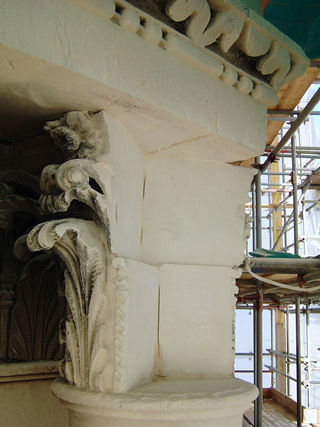
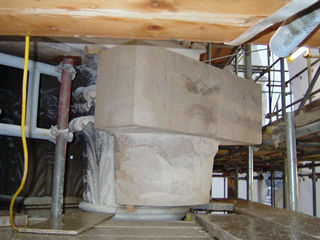
detail showing the horizontal notch at the back of the opening
and (middle) the new stone fixed in position pending carving
(below) (Photos: Katie Worthington by courtesy of Stonewest Ltd) |
|
 |
It is possible to break a typical project down into three distinct elements: the cutting and carving of the feature, the logistics of moving the replacement stone, and the secure fixing of the item into place as part of the building's fabric. The following cases illustrate how typical problems associated with these elements can be overcome in practice.
A CAPITAL AT ST PAUL'S
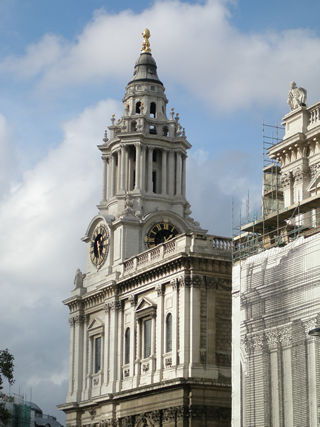
The re-carving of a section of a Corinthian capital at St Paul's Cathedral presented many problems, partly due to the sensitivity of the structure, which, as a Grade I listed building, demanded the highest standards of carving as well as the retention of as much of the original carvers' work as possible. The very public location and height of the scaffolding also presented some interesting challenges.
Work began with the cutting open of the original capital to discard badly eroded stone. Up close it was possible to see the original geometrical setting out lines, still scribed on the stone. In order to save as much historic fabric as possible, only a wedge of badly weathered material was removed, instead of the capital being sliced in half. A replacement piece of stone was then roughed out to the approximate shape of the capital to reduce its weight. This was placed on a bogey and moved by a team of masons up the tower of the cathedral via scaffolding and a hoist. The most difficult part of the route was then to push the stone up and over the v-shaped rooftop before it could be lifted up into the south west bell tower. The route required careful thought and preparation, since any protrusions and traps in the supporting scaffolding could have halted progress and caused a serious safety hazard.
The fixing of this capital had many complications. In particular the replacement section was top heavy and inclined to tilt forward. However, by accurately cutting the stone and leaving only narrow gaps for mortar beds (in this case 5mm) tilting could be prevented, as the stones above it and below would trap it in position once it was in place.
In order to create as secure a fixing as possible, a horizontal notch was cut into the back face of the opening to help interlock the new stone with the existing structure. In addition, stainless steel 316 grade threaded dowels were used to pin the new stone in place. The dowels were secured by drilling three dowel holes, two at the top and one at the bottom in the back face of the existing capital and the new section of stone, so that the holes could be accurately aligned when the two sections were joined together. After clearing the dowel holes of dust, they were filled with an epoxy resin. The stainless steel threaded dowels were then quickly inserted into the dowel holes of the existing capital. Time is of the essence as the resin can set in as little as five to ten minutes in hot weather.
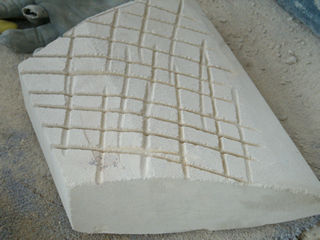
The stone then had to be 'keyed up', a process which gave it extra grip. This involved making cuts with an angle grinder (traditionally a hammer and chisel would have been used to create pits and punch marks) on the adjoining joints into which the mortar engages itself. A bed height of 5mm was prepared using a 'St Paul's mix', a proprietary mortar which sets hydraulically - that is to say, without the need for air - enabling it to set deep within the structure where there is insufficient air for lime to carbonate. (Ordinary non-hydraulic lime mortars need atmospheric carbon dioxide to set.) It also increases the strength of the mortar, enabling it to take the weight of the stone in compression without any large aggregate particles.
Once this process was completed, three masons lifted the stone with the aid of a block and tackle and straps, and rolled it into location on 5mm stainless steel dowels, thus ensuring sufficient space for the mortar bed. The stone was then grouted.
Grout is essentially a fluid mortar designed to fill voids and bed joints. It is absorbed by the new and old stone, keeping them apart. When set it remains softer than the stone and retains some plasticity to allow for some structural movement in the building. The grout used at St Paul's was a hydraulic mixture containing bentonite, a clay mineral which made the grout more fluid.
 |
||
 |
||
 |
||
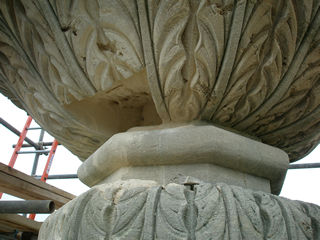
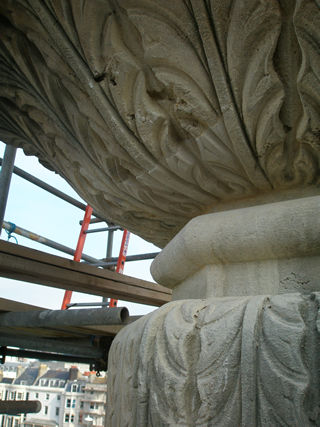
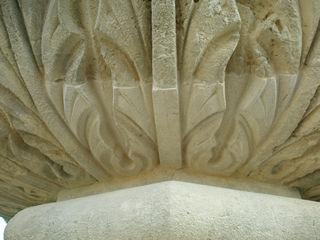
| An indent repair at the Royal Pavilion, Brighton, showing the hole in the underside of one of the palm leafed capitals after cutting out the damaged section (top) and the repair (middle). The detail (bottom) of the work before pointing shows more clearly that the lines of the new work copy the lines of the original carving, and are slightly proud of the weathered surface above |
Before grouting was carried out, the new stone was secured with wooden wedges which had been soaked in water to swell the wood, and the joints were pointed with mortar. Once this had set, the grout was poured into a hole left at the top of one of the joints though a funnel (actually half a plastic cup fixed temporarily to the wall using mortar), keeping one eye on the joints below in case a leak occurred. Pouring continued steadily until the grout filled to the top of the hole. Later, after the wedges had dried out, it was possible to remove them easily, without disturbing the stone.
THE CAPITALS OF THE ROYAL PAVILION, BRIGHTON
The Royal Pavilion is constructed with soft Bath stone. Due to its close proximity to the sea, its exterior is attacked by salt-laden sea-spray which is driven into the stone. This accelerates its decay, resulting in the need for frequent repairs. A lot of indent work was needed to cut out small sections of deteriorating stones, and in some cases whole stones had to be replaced. Work on this project proved to be as complex as the architecture of the building.
The corroded stone was carefully cut out with an angle grinder and finished by hand tools so as not to damage the surrounding stones. This enabled straight lines to be produced between the leaves, aiming to be symmetrical where possible and 'level', while following their general shape. The resulting indent was shaped like an inverted triangle, with the point at the bottom.
In this part of the facade the decorative leaves on the fanned capitals were designed to imitate those of a palm tree, giving them an intricacy that made restoration work more complicated. In this case the indents were small, so sections of plain stone could easily be lifted by hand and slotted into the cut-outs once they had been shaped to fit. By finishing the stone on the spot it was possible to get really tight joints of no more than 2mm, as specified by the architects.
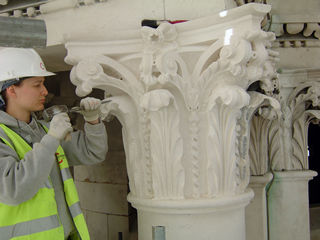
After securing the stone in position, leaf shapes were drawn directly onto its face, accurately following the shape of the surrounding leaves, and these shapes were then carved in situ. Because of their palm tree form, the Royal Pavilion's stone leaves fan out vertically and are fuller at the top, so the tips of the leaves are bigger than the bottom. They loosely resemble an inverted triangle, although the edges of the leaves are rounded and contoured.
In order to ensure accuracy, one method that can be used for this kind of work is to employ templates made on plastic template paper, to transfer cross sections of the design onto the stone being worked. Whatever means are employed, it is essential that work is thoughtful and accurate, not only for aesthetic reasons, but also because restoring a block of stone or carved element to its original size can mean that it protrudes from the surrounding weathered stone, putting it at a greater risk of erosion and giving it an incongruous appearance.
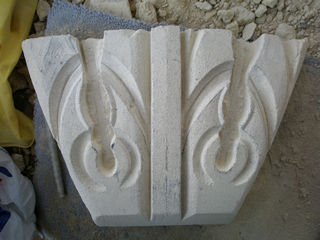
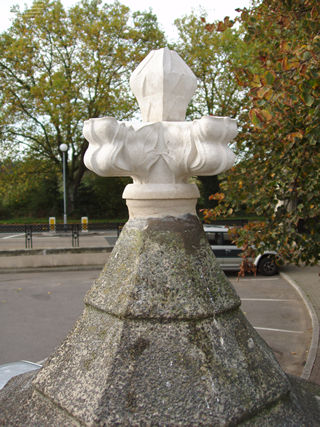
In the case of the Royal Pavilion stone, the triangular-shaped indent described above reduced the amount of stone sitting in the wall on top of the bottom stone. So, as a measure of security, a long stainless steel threaded dowel was placed through the back of the stone deep into the wall, while another dowel was 'moused' in the vertical joint. Mousing is commonly used for fixing stones through the vertical joints where one stone cannot be placed on top of another (as in the case of the finial capitals in London city cemetery, right). Mousing may also be required when fixing onto a horizontal bed. The process involves sliding the dowel fully into one stone with a piece of string (the mouse's tail) tied to the end of the dowel that is furthest in the hole. When the stone is put in place, pulling the string causes the dowel (the mouse, so to speak,) to slide back out across the joint into the adjacent hole.
 |
 |
||
| Detail of the new carving and its back after being 'keyed up' with an angle grinder (Photos: Katie Worthington, by courtesy of Stonewest Ltd) | |||
The process is not as easy as it sounds. In this case, after preparing aligning dowel holes, it was essential to ensure that there was enough room to slide the dowel back into the stone so that it disappeared and did not get in the way when putting the stone in the wall. A thin piece of string was tied onto the end of the dowel, taking care to ensure that it would be long enough to be free of the joint and adjoining stone once installed. The holes were filled with epoxy resin and any voids at the back of the stone were filled with mortar and lime for a 2mm tight joint. The stone was then placed in situ and the string pulled. Finally the dowels were checked to ensure that they had located properly. An experienced mason can do this by sliding a fine blade between the stones and gauging the feel of the dowels.
OTHER CASES
 |
 |
 |
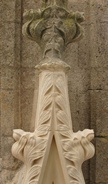
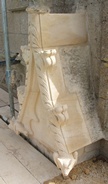
| Details of the buttress repairs at Moulton, simply fixed with mortar joints and stainless steel dowels between blocks, and interlocked with the existing stonework behind to prevent it toppling forward (Photos: Katie Worthington, by courtesy of CEL Ltd) | ||
 |
|
| A finished finial in position at London City Cemetery (Photo: Katie Worthington, by courtesy of Stonewest Ltd) |
Of course, not all jobs are as tricky as those at the Royal Pavilion or St Paul's. At the parish church of Moulton in Lincolnshire,instance, fixing the new carved stonework for the buttresses was fairly straightforward. Originally constructed with simple, square joints, the buttresses comprised of three gable stones sitting on a large bottom bed and attached to the wall behind, with a free standing finial on top. As a result there was room to move the angle grinder freely from left to right when cutting out the badly weathered and crumbling stonework, unrestricted by stones on either side. It was then simply a matter of reconstructing it using new carved replacements placed one on top of another, with the aide of a block and tackle for the heavier stones.
Finials are even easier to repair or replace, as they are completely free standing with no stones on top or, in most cases, surrounding them. When fixing the finial capitals in London City Cemetery, for example, it was possible to hold the finial above a dowel (already fixed to the top of the adjoining pier stone) and slide down. As these finials were small in size they required only one pin in the centre - in this case a stainless steel threaded dowel fixed in epoxy resin.
Each case needs to be considered individually. A solution which applies in one case will not work in another, but the principles remain the same: alter as little as possible; and ensure structural integrity.