
Organ Donors
Rodney Briscoe
Fine
Victorian organs are being transferred from derelict city churches to
country parishes, and there are signs that this is a growing trend.
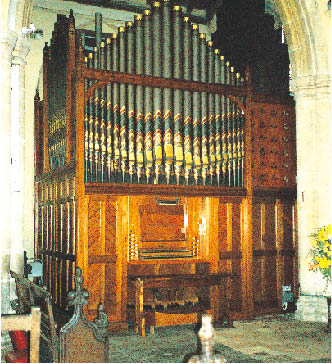
The
restored organ at Blofield Church
Cities have many large and impressive churches with equally large and impressive organs, but often their congregations are dwindling as people move out, and now many inner city churches are no longer needed for worship. In the last few years several of these organs have been re-located to country churches which could not have afforded such fine instruments in the past, where they replace either small pipe organs or, more often today, defunct electronics.
Examples of such alterations in East Anglia include Great Barton in Suffolk where a good home was found for a Maley, Young and Oldknow organ from Hounslow, removed from the church as the demolition men moved in. At Maldon United Reformed Church a three manual organ from Harrow was installed much to the delight of the enthusiastic congregation. And at Blofield, just east of Norwich, a fine rescued organ from north London was installed.
ST ANDREW'S AND ST PETER'S, BLOFIELD
The story of the Blofield organ is particularly interesting. The church of St Andrew and St Peter is a typically large Norfolk parish church, on the edge of the Broads which had housed, since 1886, a small two manual Norman & Beard organ of simple specification. By 1998 this instrument, although a quality organ in good condition, was deemed to be too small for the church's needs.
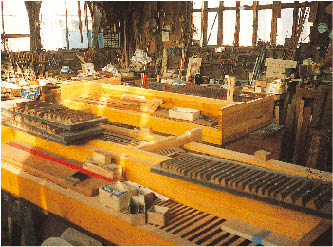 The soundboard being restored at the workshops of W & A Boggis. |
It was Rodney Briscoe of W & A Boggis who was contacted by church organist Geoff Sankey when a possible replacement instrument was found in London. A visit to St Peter's, Upper Holloway revealed a once admirable Victorian church that was now sadly deteriorating, and an 1880 William Hill two manual mechanical action organ in poor condition. However, it was clear that underneath the dust and neglect there was a well designed and built organ, which needed a good home before the conversion of the building to luxury apartments.
Rodney Briscoe had no hesitation in recommending this organ for Blofield church, knowing from past experience that with skilled restoration it could be successfully rebuilt in a new location. The necessary quotation was produced and this was accepted by the Parochial Church Council.
Before an alteration such as the removal of the organ can be made to any church in the ownership of the Church of England, permission must be obtained from the Diocesan Advisory Commission of the Church of England. (Similar requirements exist for all the other main church organisations in the United Kingdom.) To gain the permission required, which is known as a 'Faculty', applications to each diocese were made with the help of diocesan organ advisors in Norwich and London. Once the formalities were duly completed, arrangements were made for dismantling and collecting the organ from Holloway.
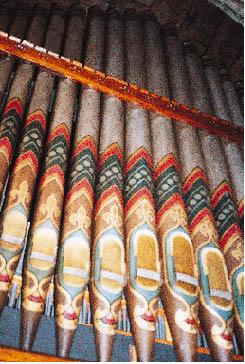 Details of the front pipes after restoration |
At the time, Geoff Sankey worked for the famous Adnams brewery in Suffolk, and as their contribution, he arranged for one of their lorries to call at St Peter's Church after delivering in London. So having unloaded some Broadside ale, the lorry took a full broadside of 16ft pedal open diapasons back to Blofield.
Organs in bits take up much more space than when they are assembled, so when it was all back in Diss, the workshop was full of rather dirty organ parts. A thorough examination prior to restoration revealed much of interest, and by referring to the records from the British Institute of Organ Studies (BIOS), the history of the instrument became clearer.
The original order from the factory records of the maker, William Hill, was found through BIOS, and it made interesting reading. It seems that the specification changed several times during the building, which took from August to December 1880. It also shows that Hill made extensive use of reconditioned pipes and other parts. The late Victorian period was a boom time for organ builders in this country, and organs were modified and rebuilt often, sometimes not long after they were built, and the discarded parts were re-used. When dismantling organs of this age and size it is very common to find screwholes and paint marks in unexpected places, showing that the parts had been used before. Hill's order book also showed that neither the mixture nor the trumpet ranks of pipes were fitted at the time. Details of the company's 1931 overhaul indicate that this was when the trumpet was fitted.
At some time in the early 20th century the swell box had been enlarged and a clarionet reed stop had been added. The 1931 overhaul also added to the pedal department, with the addition of a bourdon and bass flute. Furthermore, at this time the pedal action was changed from mechanical to pneumatic. With the current vogue for returning organs to their original specifications, these modifications were carefully considered. It was decided, however, that they were not out of keeping with the character of the organ, and added much to the instrument.
The mixture, however, was a different question. It was decided to fit the mixture that the organ had been waiting for for over 100 years, but this needed a separate faculty. In order to get the faculty, research had to be done to decide the correct composition of the two-rank mixture. Using other Hill organs of the period, a composition of 19-22, breaking back to 15-19 then to 12-15 in the upper octaves was agreed. Fortunately, Rodney Briscoe maintains an extensive stock of good quality pipework, and he was able to make up the mixture from reconditioned pipes of the correct period and voicing. After the rebuild the specification of the organ is:
Great: open diapason 8, hohl flute 8, dulciana 8, principal 4, wald flute 4, fifteenth 2, mixture ii, trumpet 8
Swell: gamba 8, clarabella 8, salicional 8, principal 4, flautina 2, cornopean 8, oboe 8, clarionet 8
Pedal: open diapason 16, bourdon 16, bass flute 8
Couplers: swell to great, swell to pedal, great to pedal
Restoration work began once all the main parts were back in the workshop, including the organ's bellows. These were nearly as big as two double beds and it needed all W & A Boggis's staff of four to lift and move them. The bellows store and pressurise the air that the organ needs. In the modern age efficient electric blowers mean that bellows are much smaller than they used to be, as they no longer have to be big enough to compensate for the fatigue of the man - or boy - pumping the blowing handle. But restoring this instrument meant that the original enormous bellows had to be retained.
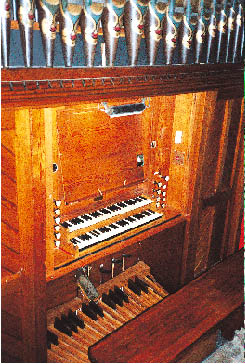 The console |
The old leather was stripped off and new leather was glued on in its place. Organ builders still use animal-based glue, just as they did when the organ was built. This has several advantages: it can be removed with hot water and it does not react with the leather and wood in an adverse way, as do some chemically manufactured glues. But, as with several aspects of organ building, these old methods and materials are used not out of a desire to be authentic, but simply because there is no better way. The re-leathering work included the feeders as well as the bellows.
The mechanical action was completely dismantled and cleaned and the iron parts were replaced with new phosphor bronze, which resists the often damp atmosphere of a church better. The soundboards were stripped down and 'flooded', this means sizing it thoroughly with slightly watered down glue to seal any wind leaks between the bars of the soundboard. The pallets were recovered with new felt and leather, the drawstop slides cleaned and re-graphited so that they move easily and cleanly.
The words 'pneumatic action' often seem to strike fear into the hearts of organ players, advisers, and even builders, but a properly restored and maintained pneumatic action is no problem at all. Organ builders without a long heritage in the industry may have never seen pneumatics in good condition and find the vagaries of air pressure harder to understand than a mechanical action. However, Mr William Boggis, who founded the business, had been apprenticed to the masters of pneumatic actions in the heyday of the technology and had himself trained Mr Briscoe. So Mr Briscoe was totally confident in retaining - after careful restoration - the pedal action in this organ.
The oak casework was carefully cleaned and refinished, returning it to its original colour and the delicate stencil work on the pipes, so characteristic of organs of this period, was cleaned. The work is of such good quality that gentle cleaning with soap and water was all that was needed to return the pipes to their former glory, with no retouching necessary.
The bourdon pipes had to be re-located on the other side of the organ for the new position in Blofield church. The casework had to be modified, since the organ was to be facing a different direction - at Holloway it was on the south wall facing north and at Blofield it is the other way around. The pipes had to be changed from one side to the other and a new case panel was made to match the existing panels on the rest of the casework.
Overall, this was a most successful project. The instrument fits perfectly with the rest of the church. If Blofield had had more money in the 1880s it is easy to see that they would have had an organ somewhat like this. The church was impressed with Rodney Briscoe's confidence that he could position the organ so that the tallest centre pipe was in the line with the centre of the arch.
This illustrates that there is much that can be done to provide a church with a high quality instrument that comes without the expense, in time as well as money, of a new organ and has the historical integrity and proven reliability of a older instrument. And two churches gained a new organ from this job, as Blofield's former organ was also moved to Colkirk, a village in central Norfolk.