
Parquetry Floors
Jasper Weldon
 |
|
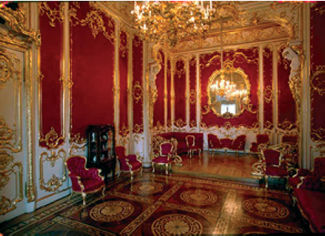
| Figure 1: The Boudoir at the Winter Palace, St Petersburg displays some of the finest parquetry ever created. |
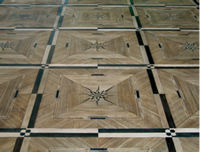
Decoration on flooring dates back at least to the Egyptians, who covered their brick floors with stucco and painted them. Marquetry, the practice of inlaying small pieces of wood into a sub-frame of simpler wood to produce a pattern or picture, had been used to decorate furniture for hundreds of years but it was not used to decorate flooring material until the 16th century, when technological advances allowed the technique to be applied on a much grander scale in conjunction with 'parquetry', patterned floors of tightly fitting blocks of wood.
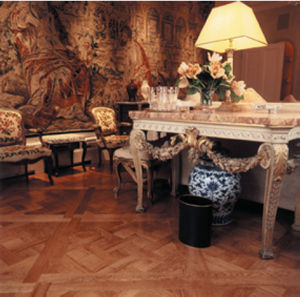
The geometric block pattern Parquet de Versailles (see Figure 5) became the standard flooring for the formal rooms of 17th century French chateaux, while much more elaborate designs were developed for Russian mansions and palaces. There, parquetry came to be seen as an extension of architecture, often determining colour schemes.
The use of parquetry flourished during the building of St Petersburg in the 18th century. Manor houses and palaces were springing up all over the new city, creating the demand for a greater range of interior design options. At a time when architectural language was determined by the desire to show off wealth, influence, taste and fashion, the aristocracy imported craftsmen from far and wide to create awesome buildings that would be admired, envied and imitated. Homes became galleries for the masters. Every detail of the building was as beautiful as the paintings, sculpture, furniture and other furnishings within it.
 |
|
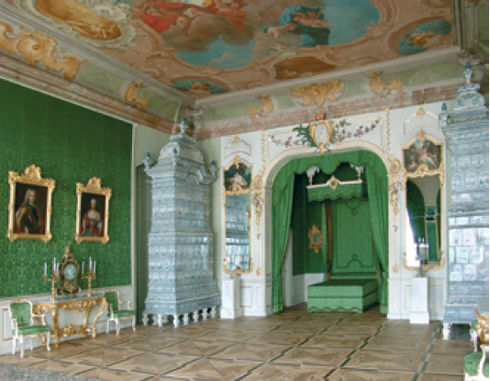
| Figures 2a & 2b (below right): The duke's bedroom at the Rundale Palace, designed by Florentine architect Bartolomeo Rastrelli for Russian Duke Ernst Johann Von Biron. By the 17th century, parquetry had become the most popular flooring in Russian palaces and mansions. |
Leading Rococo architect Bartolomeo Francesco Rastrelli was one of many European craftsmen brought to St Petersburg to design pleasure palaces for the aristocracy. He designed the parquet floors of the imperial palaces, including the Winter Palace which features one of the most outstanding examples of marquetry flooring in the world.
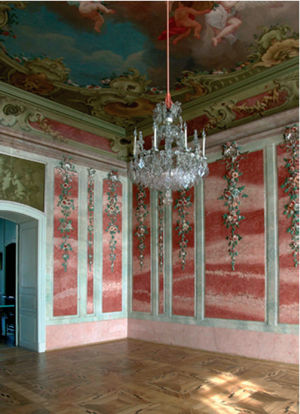
In 1736, Russian Duke Ernst Johann Von Biron commissioned Rastrelli to build a 138-room mansion, the palace of Rundale, in what is now Latvia. Sculptor Johann Michael Graff was brought in from Berlin, and Italian masters Carlo Zucchi and Francesco Martini painted the ceilings. Rastrelli's signature parquetry adorns the rooms, with the most magnificent in the Duke's bedroom (see Figures 2a and 2b).
Over the centuries, many of these treasures have been stripped or ruined, but outstanding examples of parquetry and marquetry can still be found in St Petersburg, including Menshikov Palace's Walnut Study, Ekaterninsky Palace Museum's Grand Hall, and every room in the Chinese Palace Museum.
 |
Parquetry arrived in England in the 17th century with Queen Henrietta Maria. The youngest daughter of King Henry IV of France, Henrietta Maria married Charles I in 1627 and made Somerset House (then Denmark House) her official residency in the late 1620s. Queen Henrietta ordered a major reconstruction and redecoration of the Tudor house, overseen by Inigo Jones, bringing a touch of the French Court to England.
Until then, floors in English country houses and royal palaces had been created from stone or plank. The parquetry flooring seen for the first time in her fashionably decorated court was imitated across the country but few examples have survived.
Denmark House was rebuilt in the 18th Century as Somerset House and most other examples have been replaced with newer designs and materials or have been lost through fire, decay, demolition or reconstruction.
 |
||
 |
||
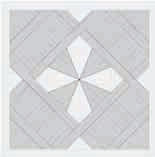
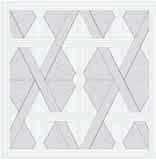
| Figures 3 & 4: Line drawings of the Serlio and Palladio panels, two of the earliest parquet designs from the 16th century. |
However, Ham House, in Richmond Upon Thames, built in 1610 and now a National Trust property, boasts fine examples of parquetry from the 17th century. The Great Hall contains a dais constructed from Parquet de Versailles and the floors of the Queen's bed chamber and closet are decorated entirely with parquetry.
Boughton House too, in Northamptonshire, has escaped alteration in the last 300 years. Dubbed the English Versailles, thanks to the influence of Ralph, 1st Duke of Montagu, a former ambassador to Paris and a devotee of French architecture, the monastic buildings and manor house were converted into one of England's finest stately homes.
The interior is resplendent with French decorative influences, including fine parquetry in many of the state rooms. The grandeur has been lovingly preserved and conserved, making Boughton House one of the finest surviving examples of the cultural aspirations of the 17th century.
The trend for parquetage continued well into the 18th century, with patterns becoming more elaborate and more ambitious. The staircase hall at Claydon House, Buckinghamshire, and a half-landing from 22 Hanover Square (now displayed in the Victoria and Albert Museum) show the intricacy of later designs.
From 1725, the fashion for expansive marquetry was displaced as carpets were popularised. Over the latter part of the 18th century, inlay started to be used as a border for the carpet, prompting a wholesale revival of parquetry in the larger houses. By 1837 it was firmly back in fashion and by the end of the century parquetry was a part of mainstream architecture, demonstrated in Blackpool's opulent tower ballroom. Designed by renowned theatre architect Frank Matcham during the Victorian entertainment boom, when it opened in 1899, the style, elegance and exuberance of stately home architecture finally became available to the general public.
CAUSES OF FAILURE
What makes parquetry and timber such a successful medium for flooring is that, treated well, it lasts and lasts. However, problems can arise including:
 |
|
| Figure 5: Parquet de Versailles, based on the mid 16th century designs of Sebastiano Serlio and Andrea Palladio, became the standard flooring for formal rooms in French chateaux. The pattern was adopted for the earliest parquetry to be used in English stately homes after Queen Henrietta Maria, wife of Charles I, brought the fashion to Denmark House, where Somerset House now stands. |
- water damage
- fire damage
- fading in sunlight
- loss of structural integrity due to failure of the substrate
- abrasion and wear.
Of these, the most significant enemies are fire and water.
As the destruction of Windsor Castle famously showed, if parquetry is lucky enough to escape fire damage, the water used to rescue the building will destroy it. Historic houses are also often victims of burst pipes and examples which have failed due to excessive water damage are common. Wood expands as it absorbs moisture and shrinks when it dries out again, but it never goes back to its original form. In addition, moisture pushes the strength of the old adhesives (normally animal glues) to the limit, and in most cases failure occurs.
Finding the point of failure in a parquet floor can often be the hardest and most time consuming part of repairing it. Simply knowing where to start is the challenge: there could be errors throughout the entire sub-floor, the glue may have split or there could be just one point of failure which is causing the whole floor to buckle or distort. More often than not, finding out what is wrong involves dismantling large sections and piecing them back together again. Testing one panel alone can take up to five hours.
Sometimes failure will be down to a weak sub-floor. Those made of softwood are more likely to expand and contract, which over time weakens the glue. In such cases it is usually necessary to rebuild the entire sub-floor with a high quality ply-wood. To provide the sturdiest base for a parquet floor which will endure, the ply-wood should be cross-bonded and waterproof.
 |
|
| Figure 6: The Rose Room at Rundale Palace |
Sunlight can be another problem, as prolonged exposure to ultraviolet light will bleach the colour of the flooring. The red, green and yellow dyes that were popular in the 18th and 19th centuries are particularly susceptible. When the parquet floor in the foyer of Charles Dickens's former home in Kent came to be restored, the entire floor had to be lifted and reconstructed in the workshop. The floor had taken a battering over the years when the building had been used as a school. Sunlight had bleached some areas of the parquetry and many of the panels had come loose and deteriorated as a result.
In certain situations it may be necessary to control the amount of sunlight falling on the floor though the judicious use of blinds and curtains. Solar control films are also available which may be applied directly to the glazing.
CONSERVATION AND REPAIR
The trick to restoring old flooring is precision: achieving a perfect grain match and getting the new sections to the right colour. This can only be done through a combination of the best of modern technology, traditional techniques and, of course, the right choice of wood.
There is an abundance of very good antique oak available in various European countries from which to source old floorboards and timber joists to recreate the missing panels or boards in historic floors.
To ensure that all new components for the restoration of original floors fit perfectly, new components must be cut with considerable accuracy. At Weldon this is achieved by using laser technology to achieve working tolerances of 0.1mm: far better than could ever be achieved with hand tools.
Wherever possible, original finishes are retained intact and the new components are dyed and French polished to match using the same techniques and materials as those used originally, building the coats up to the same level. Finally, several coats of French polish are usually applied across the whole floor to help integrate the original and new components.
French polishers spend years in training and devote decades to understanding how wood ages and how colours change with age. Achieving a colour match with the Charles Dickens foyer floor took four weeks of applying varnish coats, burnishing it off, and repeating the process day after day.
 |
|
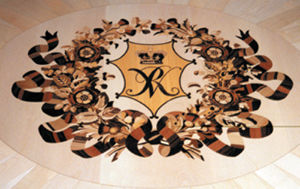
| Figure 7: The Royal Cipher in The Crimson Drawing Room at Windsor Castle, which had to be recreated following the fire in 1994. |
The good news for new timber floors is that modern building technology is creating more sympathetic indoor climatic conditions to protect them. By stabilising humidity, air conditioning has been a real friend to timber. As a hygroscopic material, timber is very susceptible to movement when exposed to differing humidity levels.
Timber tends to expand in the summer months as it absorbs moisture when humidity is high, and contracts during the winter months when heating is in operation and humidity levels are low. This expansion and contraction is most notable across the width of a piece of wood and, in some cases, the compound effect may add up to several inches of movement across the width of a large room. The movement is accommodated by gaps at the edges of the room where they are hidden by skirtings.
New technology used in combination with traditional materials and techniques have helped to enable some of the most magnificent timber floors to be restored accurately, extending their lives by centuries. However, perhaps the most important lesson to be borne in mind is the need to protect historic parquet floors, so avoiding expensive restoration jobs. In particular, keep water away and use natural waxes and polishes to keep the blocks supple and the colour balanced.
 |
|
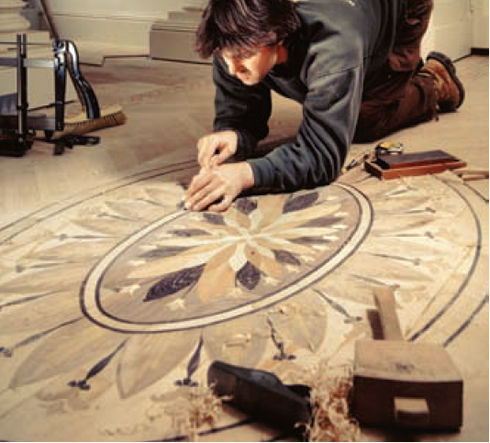
| Figure 8: A Weldon craftsman working on a new decorative panel in wenge, teak, walnut and oak at Regents Park, London. |
Recommended Reading
- Jane Fawcett, Historic Floors: Their History and Conservation, Butterworth-Heinemann, Oxford, 1998