
Portland Stone Facades
Catherine Woolfitt
 |
|
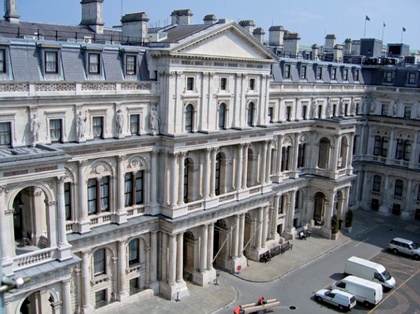
| View of the Foreign Office Quadrangle after recent water cleaning, which has enhanced the legibility of the Portland stone masonry and detail, including decorative friezes and sculpture (all photos: Catherine Woolfitt) |
Historically, Portland stone has been the most widely used of the Jurassic limestones of Britain. It is arguably the principal building stone of London, at least since the post-medieval period, and became popular in the 17th century following the demise of timber as the predominant construction material, particularly after the Great Fire of 1666.
Many of the most significant public buildings in London have been constructed or faced in Portland stone, from churches to government buildings. A list of such buildings in the capital would encompass important streetscapes, notably in Whitehall, Trafalgar Square, and the City, as well as a number of national museums and galleries.
Fully understanding the properties of Portland stone and following best practice in its repair and maintenance is clearly important to the long term care and protection of a large number of significant historic buildings. Public buildings typically feature some decorative stonework and sculpture in their design and conservation planning needs to take account of these elements, which might require specialist input.
SOURCE AND CHARACTERISTICS
The source of this stone, the Isle of Portland, is a key part of the Dorset and East Devon Jurassic Coast, which has been accorded the status of a world heritage site in recognition of the significance of its landscape and geology. Evidence of past quarrying activity is ubiquitous on Portland. The site benefitted not only from the quality of its stone, but also from ease of transport due to its proximity to the sea.
Portland is a relatively pure limestone containing, on average, 95 per cent calcium carbonate. It is creamy white in colour, weathering to a duller greyish brown tone and often to darker brown in localised areas where water penetration occurs through neglect. It is an oolitic limestone but the ooliths (spheres) are not readily visible. The stone occurs in distinct beds known as Portland Base Bed, Portland Whitbed and Portland Roach. Fossils are prominent in most Portland stone and, as natural weathering occurs, the harder fossils tend to stand proud of the surrounding matrix. The bed with the most obvious fossils is Portland Roach, which has large shell fossils and bears the concave imprints of those which have been lost. Portland can be extracted in large blocks and holds an arris well, lending itself to use in dressed stonework.
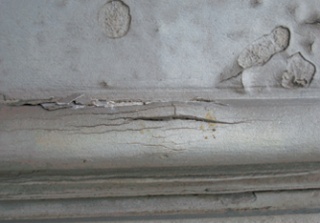
In general, Portland is a durable stone with good weathering characteristics and it can be used for all exposures on buildings including elements which must endure the worst of the weather, such as copings and ground level plinths. Long-term weathering depends, however, on good repair and maintenance to prevent rainwater ingress. Neglect or poor work, particularly poor work to joints or the use of very hard and impermeable mortars, will cause serious masonry defects to develop. In common with other limestones, Portland stone surfaces can develop gypsum skins in areas not regularly washed by rainwater. In these sheltered conditions, the limestone (calcium carbonate) on the face is converted to gypsum (calcium sulphate, known as a gypsum skin or crust) and the stone surface may be stained and cracked, and eventually become detached as a result.
 |
 |
|
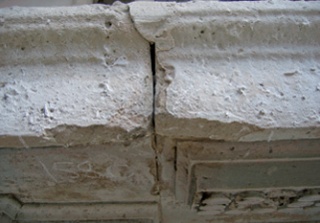
| Typical gypsum (calcium sulphate) skin on sheltered Portland stone in the process of blistering, cracking and detachment | Poor joint treatment: in this case past smearing of hard mortar over the sky face of the cornice joint left the lower section open. |
SURVEY AND TYPICAL DEFECTS
The first stage in any programme of work to a facade is a survey to determine the type and extent of defects, as well as suitable repair methods and materials. The most useful diagnostic tool is close range visual inspection and hands-on assessment of visible defects, from a hydraulic access platform or, ideally, from access scaffolding.
There are more sophisticated non-destructive techniques, such as impulse radar and thermography, for the detection of problems such as embedded iron cramps, voids and the depth of facing stones, but actual acoustic sounding by hand using tools will identify hollowness and detachment, for example where fractures or spalls (in stone or mortar repairs) are visible and there may be a risk of stone falling. It is important to have tools at hand during survey, including chisels of suitable size for joints, to check the soundness of original mortar and later repointing, and a heavier tool (chisel or other) for acoustic sounding of surfaces: literally for tapping to check whether detachment is audible.
It is best to carry out detailed survey work after cleaning as soiling conceals defects and much is normally revealed about the masonry condition by removal of soiling deposits. The effects of past aggressive cleaning, carried out before the potential for damage was appreciated, such as surface pitting and ‘gun shading’ (marks from high pressure water jet or dry abrasive cleaning) are often visible and are, unfortunately, permanent.
Decay mechanisms typically encountered in the survey of Portland stone facades are common to limestone masonry in general. Open or superficially filled joints are very common. Joints in this condition often exhibit associated dark staining from long-term water saturation. Poor quality joint treatment, where mortar (often based on hard ordinary Portland cement) is applied to the face only, leaving voids behind, is often encountered. In these cases the mortar-stone bond typically fails and hairline cracks develop, becoming more prominent with time. Even relatively fine cracks admit rainwater and contribute to long-term saturation, staining and decay of the stone.
Sometimes evidence of rainwater run-off (especially in projections such as cornices) is visible where direct penetration through the sky face of the joint occurs and water then runs out of the lower section of the joint, leaving streaking on the face of masonry below. Lead can be very effective in protecting and preventing rainwater ingress on projections and weatherings and is often used on cornices.
REPAIR TECHNIQUES AND MATERIALS
Weathering of arrises at joints which have been neglected or poorly treated (as described above) is a typical problem on projecting elements (cornices, copings, bands) and it is often necessary to decide whether repair is necessary, as well as joint filling. Where the weathering or loss is relatively limited in scale and the exposure not severe, a mortar repair may be adequate and less invasive. However, where the area of decay is substantial, and particularly in more demanding exposures, an indent (stone) repair is the better and longer lasting repair solution.
 |
|
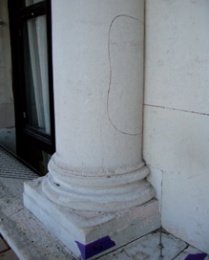
| Historic indent (stone) repair carried out during construction: as in this Victorian example, these repairs were typically of high quality and followed the informal contours of the damaged area. |
Indents must be properly specified and used; they typically need to be dowelled in place but on projections and exposures dovetailing is also advisable. Careful study of extensive Portland stone facades will normally reveal a number of historic stone indents (repairs) carried out when blocks were damaged during construction. This was traditional masonry practice and the repairs are typically very well executed and follow the informal contours of the damage. Unfortunately, it is very difficult to attain this standard of repair in current work, due to a shortage of the relevant skills and also to expectations of cost and what should reasonably be expected in repair work.
Repair methods which should be anticipated for a Portland stone facade that has been poorly repaired or neglected in the past will include:
- cleaning
- repointing of joints (of varying widths)
- grouting joints and fractures
- deep tamping of severely eroded joints
- pinning through fractured elements
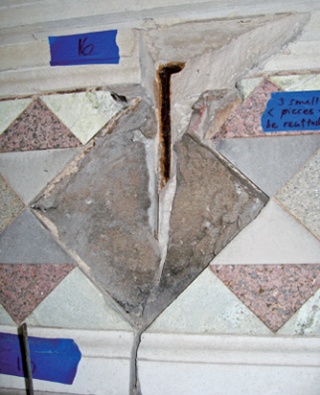
- removal of redundant fixings and corroding embedded iron cramps which have caused spalling on the face
- indent repairs for large losses, areas of decay or damage
- and mortar repairs for small scale losses and areas of damage, such as fixing holes.
To achieve a durable and visually acceptable mortar repair, a number of parameters must be specified and followed:
- preparation of existing stone
- reinforcement
- mortar mix (binder and aggregate types)
- protection and curing.
In the case of open joints in projecting elements (cornices, copings, plinths and bands), it is typically better to grout the joint to ensure complete filling before pointing the joint face. This depends on the depth of mortar loss but where joints are degraded to a considerable depth grouting will be the only way to ensure that voids are thoroughly filled. Proprietary grouts based on hydraulic lime may be used, depending on composition and strength. Typically, a suitable mix for joint treatment and mortar repairs will be composed of blended aggregate (usually crushed Portland stone and an appropriate sand) and natural hydraulic lime of a grade to suit the level of exposure. It is essential to control moisture content and drying when executing any lime-based repair, using measures such as pre-wetting and protection with sheeting, as rapid drying will result in powdering of mortars and grouts and failure of the repair.
When defects are so extensive that the integrity of the block as a whole and its ability to function and shed rainwater is compromised, or where the number of repairs required to restore integrity would be unreasonable, replacement is the best option. This condition may entail overall surface weathering and erosion or a combination of various defects, such as fractures, spalls and erosion. In most cases it is pointless to ‘reface’ a complete stone in this condition with mortar. Unfortunately, such repairs are commonly found on historic buildings, often in severe exposures and without adequate reinforcement, and need to be removed.
 |
 |
|
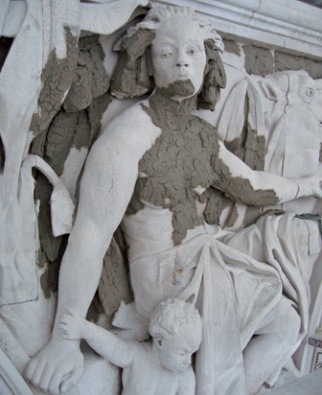
| Corrosion and expansion of imbedded iron cramps, a very common problem requiring repair of the resulting surface spalling and fractures | Plain clay poultice: a useful technique for the localised removal of soiling on sculpture, it is very gentle and avoids the marked contrast that can occur between cleaned and untreated areas when using chemical cleaners |
CLEANING
Cleaning, and each type of stone repair, should always be subject to trial to determine the best methods and to set parameters. Provided that heavy black soiling deposits have not developed, which is unusual now in London, Portland stone typically responds well to water cleaning. In the past, flood cleaning using large quantities of water was normal. In current practice, water delivered from fine sprays provides sufficient water to dissolve and mobilise the soiling that develops in urban areas. Some brown staining (thought to be mobilised from within the stone by water) is likely to emerge after cleaning, as the stone dries out. This normally occurs in areas of past water penetration, such as around open joints and fractures, on projections, or where staining was visible before cleaning. Plain clay poultice will typically reduce this brown staining, which also recedes with exposure to sunlight.
Where soiling or staining is not water soluble it may be necessary to resort to chemical cleaning agents or poultices. For example, oil staining and metallic staining from iron or copper will not respond to water cleaning. Various proprietary products are available for treatment of these and other types of staining. It is normally best to trial chemical cleaners in unobtrusive areas as they can be overly effective and the contrast between clean and untreated areas can be stark. For water soluble staining the plain clay poultice is gentler and avoids this problem of contrast.
SCULPTURES
Sculptures should be treated as distinct elements from the masonry and may require specialist conservation treatment. Some principles apply to both masonry and sculpture: the need to prevent water traps as far as possible and cleaning to reveal detail and facilitate future survey work. However, sculpture is more vulnerable to damage, particularly in the context of cleaning. It may be necessary to provide temporary protection to prevent accidental impact damage in the course of work. Initial survey should identify the need for any special cleaning materials or techniques, as well as vulnerable areas which might need treatment, for example mortar repairs to protect or prolong the life of detail.
~~~