
Restoring a Georgian Terrace
Queens Road, Peckham
Eleni Makri
 |
|
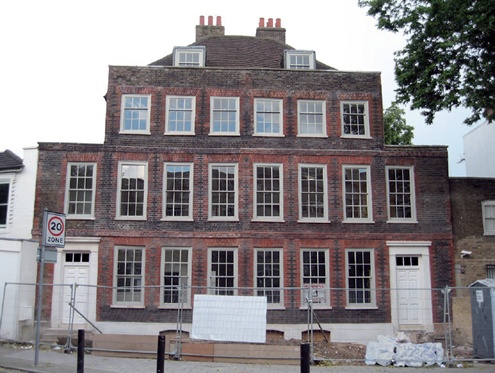
| The front facade as it now appears |
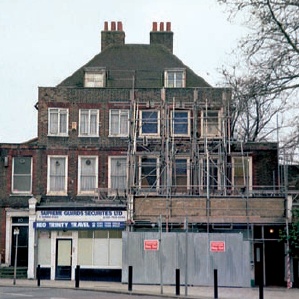
Nos 6-10 Queens Road, Peckham were listed Grade II in 1975. When part of the front facade brickwork collapsed in December 2004 the building had already been on the English Heritage Buildings at Risk register for several years as it was partially occupied and partially squatted.
The collapse allowed the owner to bring to a conclusion a long legal struggle to recover possession of the building and the author to secure the restoration of the front facades and forecourt enclosures with the support of an English Heritage London grant.
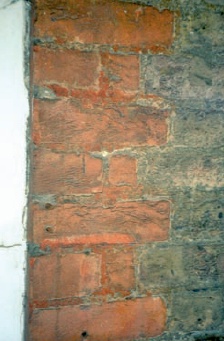
The restoration itself was to be based on the evidence of original finishes and features visible before work on site commenced. The building clearly retained original box frames at first and second floor levels, the original stucco doorcase to No 10, red bricks to window dressings and flat arches, and traces of original tuckpointing and colour coatings. Internal inspection established that one ground floor window at No 10 retained its original interior panelled linings and shutters, confirming the original ground floor window design and sill height.
 |
|
| Nos 6-10 Queens Road, Peckham following the collapse
of the front brickwork in late 2004 |
Despite the collapse, it transpired that the front brickwork was otherwise structurally sound and that it consisted (typically for the period) of a two-brick solid construction dressed externally with a single skin of decorative brickwork of stretchers and half snapped headers. This was the element in the brickwork construction that became detached from the rest of the brickwork and partially collapsed in 2004. As a result, there was no need to take down and rebuild the whole of the front wall. Instead, the finishing single brick skin could be pinned back using stainless steel rods anchored to the joints behind and, where it had collapsed, rebuilt and fixed back to the sound brickwork in the same way.
The listed building dates from around 1715 and was constructed as a pair of residential villas each with lower ground floor, upper ground floor, two floors above and an attic. The addition of shops to the original forecourts in late Victorian times and subsequent commercial use had resulted in significant changes to the original external brickwork at lower and upper ground floor levels including alterations to the original openings and the rendering of the originally exposed brickwork as part of the interior of the shops.
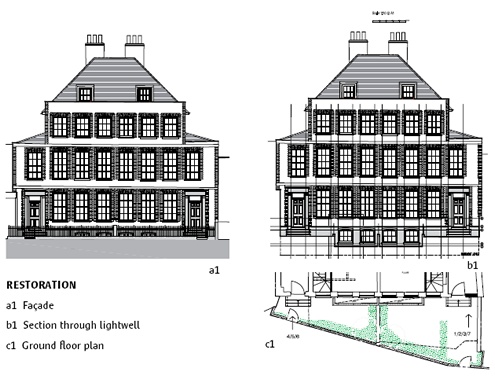
The demolition of the Victorian shop front and the roof of No 10 was a relatively easy exercise and importantly it yielded significant and unexpected new archaeological evidence that was of enormous assistance to the restoration work. The removal of the internal render uncovered extensive areas of extremely well preserved original tuckpointed Georgian brickwork, which could be retained unaltered. The Portland Stone sill of the original window at upper ground floor level at No 10 was found to have been chipped back level with the brickwork so that the wall could be rendered flat. Directly below, an original cellar window with an arch lintel and very well defined outline was uncovered along with the floor of the original lightwell and its perimeter retaining walls. The jamb lines of an adjoining blocked cellar window revealed a two-window cellar and one lightwell for each villa. Evidence on the wall suggested the existence of a rendered plinth to contain these cellar lights.
The shop structure at Nos 6-8 proved more difficult to remove as it incorporated concrete beams embedded in the original upper ground floor window openings directly underneath surviving flat arches. The removal of the internal render revealed later brickwork of flettons and a completely blocked-up cellar front wall. In order to restore the original appearance, the brickwork was removed to a depth of 60mm and then dressed with reclaimed bricks matching the original plums and reds of the surviving Georgian front. The cellar windows were recreated using the geometry that emerged from the survey of the original (blocked) cellar window that was found next door at No 12.
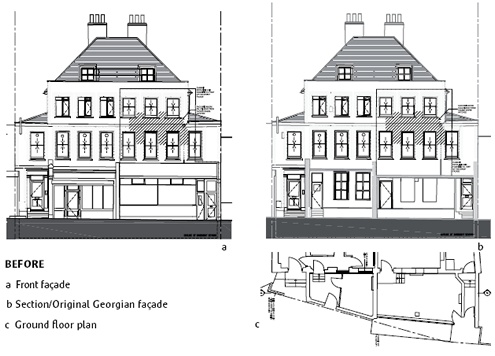
The removal of the shop front and internal render at Nos 6-8 revealed an original element of tuckpointed brickwork which had originally provided the divider between the window of the upper ground floor and the front entrance door, confirming the original location of this door and the missing doorcase. These findings are recorded in the elevation, section and plan drawings reproduced below.
The overall approach to finishes was to incorporate the original finishes where traces of these had been found and to reproduce them where they were missing. The finishes included the replication of the black stopping mortar which had provided the basis for the tuckpointing to the main brickwork and the red stopping mortar to the cornice and opening dressings. The missing portico was reintroduced in its original location along with new front doors and fanlights consistent with the period. The colour of the windows and doors matches the original lead-based paint of the original ground floor window and its architrave, which had survived behind later Victorian joinery work.
For a number of practical reasons, it has not so far been possible to install the cellar windows and to restore the lightwells and the forecourt enclosures. The conversion of the building into six apartments will combine upper and lower ground floors for which appropriate headroom will need to be achieved at lower ground floor level. The excavations for this will require the lightwells and cellar windows to be constructed afterwards.
 |
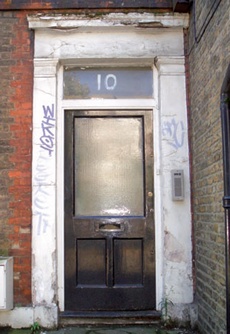 |
| Front door at No 10 before restoration | |
 |
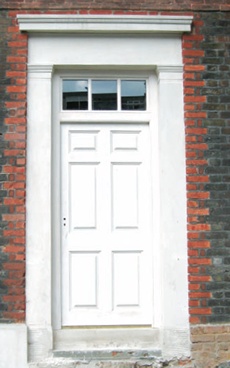 |
| Restored front door at No 6 |
One of the most complex aspects of the project was to have adequate provisions made for a flexible approach to the restoration where the exact nature of the work required was difficult to predict. For example, there was a strong possibility that the original external brickwork at upper and lower ground floor levels, concealed by the later render, survived in a defaced condition or perhaps had not survived at all. In order to deal with this possibility, the contract provided rates either for re-facing the brickwork with salvaged matching bricks or for rendering it with stucco. As it turned out, large areas of original tuckpointed brickwork were uncovered in an excellent state of preservation, which justified the re-facing with salvaged bricks of those areas which had been replaced with 20th century brickwork. The overall project therefore combined the conservation of elements of the original elevation with the conservative restoration of missing features identified by the archaeological evidence that was uncovered during the implementation stage.
The work achieved a commendation at the 2007 Georgian Group Architectural Awards in the Restoration of a Georgian Building in an Urban Setting category.
 |
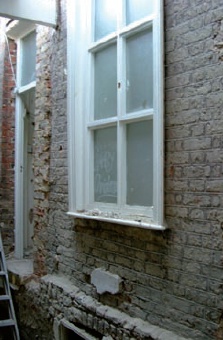 |
| Traces of original tuckpointing and colour coatings | Original box sash window |
~~~