
Making the Most of Quinquennials
Jonathan MacKechnie-Jarvis
 |
||
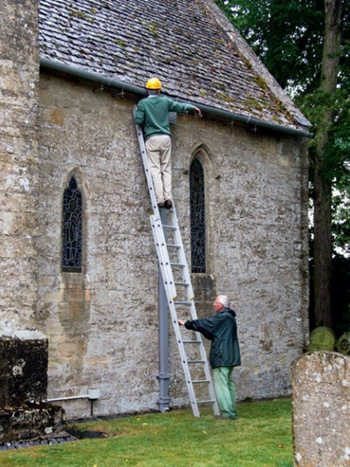
| Heavy rain is good for a fabric inspection: Toby Falconer at work at Cold Aston, Gloucestershire |
The Church of England’s Inspection of Churches Measure 1955, which first set out the requirement for the quinquennial inspection (QI) of churches, has now been in force for over half a century. Its origins had a lot to do with the early grant-making bodies, such as the Pilgrim Trust, which were struggling to cope with urgent requests for funds as parishes tried to address fabric deterioration caused by the long years of wartime and post-war shortages of materials and labour. There was a feeling that fabric crises were popping up out of a bottomless pit and what was needed was advance warning and prioritisation.
At first, the new requirement that each consecrated church must be inspected every five years by an approved architect was greeted by parishes as yet another burden, administrative as well as financial, but it has come to be seen by many, both outside and inside the Church of England, as a vital discipline which has paid great dividends over the years.
The purpose of this article is to examine how parishes can make the most of the inspection process and its follow up. The QI, after all, is something that every parish has to do, and to pay for. It makes sense therefore to get the best out of the system and from the services of the ‘QI consultant’. (Although the term ‘church architect’ is still commonly used, for many years chartered surveyors with conservation skills have been eligible for inclusion on the list of approved practitioners. To avoid tedious repetition of ‘church architect or surveyor’, the term QI consultant is used here instead.)
It is often said by those who work in Church of England dioceses that there are 43 ways of doing everything. The Inspection of Churches Measure laid down a general principle, but it is up to each of the 43 dioceses to make its own scheme under the Measure setting out precisely what is expected. Similarly, each diocese has its own method of appointing of QI consultants, the setting of fees and the instruction process for the inspection itself. For instance, in the Gloucester diocese, once someone is appointed to the approved list, he or she may be used by any parish to do its inspections without further reference to the diocese, although in practice the DAC secretary is often consulted when changes are made.
By contrast, there are some dioceses where the individual appointment needs to be approved and/or where there are sub-groups within the approved list such that only certain practitioners are approved to deal with say Grade I buildings. Regarding the inspection fees, a wide range of methods exists. Probably the most common scheme is to categorise churches as ‘small’, ‘medium’ or ‘large’ (not an easy process in itself) and to have standard fees relating to these groups. Some dioceses have no recommended fees at all and leave it to the parish to negotiate with the architect.
One could argue that greater standardisation would be helpful, especially to the hard-pressed practitioners, most of whom have complained for many years that church inspection work is not remunerative and that the system needs to be reviewed. But for now let us concentrate on the broad issues of the inspection process, and how it can best be used to benefit the parishes.
APPOINTING A QI CONSULTANT
Every DAC secretary will be familiar with the plaintive phone call from a parish officer asking how one sets about appointing a new QI consultant. In the next few seconds one tries to remember who their current one is, who the personalities in the parish are and what might have gone wrong with the professional relationship.
To help the appointment process some DACs provide guidance notes for parishioners. Gloucester DAC’s guidance, for example, is aimed at helping to manage expectations and to prompt the people responsible for the selection to ask appropriate questions. It will usually pay dividends for parishes if they take the appointment process quite seriously. Often the best thing is for two or three members of the PCC to meet a small shortlist of possible candidates. It may be helpful to telephone other parishes for which each candidate has worked.
It is probably better for the selectors to meet the candidates in their offices than at the church: you can learn a lot from the style of the practice and the resources at its disposal. How will your church work fit in with the sort of projects which the practice normally undertakes? You can take some photographs and a plan of the church so as to have something to discuss.
It’s very important at that meeting to ask about fee structures. The QI fees are usually laid down in advance, but the PCC needs to be quite clear about fees for subsequent repair work and, even more importantly, for general advice.
THE RELATIONSHIP WITH THE QI CONSULTANT
One of the great missed opportunities in the care of churches field is that PCCs tend to use their QI consultant every five years for the quinquennial (when they have to), and as little as possible in between. It has been suggested many times that ideally the relationship ought to be rather like that with the family doctor – in other words somebody to consult whenever one is in doubt about anything. Although well meant, this analogy is rather naive, because by and large we do not have to pay to go and see our doctor. Many PCCs are frightened even to speak to their QI consultant, in case the imaginary taximeter starts to whirl.
 |
||
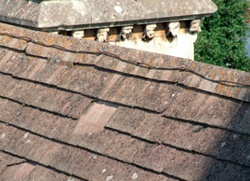
| Photograph taken from a cherry picker at St Peter’s, Cheltenham: this kind of access can give an invaluable close-up view of roof defects |
You therefore need to ask a prospective candidate: ‘What is your attitude to charging for casual advice?’ The fact is that most church QI consultants are very happy to be consulted informally and will not charge unless and until they need to make a special journey to the church or to produce written work such as an instruction for the builder. The wise churchwarden or fabric officer will therefore not hesitate to make a call, which may well set his mind at rest or may result in an offer such as: ‘I will be passing the church next Wednesday. Shall we meet there and have a quick look at it?’ At this stage there will normally be no fee, but for the health of the professional relationship, the PCC does need to be very clear what constitutes fee paying work and how much the bill will be when that stage is reached.
Sadly, many of the difficulties which crop up between PCCs and their QI consultants are due to a failure on both sides to look each other in the eye and discuss what professional services will cost. PCCs for their part need to understand that a professional practice cannot run on thin air and that time-consuming work needs to be paid for. The QI consultant also needs to acknowledge that formal professional work such as preparation of a specification will be inordinately expensive if the work in question is very minor. More of that later.
PREPARING FOR THE QI
Let us now assume that the date for the next quinquennial survey has been set. How should the PCC prepare, so that the best use is made of the time?
Many QI consultants will set out in a standard letter quite clearly what they need, which essentially boils down to safe access to as many parts of the building as possible. The QI consultant cannot report on conditions if there is a locked door preventing access. Make sure therefore that every key is available, including boiler room and tower.
The next stage is to think about high-level access, other than the tower top, which is usually straightforward. One of the questions to ask at the selection interview is whether the QI consultant is content to use ladders – always provided that these are safely fixed. The answer should be an unequivocal and cheerful ‘yes’. Depending on the physical characteristics of your church, it may suffice to bring in a competent local builder with good ladders. In some cases, the parish may have suitable ladders available, but make sure that the QI consultant is going to be happy using them and that sufficient able-bodied people are available to get the ladders into a safe position and to hold the bottom safely.
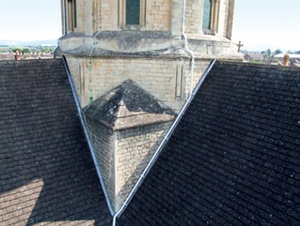
For some churches, the only way to get up to high level parts is with a cherry picker. This will add considerably to the cost of the exercise, but it may be money well spent. What is the point of paying £500 for the quinquennial if the findings are prejudiced by the inability to get a close up view? It may cost an additional £300 to bring in a cherry picker, but this could dramatically enhance the value obtained from the report.
Furthermore, the cherry picker can be used in other ways, for example to clear gutters or to change light bulbs, as part of the same operation. Loose pieces of masonry can be brought down for safety using the cherry picker. But if you are planning to do this, make sure that the QI consultant is aware that he or she is expected to go aloft. If you are hiring a cherry picker, you will need to be very precise about timings, so that the QI consultant can make the best use of the equipment without unnecessary delay. Ensure that plenty of photographs are taken while you have the opportunity to get close to high level stonework, etc.
THE LOG BOOK
 |
|
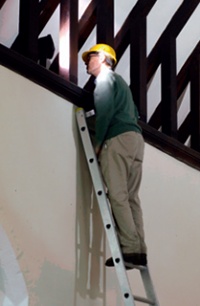
| Toby Falconer examines the wall plate |
The QI consultant will want to see the parish’s log book, so this will be a good opportunity for the wardens to check that it is up to date. Not all parishes are equally conscientious in the way they maintain this important document. At its best, it can be a dossier of detailed information, supplemented with photographs, copies of repair paperwork from contractors, and so on. It is more important that it is comprehensively maintained than that it follows any particular laid down format. It is of no use whatsoever, of course, if it has been mislaid.
It is helpful if the report states clearly whether the log book was produced, and if it was, it should form the basis of the customary list of works carried out since the last inspection. This list should indicate which (if any) of these works were supervised by the QI consultant.
Apart from the log book, it may be helpful to have the inventory available, together with details of any regular servicing arrangements such as boilers, fire extinguishers, etc. These all have implications for the wellbeing of the building, and the QI consultant should take note of them. The QI consultant should also be made aware of any standing arrangements with local builders, for example for gutter-clearing or attention to minor repairs.
In the Gloucester diocese, a new service known as ‘GutterClear’ is intended to help the QI consultant’s work by making available reports and photographs taken as part of the maintenance exercise, and it is hoped that similar schemes will gradually start in other parts of the country.
SAFETY AND SECURITY
If you have a ring of bells in your tower, ensure that the bells are down on the day of the inspection, and check with the tower captain whether there are any issues which need to be drawn to the QI consultant’s attention. After the inspection is finished, make sure that all doors are locked and that ladders have been stowed away properly.
FOLLOW-UP
Many QI consultants offer to come to a PCC meeting to discuss the findings of their report, this often being included as part of the service. This is well worth taking up. It enables people to ask questions and to meet their consultant, who is otherwise only seen by the churchwarden or fabric officer.
The format and content of the report is another area where standardisation has been suggested over the years, but there is little sign of it to date. Many QI consultants are now including a ground plan and/or roof plan of the church, which can be very helpful, and annotated photographs also bring the report to life and should be regarded as essential. For the DAC secretary or archdeacon, a covering letter drawing attention to any outstanding issues can be very helpful, as there is not always the time to go through detailed paragraphs in quite the way that the recipient parish is likely to.
The QI consultant is expected to prioritise works. Typical categories are ‘urgent/immediate’, ‘within 12 (or 18 months)’, or ‘within five years or more’.
 |
||
| Another view from the cherry picker, closing in on an inaccessible central tower at St Peter’s, Cheltenham |
Some QI consultants attempt to put budget prices against their recommendations for dealing with defects. This too can be extremely helpful to parishes, but one can understand why some consultants are very cautious about doing it. Without a detailed exercise by a quantity surveyor (which is an expensive proposition) one cannot be very certain about the reliability of the figures quoted. But from the parish’s point of view, a strictly broad brush indication is a tremendous help. Are we talking about £1,000 or £10,000?
Some people regard the traditional style of a QI report as rather ponderous, which is understandable. We need to see the wood for the trees: some reports have a bad habit of expending the same number of words on a minor matter such as a bit of scattered woodworm or a loose door handle as they do on the state of a major roof slope. The PCC needs to focus on the big issues which ultimately could prove life threatening to their building, such as the roof, the stonework, the drainage and so on.
To be fair to the QI consultant, it is notoriously hard to say when, for example, a given roof slope will come to the end of its life – whether it can stagger on for another five, 15 or 25 years. The wise PCC will want to get the most accurate information possible on the things that really matter, although this may mean a more detailed exercise, perhaps with a competent builder helping the consultant by carrying out some investigative work, which would otherwise be outside the scope of the QI.
LIMITATIONS OF THE QI
Too many PCCs make the classic mistake of going to a builder with an extract from the QI report and a request for a quotation. The difficulty is that the QI report merely sets out the defects and a general approach to their remedy, and that is not the same as a specification for the necessary remedial works. It does not attempt to set out the detail of methods and materials, nor does it cover the essential preliminaries which need to be agreed before work starts, for the protection of the PCC.
Where major works are involved, such as the relaying of a roof slope, there will be no alternative but to obtain a formal specification, which is a major document. It is only fair that this work should be offered to the QI consultant, who in any case will usually be best placed to undertake it.
Minor works arising from the QI are more difficult, because as has been noted above, the cost of formal paperwork may be out of proportion to the cost of the works. There are various compromise ways forward. For example, the QI consultant might meet on site with the PCC’s usual builder, and a clear understanding can then be reached on a range of minor works.
FIT FOR PURPOSE?
The QI system has long since proved its worth as an essential part of the proper care of a church building. On the other hand far too many parishes fail to take the simple steps needed for proper preparation and follow up. Without these, the QI’s potential cannot be realised and its cost will be at least partially wasted. Following the advice above should help ensure that the parish and its consultant will together make the most of the opportunities presented.