
Non-Contact Recording and Replication of Cultural Heritage
Annemarie La Pensée
|
Figure 1 (top
left). Figure 2 (left).
Figure 3 (above ).
|

Originally pioneered in the 1980s within the automotive and aeronautical industries, 3D recording using laser scanners has been exploited for a vast number of diverse applications. From manufacturing to modern art, product design to film production, the ability to digitally record an object in three dimensions has radically changed the way we produce virtual images and environments.
Most documentation of cultural artefacts and sites relies primarily on photography. There are however, situations in which it is invaluable to have a highly accurate three-dimensional record, such as can be provided by employing 3D laser scanning system.
Currently there are two types of laser scanner available. Those that operate by a time-of-flight (TOF) system, and those which calculate the location of a point on a surface using triangulation. Once a scanner has obtained a data set, the data is post-processed prepare it for its end use.
TOF scanners are used extensively in the fields of architecture and surveying. They emit a spot of laser radiation and the time taken between the incident radiation being emitted from the scanner, and the reflected radiation to be detected, provides a range measurement. Such a scanner can scan the façade of a building, with a point separation of around five millimetres, within hours (to an accuracy of approximately 2-3 mm), or even minutes (to an accuracy of approximately 5mm).
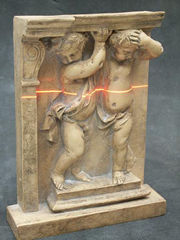
In contrast, triangulation based scanners project a thin stripe of low-power laser light onto the surface of an object (see Figure 1). The reflected light is recorded by an off-axis digital camera. As the angle between the scanning beam and the sensor is known, the location of points along the stripe of light can be calculated. Under ideal conditions, the resolution and accuracy of such systems can be sub-millimetre. While the raw data obtained by 3D laser scanning does provide the information required for some applications, usually this ‘point cloud’ is converted to a wireframe mesh. This polygon mesh data is then post-processed to prepare it for its end use. Post-processing includes filling small holes (caused by obstructions in the path of the laser light) and cleaning-up the data. Polygons that are inverted or crossing one another can arise during the complex calculation performed by software during the meshing process. Unclean areas of data can also be caused by scanning dark, shiny, or crystalline surfaces that absorb the laser beam or reflect it specularly. Decimation may also be applied at the end of this stage of the process to reduce unnecessary data. Areas of low detail can be made up from larger, and therefore fewer, polygons than areas of high detail, which require a denser mesh to define them. In this way the overall file size can be reduced, although care must be taken not to lose resolution or detail by over decimation of a data set. A finished data set is shown in Figure 2.
Recording in 3D can produce detailed archives of important objects. The virtual image recorded is not affected by the ambient lighting at the time of data capture (as is the case for photographs). In fact, the image can be lit from any angle, allowing surface details to be examined closely. Moreover, data can be transferred easily between institutions around the world, allowing access for a wide audience to objects that cannot be moved.
The data produced by laser scanning can also be transferred into virtual environments. This means that objects can be placed into a historical context in computer simulations. Such images enhance museum displays and bring together objects from around the globe in ‘virtual galleries’. Scan data can also be used for digital reconstruction of sculpture and architectural fragments, to examine what a damaged piece might have looked like when it was intact, without interfering with the original.
Combined with rapid-prototyping technologies, the data obtained from 3D scanning allows accurate replicas of objects to be produced. Processes such as stereolithography, 3D printing or object-layermanufacture (and there are many others) can produce replicas in a variety of synthetic materials, such as resins and fused powders, from the data obtained from 3D scanning. Computer numerically controlled (CNC) machining uses the data to control the tool path of a drill mounted on a robotic arm, as it moves across the surface of a block of material. In this way, replicas can be produced in their original material, such as marble, granite or slate.
 |
|
| Figure 4. The Garden Temple at Ince Blundell Hall |
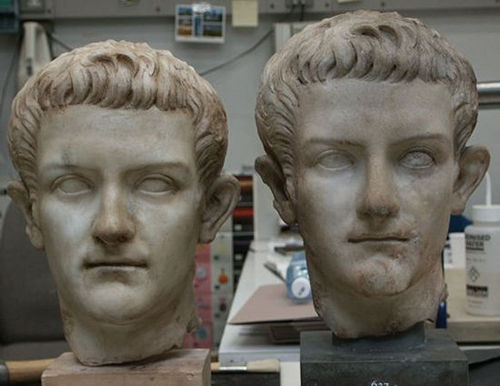
When curators at the NY Carlsberg Glyptotek, Copenhagen, wanted a marble replica of a life size marble head of the Roman Emperor Caligula, scanning and replication provided the answer. The head, seen on the right in Figure 3, is thought to have been carved around 37 AD and would originally have been painted. Unusually, the piece still has traces of the original polychromy. Having analysed the remaining pigments in detail, the curators wished to re-create a possible colour scheme on a replica object. Production of a replica would traditionally have meant taking a mould directly from the surface of the sculpture and using the mould to produce a plaster replica. In the case of Caligula, the production of a plaster replica would be unacceptable, as the process of taking a mould would damage the original delicate painted surface. In addition, painted plaster would be a poor substitute for the recreation of polychromy on marble. Alternatively a sculptor could copy-carve a piece. The copying of artworks by hand does not have the problems associated with moulding, but depends on the skill of the sculptor, and can become a re-interpretation, rather than a replica.
 |
|
| Figure 5. Marble replica (right) and original (left) marble Roman relief |
Scanning the marble head of Caligula and post-processing were undertaken by Conservation Technologies, Conservation Centre, (NML,) Liverpool. Scanning using a Modelmaker (3D Scanners UK) laser scanner (a triangulation based system) took three and a half hours. The post-processing of the data set took one week to complete and resulted in a finished data set of approximately two and half million polygons, (approximately 70 MB). A screenshot of the final data set is shown in Figure 2. Machining was carried out by Hothouse Ltd, Stoke-on-Trent. Using a five-axis CNC machine, it took six days to cut the replica Caligula from a new block of Carrara marble.
When machining was complete, the replica piece came back to the Conservation Centre for a small amount of hand finishing, which included removing small, localised, drill markings, using a fine abrasive paper. To aid the sculpture conservator in this process, a thin watercolour wash was applied to the surface of the replica, as it is difficult to see details on a new ‘clean white’ marble sculpture clearly. The hand finishing took 12 hours to complete and the replica can be seen next to the original in Figure 3. The replica is on the left. The replica was re-painted by the Glyptotek Museum in Munich to show how the original head is believed to have looked with its fully polychromed surface. The painted replica has been on display, next to the original, in Munich and Copenhagen as a part of a major exhibition entitled Bunte Götter (painted Gods).(1)
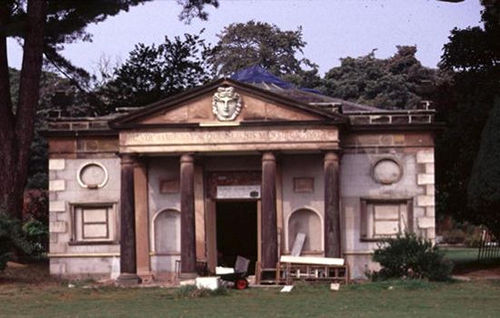
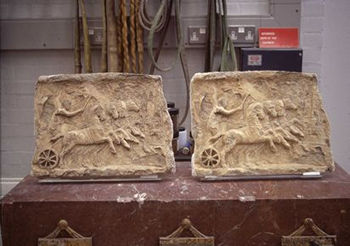
As part of the restoration of a Garden Temple at Ince Blundell Hall (Figure 4 ), it was necessary to remove two pieces of classical sculpture from the fabric of the building. They were badly deteriorated as a result of having been exposed to a harsh maritime and industrial environment since the 18th century. The panels were to be replaced with accurate replicas to preserve the integrity of the building. Both of white marble, the reliefs date from the Roman Imperial period and depict a charioteer and lion. The panels were in an advanced state of decay and the surface was too friable for moulding to be considered an option. The reliefs were scanned with a Cyberware scanner, the final file was transferred to a three-axis CNC machine, and the replicas were cut into new Carrara marble. Once finished, the replica reliefs were patinated to ensure that they would blend into their environment. In addition, a protective coating was applied. One of the replica panels can be seen in Figure 5. The original is on the left, the replica on the right. The replica panels were placed on the façade of the Garden Temple. The original panels were cleaned and conserved, and are now on display in a protective indoor environment.(2)
Prior to production of a replica object, the data obtained by laser scanning can be scaled up, allowing artists to realise their small-scale maquette on a large scale in resin or even marble. By scaling down an object, smallscale replicas for commercial sale can be made. Scaling can also be used to allow for shrinkage in the casting of metals such as bronze. This is important when making new masters and moulds for casting. This technique was recently applied to a bronze fairy’s head from George Frampton’s 'Peter Pan' (Sefton Park, Liverpool), and an arm on a lead Hercules in Shrewsbury.
Replicas of objects enable greater public access to works of art, for education, study and appreciation. Replica objects can be handled in ways the original cannot, allowing valuable hands-on sessions for children and the visually impaired. In addition, conservators are often faced with the dilemma of removing a piece of heavily weathered sculpture from its original location, to protect it from further deterioration, whilst finding a way to retain the integrity of the original surroundings. The highly accurate replicas produced using non-contact recording and replication techniques can solve such dilemmas. Non-contact 3D recording and replication is now being employed by the private and public sectors alike, as a means of preserving works of art without compromising their original context or accessibility.
Notes
-
Jan Stubbe Østergaared, ‘ClassiColor, Farven Antik Skulptur’, NY Carlsberg Glyptotek, 2004
-
PS Fowles, ‘Non-Contact Replication of a Roman Relief Panel, The Garden Temple at Ince Blundell Hall’, The Journal of Cultural Heritage, Vol 1:1, 2000