
Science and Conservation
David Watt and Belinda Colston
The role of science in the conservation of historic buildings and monuments is increasing as we seek to understand our heritage in ways that require greater levels of analysis and investigation. Much of this scientific work has concentrated previously on the archaeological evidence provided by materials and methods of construction, which has increased our knowledge of both social and technological development.
The intention of this article is to explore the role of science in architectural conservation and show how relatively simple techniques can be used to develop a better understanding of the physical condition, as well as the history, of historic buildings and monuments. Such work is considered essential in planning and implementing appropriate methods of remediation and aftercare.
DEFINING THE ROLE OF SCIENCE IN CONSERVATION
Although conservation science is a clearly recognised discipline, particularly for those engaged in museums and galleries, there is currently no widely agreed definition that embraces the full range of activities undertaken by conservation scientists within the United Kingdom. Such work is, however, acknowledged to include the study of materials, conservation treatments, and the principles and practice of preventive conservation. Within the United States, a conservation scientist is defined by the American Institute for Conservation (AIC) as 'a professional scientist whose primary focus is the application of specialized knowledge and skills to support the activities of conservation in accordance with an ethical code.' (AIC, 1996). Whether it is better for a scientist to develop conservation skills or for a conservation professional to acquire the relevant scientific knowledge may be a moot point, but the key point is the importance it attaches to the ethical code that guides and distinguishes all conservation work. The application of science and scientific methods is inherent in many of the approaches taken with the conservation of historic buildings and monuments. Take, for instance, the 16 different types of professional identified by Bernard Feilden (1999, 9) as being involved in architectural conservation. In this set of 'profiles', the 'Material Scientist' is involved in ten out of the 14 identified professional tasks. The value of this broad discipline is often not fully recognised.
THE APPLICATION OF SCIENCE
The application of science in architectural conservation can range from the relatively straightforward use of moisture meters and other forms of non-destructive survey equipment to sophisticated analytical methods that are able to provide qualitative and quantitative data about specific material properties and decay phenomena. In utilising such methods, one must be clear as to what is expected and how the resulting information might realistically be used to inform or enhance a planned course of action. In all forms of analyses, it is the interpretation that is of primary importance rather than the raw data themselves. Thus, having a mortar sample analysed can tell you about the mix proportions and constituent materials, but without careful interpretation an unsuitable replacement mortar may still be specified. When taking samples for any form of analysis, it is essential to understand the need for obtaining representative data - building materials are likely to be heterogeneous and more than one sample will be required to gain meaningful information.
 |
|
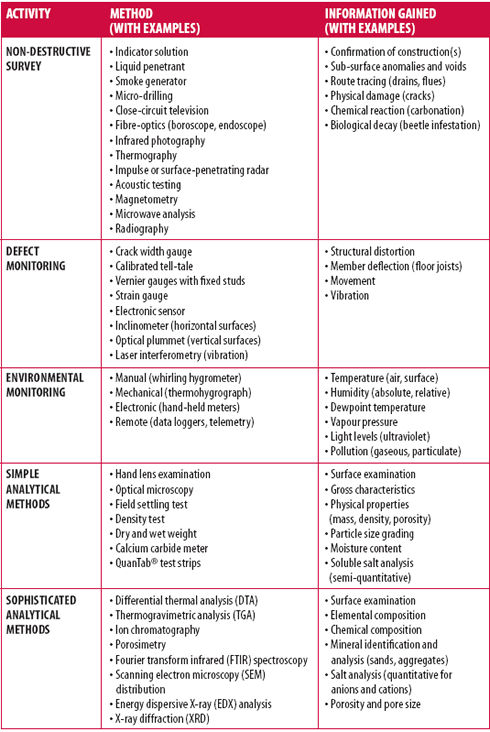
| Table 1: Summary of investigative methods |
With typically less than 10 per cent of the fabric of a building available for direct observation and assessment during a survey, the use of non-destructive survey techniques - such as impulse radar, thermography, fibre-optics, or micro-drilling - can assist in identifying and determining the condition of structure and fabric lying below ground, within the construction of the building, or hidden beneath finishes. Key information may also be gained by way of indirect methods, such as through the analysis of material samples or interpretation of remotely-gathered data. Where, for instance, the measurement of moisture content and hygroscopicity is undertaken, the need for greater accuracy might dictate the application of gravimetric analysis (wet and dry weight comparison) or use of a calcium carbide meter rather than a standard resistance moisture meter. Remote moisture monitoring may be undertaken using permanent sensors.
Similar techniques may also be used to monitor conditions in order to provide absolute or relative data over a defined period of time. This might include structural distortion and movement, material deterioration, and environmental parameters. The range of scientific methods that might be of use to the built environment professional involved in architectural conservation is given in Table 1. It is important to be aware that each has its own specific advantages and limitations, and that the more sophisticated methods are not always necessarily the best choice. Useful information may often be obtained by using relatively simple techniques.
CONCLUSION
Science undoubtedly has a growing part to play in the conservation of historic buildings and monuments. As we require more information on which to base increasingly complex solutions, our need to better understand the building or monument - including its materials, construction, defects, and environment - becomes all the more pressing. In practice, this means adopting a more analytical and rigorous approach to our work so that each and every decision is based upon current and valid information. Whilst such an approach is common to those trained as conservators, it is fast becoming the necessity for those engaged in architectural conservation. The term 'forensic conservation', first used by Martin Weaver in 1993 and defined as 'conservation practised scientifically and to such a standard that the practitioner could appropriately present any aspect of the work as expert testimony or evidence in a court of law' (Weaver, 1995, 31), might well be used as a measure of how far we have moved - or might need to move - from earlier practices.
~~~
Recommended Reading
- American Institute for Conservation 'AIC Definitions of Conservation Terminology', Abbey Newsletter, Vol 20 No 4-5, 1996
- Colston, B, Watt, D and Munro, H 'Environmentally-Induced Stone Decay: The Cumulative Effects of Crystallization-Hydration Cycles on a Lincolnshire Oopelsparite Limestone', Journal of Cultural Heritage, Vol 4, pp 297-307, 2001
- Feilden, B 'Architectural Conservation', Journal of Architectural Conservation, Vol 5 No 3, pp 7-13, 1999
- Watt, D 'Investigating the Effects of Site and Environmental Conditions on a Historic Building and its Contents', Structural Survey, Vol 19 No 1, pp. 46-56, 2001
- Watt, D and Colston, B 'Investigating the Effects of Humidity and Salt Crystallisation on Medieval Masonry', Building and Environment, Vol 35 No 8, pp 737-49, 2000
- Watt, D, Colston, B and Bülow, A Predicting Damp-Related Problems in Historic Buildings and Monuments Used for Library and Archive Purposes. Draft report prepared for The Council for Museums, Archives and Libraries (re:source), Leicester: De Montfort University, 2001
- Weaver, M 'Forensic Conservation and Other Current Developments in the Conservation of Heritage Resources and the Built Environment', Journal of Architectural Conservation, Vol 1 No 3, pp 26-41, 1995