
Signs and Signage in the Historic Environment
Michael Copeman
There is a remarkable consensus about signage among conservation practitioners: too many signs clutter up our historic towns and obscure historic buildings and townscapes. Traffic signs, in particular, should be rationalised, sited carefully and with respect for their historic context. Advertisements should be controlled. Old features such as street nameplates should be kept wherever possible. Shopfronts should be designed and made in such a way that their proportions and materials respect the building and streetscape of which they form a part, maintaining their individuality, and standard corporate fascias should be avoided. Local distinctiveness, well designed signs, careful lettering, a diversity of imagery and individual expression should be encouraged to enrich the townscape.
 |
|
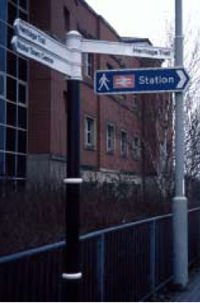
| Heritage clutter in Stoke-on-Trent |
These principles are sound but the practice is leaky. Compare almost any historic town centre with a photograph of the same place 30 years ago, and it will be clear that there has been an astonishing proliferation of signage. Standard traffic signs predominate, old details have been lost, and corporate logos prevail. To understand what might be going wrong, the assumptions in the consensus outlined above bear examination, both about the nature of the problem and how to resolve it. Although this article considers signs as objects bearing text or images in the historic environment, it should never be forgotten that signs are primarily messages, not things.
Not all signage in the urban scene is contentious. Some signs, such as traffic signage, shop signs, and advertising bill-boards, are felt to detract from the historic environment, while others, like street name plates, painted advertisements, or blue plaques, are treasured. This is not simply a matter of age or rarity. 'Clutter' is essentially a value judgement. Redundant or obsolete signage is 'clutter' because it is not old enough to be enjoyed. 'Clutter' may mean that there are too many signs, posts, boards and notices, literally getting in the way of our enjoyment of the historic scene, but equally true is the old cliché about communist Eastern Europe: that visiting Westerners found the streets without advertisements bleak and visually impoverished. Colour, lettering, individuality, and visual incongruity, are vital qualities in the urban scene.
LEGISLATIVE BACKGROUND
The diversity of signage in the urban environment is extraordinary. The most prominent and numerous are traffic signage and advertising (including shopfronts), and it is these with which conservation is largely concerned. Planning authorities can exert a considerable control over signage in historic areas, but it is largely discretionary. PPG15 (for England) (1) and the parallel guidance for Scotland and Wales set out a general approach. For example, PPG15 states that 'it is reasonable to assume' that local authorities will apply more exacting standards to the control of advertisements in conservation areas, (paragraph 4.31). Similarly, 'authorities should take advantage of ' such flexibility on traffic signage as is allowed by the Department for Transport (DfT) (paragraph 5.16).(2) A wide range of practical advice is available (see the Notes and Recommended Reading sections at the bottom of this page). Most local conservation area policies contain controls on advertising and shopfront design, and some guidance on traffic signage. Advertising and shopfronts can be controlled through the planning development control system, but traffic signs are a highways matter. In designated historic areas regional DfT offices will grant dispensations for non-standard street signs, although not enough authorities have fully effective mechanisms for securing them.
TRAFFIC SIGNAGE
Traffic signage in historic areas tends to be regarded as a necessary evil. The DfT states that: 'Modern usage of streets has demanded an increasing provision of street furniture including... traffic signs... sometimes at the expense of visual order'.(3) The guidance aims to: 'highlight... how traffic engineering and highway improvements can be designed sensitively in historic areas'. In some situations this is a wholly appropriate approach. Traffic signs depend on a standardised code, quickly understood by the passing motorist. The English Historic Towns Forum (4) and English Heritage (5) guidance, for example, show how traffic signs can be reduced in number and size. One post can serve several functions, signs can be attached to buildings, reflective materials can obviate the need for additional lighting, and many traffic signs are unnecessary and ineffective. (One might ask why smaller, more discreet signs are workable in historic areas and not elsewhere.)
On the other hand, conservation standards have become an orthodoxy. Red phone boxes, miniature road signs, York stone, black and gold litter bins and finger-posts are visual shorthand for conservation area. These features may well reflect effective management of the historic environment and 'joined-up' thinking in the local council offices. Unfortunately, they are turning historic towns into indistinguishable, bland, sterilised imitations of themselves. This is not just a British problem. In the USA, 'too many... re-done streets are over-designed. There is too much unified signage... too much good taste in general, or the pretension of it. Too may designers have the same good taste and the result is bland conformity'.(6) Area conservation is predicated on the concept of local distinctiveness. If it results in the unthinking replacement of one standard with another, it has failed.
Historic towns are gathering and stopping places. Highways engineers want to move the traffic quickly and efficiently. We must decide to what extent we want through traffic to compromise other interests, but 'conservation' strategies need careful thought. Pedestrian priority schemes can lead to an explosion of new signage for pedestrian zones, parking restrictions, loading periods, park-and-ride schemes, heritage trails, interpretation and the rest.
Ultimately, traffic is the problem, rather than road signs. However well designed, 'traffic-oriented devices and signs reinforce the message that the space is primarily for traffic'.(7) There are radical possibilities. Removing direction signs in town centres, for example, could discourage through traffic in favour of local traffic. A recent experiment in which traffic signs and signals were removed from the centres of several small Dutch towns resulted in better traffic flow.(8) The scheme depended on low traffic speeds in relatively small urban centres, and while this may not work everywhere, it could be highly appropriate to some historic towns.
ADVERTISEMENTS
 |
|
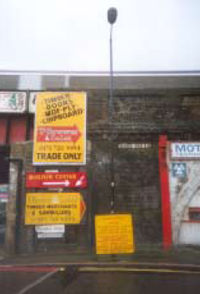
| Typical urban clutter in Clapham, London: note the old and new street name signs |
Advertising is ephemeral. Too much attention to design risks emphasising the permanence of something which will disappear of its own accord. Temporary or moveable signs may not only be cheaper but more appropriate than expensive designs, but if a business is required to make a detailed planning application for every shop sign, including temporary ones, there is no incentive to use them. If we are to maintain the character we value in old places, we must leave some things alone; let them fade, rust and decay, and make space for happy accidents and unintended juxtapositions. Not everything we value in historic townscapes is beautiful. Advertising can provide an opportunity for individuality and self-expression that need not be limited by preconceived notions of what is appropriate or tasteful.
Two well-known books from the 1960s make an instructive comparison. Gordon Cullen's Townscape (9) illustrates approvingly a corner shop haphazardly plastered with bills, posters and advertisements and calls its intricacy and colour 'delightful'. Preservation and Change, (10) an official publication which articulated many of the principles underlying present day conservation practice, shows a virtually identical shop to illustrate 'before' in a 'before and after' example of the removal of clutter. Again, appropriate signage in historic areas is a matter of taste.
In this context, diversity is an absolute virtue, but the problem is whether it can be imposed. Diversity can be encouraged, not imposed, and it emerges from use, not from the imposition of superficial visual standards. Like traffic control, advertisement policies can have the opposite effect to that intended. The chaotic parade of signs along a down-market street of small shops has a wonderful variety which gentrification and conservation area policies will eradicate. Branded shop fascias and corporate logos represent an economic reality. Only a multiplicity of uses is likely to preserve visual diversity.
OLD SIGNS
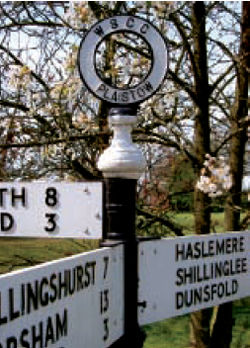
The conservation of surviving old signs ought to be straightforward. If something is old and functional, it can safely be left alone. Regrettably, local authorities are still replacing old street nameplates with new 'branded' ones. This may be a well-intentioned attempt to create local identity where historically there was none, but the result is uniformity where difference was attractive and functional. There is no reason why nearby street nameplates should all conform to a particular style, as long as they are clear. A cast iron street nameplate proudly subtitled with the name of a long erased corporation is not only charming, but often more useful than a new one which bears the logo of the new and distant unitary authority. This is a larger issue than conservation. The new signs are advertisements for a local government system increasingly disconnected from real places and communities. We value much the same qualities in old signs as we do in buildings, but we should not start listing them. Fine old lettering is a joy. The sight of an old faded advertisement painted on a gable end is one of the delights of urban life: its original message may now be obsolete but the sign acquires a new value in connecting us with the past. Old graffiti, such as the brown-shirt slogans that survive here and there, may provide an insidious reminder of our past, but they are essentially ephemera: by retaining it we may simply be encouraging further graffiti, leading to its eventual loss.
 |
 |
|
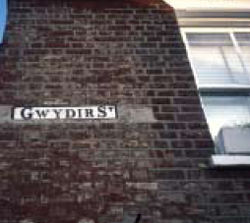
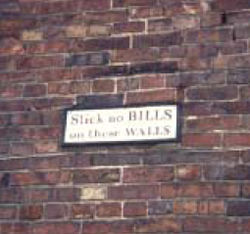
| A fine old non-standard street name sign in Cambridge | Stick no bills - elegant if not eloquent | |
 |
 |
|
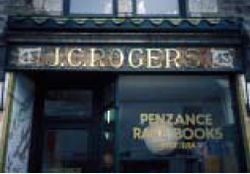
| The variety of signs, which is the product of the varied use, contributes their own character and interest to this street in Leith, Edinburgh | An old facia sign above this book shop in Penzance has been retained by the new owners and left to grow old, gracefully | |
 |
 |
|
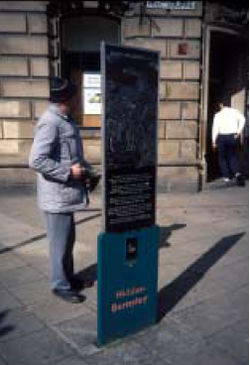
| A fine old cast iron fingerpost in Sussex | Interpretation board in Barnsley: a well intentioned design but giving too much emphasis to the sign as an object |
LEGIBILITY
The currently fashionable concept of 'legible cities' is underpinned by the idea that somehow we have lost the ability to understand places and that we need more signs to do so.(11) The preoccupation with 'branding', about how cities need to 'rethink how they present themselves... communicate more effectively with their users' is actually about marketing. The ubiquitous brown tourism signs and the 87 official and internationally incomprehensible icons which adorn them, are another form of advertising masquerading as information. Signs do not explain places; they direct our experience; and this is something far better done for yourself.
Traditional towns are legible; the relationship of church, street and market place, bridge, pub or guildhall is self evident. There is no need to explain that one building has higher status, or that the square is the centre and meeting place of the community. Even changing functions do not obscure this, and combined with simple nameplates few of us will get lost. The Barbican, an estate in the City of London, is notorious for its disorienting design and confusing topography. It lacks the familiar markers of a town or village so the visitor is dependent on signage.
This unwritten sort of legibility might help in the context of the Disability Discrimination Act.(12) An unthinking application of DDA standards to signage could result in ever more bigger, bolder signs. It is frequently segregation and special rules that produce the need for explanation. Perhaps these distinctions need thinking about, not the signage itself. Careful consideration of how a place works, based on the principle of equal and easy access for all, and a real understanding of its buildings, topography, development and uses ought to reduce the need for signs and make the place easier for everyone to use, understand and enjoy.
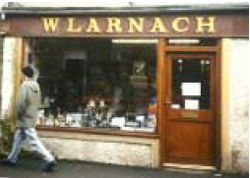
A great deal of signage is unnecessary, and reflects a failure to think about possible alternatives. Conservation can put too much emphasis on the sign as an object. Street signs are essentially modern, and often transient. There are no authentic historic traffic signs. The purpose of a street sign is to convey a message with as little interference from its physical form as possible. Signs may contribute to the townscape, but disguising a sign is as much contradiction of its purpose as trying to make it unobtrusive. In contrast, there is a sad lack of good lettering today, although it is the best means of strengthening the message without weighing down the object.
 |
|
| Wick, Caithness; the sign is the architecture |
Too often a sign is a cheap substitute for decent services. Regular effective rubbish collection and street sweeping will do more to improve the environment than a sign asking people to use an overflowing bin. The ubiquitous clumps of empty signposts (although they are useful for locking up bikes) are a consequence of careless management and poor communication, not bad design or inadequate conservation policies. Removing redundant posts and using a single existing one is both cost effective and an environmental enhancement.
Towns and cities must contain a mass of conflicting interests, and conservation area management at its best is a model for working together to balance them: but why should high standards be restricted to historic environments? Ideas about community empowerment from sources like David Engwicht's book Street Reclaiming have roots in alternative politics but could be read as a paradigm for historic areas: human and not mechanical, local not remote, distinctive not standardised.
Although signs are perceived as especially problematic in the historic environment, the underlying issues concern the public realm as a whole. Signage does not exist in isolation. It serves a purpose, and the best sign is the one that serves its purpose most effectively. The worst signs say one thing and mean another: nameplates or signs to tourist attractions which are really corporate advertising; information boards that are really bad sculptures, finger posts pointing to an imaginary past. Gigantic billboards are not, in themselves, works of the devil, but in the wrong place they are a blight. Signs do proliferate without control and obscure buildings, vistas and details, but the signs are only a symptom. If a town is bisected by trunk roads and its shops are all chain stores, that's what the road signs and shopfronts will say.
~~~
Recommended Reading
- Conservation Area Management - A Practical Guide, EHTF Report No 38, 1998
- Streets for All, English Heritage/Government Office for London; 2000
- Planning in Small Towns, Planning Advice Note PAN 52, The Scottish Office, 1997
- Urban Design Compendium, Prepared for English Partnerships and the Housing Corporation by Llewelyn-Davies in association with Alan Baxter and Associates, London, 2000
Notes
| (1) | Planning Policy Guidance: Planning and the Historic Environment (PPG15), Department of the Environment/Department of National Heritage, 1994 | |
| (2) | Street Signs Manual, Department of Transport | |
| (3) | Traffic Management in Historic Areas, Department for Transport Traffic Advisory Leaflet 01/96 | |
| (4) | Traffic in Historic Towns, EHTF, 1993 | |
| (5) | Street Improvements in Historic Towns, EH, 1994 | |
| (6) | W Whyte, City: Rediscovering the Centre, Anchor Press, NY 1990 | |
| (7) | D Engwicht, Street Reclaiming, New Society Publishing, Gabriola Island, British Columbia, Canada, 1999 | |
| (8) | The Observer, London, 30 June 2002 | |
| (9) | Cullen, Gordon, Townscape, Architectural Press, London, 1961 | |
| (10) | Historic Towns: Preservation and Change, Ministry of Housing and Local Government, HMSO, 1967 | |
| (11) | See (eg) Building Legible Cities, Kelly, Andrew, Adshel, 2001 12 Disability Discrimination Act 199 | |
| (12) | Disability Discrimination Act 1995 |