
Site Protection
Jonathan Taylor
 |
||
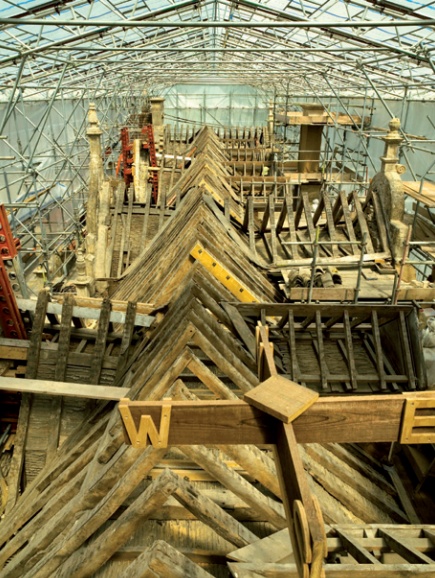
| The east range of Apethorpe Hall, Northamptonshire, protected from the weather by a scaffold roof during English Heritage’s comprehensive programme of conservation (Photo © English Heritage) |
Historic buildings are often at their most vulnerable during programmes of conservation and repair work. Vacating the place for the duration of the project exposes it to an increased risk of burglary, arson and vandalism. Building operations expose the fabric to accidental damage, and there is always the risk that even the best specified work affects the fabric in a manner that causes damage in the long term, if not immediately. The success of all building works depends on careful analysis of the issues and risks, meticulous project planning, and a continual process of monitoring. This is particularly important where historic fabric is concerned.
From the outset, responsibility for co-ordination of risk management must be clearly established and communicated. Every person involved on the site will have some responsibility for creating and managing risk, from the consultant responsible for drawing up the proposals, to each individual contractor or craftsman responsible for implementing work on site. They include, for example, the scaffolder carrying a heavy scaffolding pole, the stonemason wielding a lump hammer, and even the delivery lorry dumping a tonne of aggregate on the ground. It is therefore crucial to establish a chain of responsibility to control all the activities on site, and to appoint one person to co-ordinate responsibilities. To add to the complexity, the chain of responsibility may change as the project proceeds and different people become involved.
INVESTIGATION AND ASSESSMENT
How the initial investigation of the existing fabric is approached will depend on the nature of the project. A building in an advanced state of decay will require a more cautious approach than one that is habitable, since the investigation itself will entail obvious risks to the structure and to personal safety. However, the same principles apply. In addition to a general survey to record the structure as it stands, a more detailed examination of some parts of the fabric will be essential. In particular these will include areas where it is suspected that there may be defects requiring remedial treatment, and wherever proposed alterations are likely to affect historic fabric.
Vulnerable fabric needs to be identified, both to establish the scope of the project, and to determine how the work can be carried out without endangering personal safety, and with minimum risk to the fabric itself. Some defects may be obvious, but others will have to be investigated by opening up, or through the use of non-destructive investigation techniques. These might, for example, include thermography to establish moisture paths and structural continuity, impulse radar to locate metal cramps, and core-drilling timbers using a micro-drill to determine the extent of timber decay.
Several visits may be required by different specialists where the issues are complex, backed up by researching archival sources. Even then, a full picture of the way the fabric is performing may not emerge until much later, when remedial treatment commences.
Data gathered at this stage concerning the structural integrity of the building, the condition of its fabric, its layout and its significance architecturally and historically, feeds into the design process and, ultimately, the programming of work and the management of the site.
INSURANCE
Once the project has been designed and the necessary consents granted, the scope of the work will be clear. Under standard UK contracts, responsibility for ensuring that the appropriate insurance is in place for the works to proceed lies not with the contractor carrying out the work (although the contractor’s insurance will provide much of the cover required) but with the owner. It is therefore essential that the owner contacts the policy provider in advance with details of the work. Risks include direct and indirect damage to the property during the work, vacancy, and the value of plant and materials stored on site. The value of the property itself may rise during the work and on its completion, and where a claim is made on a property that is undervalued, it can be an unpleasant surprise to discover that the insurance company reduces the amount paid in proportion to the amount by which the property is undervalued.
PLANNING THE PROJECT
Some work on planning the project may be carried out at the design stage, but developing a detailed plan for implementing the proposals on site requires the involvement of the whole team responsible, including the contract manager and all the specialist contractors and consultants.
FIRE
The greatest risk is arguably fire, since the consequences can be so far-reaching. Obvious causes include processes that use a naked flame, such as a blow lamp for soldering pipes, and appliances that produce sparks, such as an angle-grinder. In addition, many processes also involve highly flammable materials, including the volatile organic solvents used in adhesives, paints, and damp and timber decay applications. Ignition can be caused by just one spark. Flammable materials are often introduced in the course of construction and repairs such as tarpaulins and other sheet material. Parts of the building fabric may also be highly flammable, such as dry straw on the underside of a thatched roof.
Where a process creates a high risk of fire and is considered unavoidable, it is important to ensure that there is an adequate policy in place to mitigate the risk. This would usually include having an assistant at hand with a portable fire extinguisher, heat shielding to ensure that any elements of flammable material that cannot be removed are protected from the flame or sparks, and battery-operated smoke detectors. Depending on where the work takes place, it may be necessary to limit the use of the flame to certain conditions, such as ensuring that blow torches are not used when it is windy, nor within one hour of the site closing at the end of the day. A check should also be made on the area by a responsible person an hour after the work has finished to ensure there are no smouldering elements.
To avoid the build up of fumes where
volatile solvents are used, it is most important
to ensure that there is adequate ventilation.
All possible sources of a spark should be
considered, and any electrical appliances
removed or isolated.
Smoking must be confined to specific
areas as a condition of every contractor’s
and sub-contractor’s contract, and the policy
strictly enforced.
BURGLARY, THEFT AND ARSON
The protection of a building left unoccupied is another priority. Consider each line of defence in turn. Where a building is set back from its perimeter, consider the perimeter boundary and what it is practical to exclude at this point. At the very least, aim to ensure that it is not possible to drive a vehicle up to the building when it is unoccupied.
The second line of defence may be the
envelope of the building itself, but this will
not deter villains from stripping the lead from
the roofs, so a temporary perimeter fence
may help here. Windows, doors and other
openings should be secured, if necessary by
boarding fixed from inside, ensuring that the
manner of fixing does not itself damage the
building if it is forced. Remove ladders to a
secure place, along with all tools, and make
access to any scaffold as difficult as possible.
Finally, consider individual objects
of value. Fireplaces for example are easily
stripped out, so these and other similarly
portable items should be security marked
with a property ID system (SmartWater or
SelectaDNA for example), and boarded up to
hide them from view. Details of the property
identification system should be displayed
at the perimeter to deter would-be villains,
together with emergency contact numbers.
 |
 |
|||
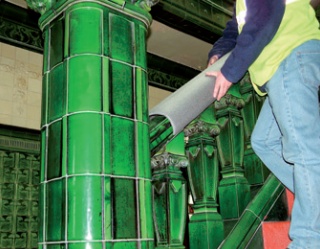
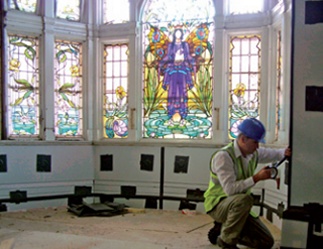
| At Manchester’s Victoria Baths the recent programme of restoration and repair required extensive protection for much of its magnificent tiled decoration. (Above left) U-profile foam protectors were fitted around the faience handrail and clipped in place with cable ties, and (above right) the walls were protected with sheets of Ockwells’ TwinShield, a twin-wall polypropylene board. These were fixed in place through holes in the boards using a low-tack adhesive tape. (Photos: Nigel Massey, Ockwells Limited) | ||||
ACCESS ROUTES
Access for equipment, materials and people needs to be carefully considered, from the perimeter of the site to the point of work.
When the materials and equipment come onto the site, where are they to be stored, and in what quantities? What effect will this storage have on the site itself? How effectively are they contained? Chemicals may be hazardous to people as well as to the fabric itself, and some materials and equipment may present hazards to other materials being stored. Safe storage may require different parts of a site to be set aside for different types of material and equipment. Weight is another factor to be considered at this stage, as the dead weight itself may cause damage to underlying material, such as paths, vaults or simply the vegetation. Grass which has been covered over for more than a few weeks will die.
Site storage must also take into account the need to access materials and move them. And the act of moving them also poses further problems for historic fabric. Access routes should be chosen to avoid proximity to vulnerable fabric, but this is rarely possible in historic buildings. Mitigation measures in fine interiors usually involve the use of foam padding and sheets of plywood or plastic padding for the protection of floors, staircases and balustrades. These must be carefully cut to fit, and fixed together to minimise the risk of them becoming trip hazards. Sheets are usually taped together at joints, and the principal traffic areas need to be checked regularly to ensure that they remain sound and have not moved. Vulnerable corners and projections may also need to be protected with foam rubber or expanding foam separated from the material by a sheet of polythene.
The weight of objects being carried also needs to be taken into consideration, particularly where large sections of stone have to be moved from one part of the site to another, and then fitted into an obscure place away from the main trafficked area. With the advice of a structural engineer it may be possible to spread the load over a wide area of the structure, but where the strength of historic structures is unknown, the only solution may be to use cranes, derricks or mobile access platforms, or to devise scaffold-based solutions.
 |
|
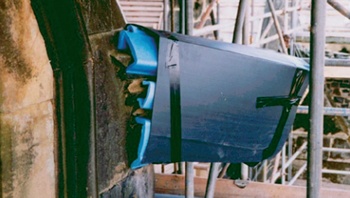
| A gargoyle at Grey Towers, Nunthorpe, well wrapped in U-profile foam protectors and TwinShield to protect it from traffic along the scaffold (Photo: Nigel Massey, Ockwells Limited) |
Scaffolding also creates risks for the structure. In some cases the scaffold may be braced by structural elements of the building, but in other cases the reverse applies, and a free-standing scaffold will be used to support the structural elements, as well as providing access to the fabric concerned.
Scaffolds need to be designed and installed with sensitivity to historic fabric, and in all but the most simple cases will require the involvement of a structural engineer who is experienced in dealing with historic buildings. Usually the scaffold will be supported by the ground but tied to the building for lateral restraint, and sheeted to protect workers from the elements. These structures can impose extraordinary loads on historic fabric when the wind blows, particularly if they are also roofed. Historic fabric may not be able to support these loads, unless they are distributed widely.
Lateral restraint often involves inserting ties through window openings to form a clamp with the exterior wall. Sash windows can be opened and partially boarded for this. If panes of glass have to be removed, these must be checked by a specialist consultant to determine that only modern panes are removed. The alternative may be to create a fixing directly to the masonry, but only if and where the masonry can provide adequate lateral restraint.
All scaffold pole ends facing the building should have plastic end caps to protect the face of the building, and careful consideration must also be given to the footings, particularly where basements project beyond the face of the building.
INCIDENTAL DAMAGE DURING REPAIR OR CONSERVATION WORK
All interventions entail some risk. Sometimes the damage caused is a necessary and inevitable consequence of the operation. For example, in the process of removing a rusting metal cramp which is buried inside a wall, some incidental damage may be unavoidable. On the other hand, excessive stone-cleaning causes damage which is predictable and unnecessary. The key here is to identify the risks and reduce the likelihood of occurrence, and its severity. Consider the process and the tools, and the skills required, then consider how these will effect both the object concerned and the related areas of fabric, now and in the future. Do related areas need to be protected – or even consolidated – in order to allow the work to proceed? Will test panels help? Is the craftsperson carrying out the work the right person for that particular task?
WATER DAMAGE
Fire is perhaps the most obvious, headline-grabbing catastrophe that can befall any historic building, but water is insidious and equally destructive in the long term. If masonry becomes saturated, consequences include later outbreaks of timber decay, frost damage and salt crystallisation damage. As well as rain, sources include water introduced during pointing, masonry cleaning and other conservation processes, and the cumulative effect of different sources should be borne in mind. The envelope of the building must be maintained if the scaffold is not to incorporate a roof, and wall heads and openings must be protected from driving rain. Gutters and downpipes removed during the course of work to the roof or the walls should be reconnected immediately, or a temporary drainage system introduced. In some situations run-off from a tarpaulin can be just as destructive as an internal leak.
LOOKING FORWARDS
As well as considering the consequences of the processes of conservation and materials used when the work is carried out, it is also necessary to project the consequences forwards.
What is the life expectancy of the work carried out? And what will be the consequences of regular repetition? Repeating the process of repair every five years will bring to bear all the risks entailed by the process the first time round, including access issues. In some cases it may be necessary to balance the benefits of a process (authenticity or reversibility for example) in the short to medium term, against the long term effects of regular repetition of the process. It may also be necessary to design the process in the first instance so that the next time it can be completed with less severe consequences and risks to historic fabric. This might involve clear written guidance, so that the next time the operation is carried out, only fabric disturbed in the first operation is disturbed again.
 |
Thorough and concise recording at each stage of the operation is important, including making clear what was done in the past, and which elements are new. If problems with work arise, the records will also help the next conservation team to work out what went wrong, and learn from past mistakes.
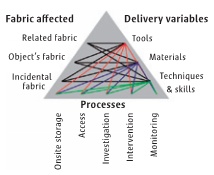
To conclude, project planning must take into account a huge range of variables as illustrated by the above graphic. Good co-ordination will help to manage risks, but success ultimately depends on the involvement of everyone on site in the management of risk. Everyone involved must consider the consequence of their actions. A conservation site is not a place for unskilled labour.