
Sound Insulation in Historic Buildings
Chris Pike
 |
||
Intrusive sounds that penetrate external walls, party walls and separating floor structures are a major concern for the inhabitants and users of buildings. In existing buildings where noise is a problem, any reduction will be welcomed, giving relief, comfort and a heightened appreciation for the quality of the living space. In conversions, alterations must be designed to minimise the risk of disturbance from external noise sources.
NOISE
Noise can be defined as ‘any unwanted, unpleasant or unexpected sound’. Most people will be disturbed by any unexpected noise, but many are subsequently able to become accustomed and de-sensitised to background noises as long as these do not vary in pitch or become too loud or intense; for example, residents living under an airport flight-path or adjacent to a railway line. Noise often originates outside the building envelope from sources such as traffic, crowds, alarms, horns and sirens, but noise can also be generated from within buildings by household activities and appliances such as televisions, radios and washing machines. Worn or badly maintained mechanical plant and plumbing systems, including old central heating boilers and air conditioning units, can generate significant whine and hum that can be very upsetting to certain ‘sensitive’ people.
Noise intensity is measured in decibel (dB) units and rises on a logarithmic scale. A 10dB increase is normally perceived as a ‘doubling’ in loudness. The table below gives the typical decibel level of some example sound sources.
The ideal background (ambient) noise level in dwellings is 35dB. This is very often reduced to 30dB for sleeping areas.
In order to consider the options for tackling noise it is necessary to have a basic understanding of sound properties and behaviour.
SOUND TRANSMISSION
Although sound waves are invisible they can be compared to ripples or waves in water that spread out from a single point.
There are two types of sound transmission. Airborne sound is produced by active systems, speech and loud music, and is a series of pressure waves carried through the air. Impact sound results from objects striking a surface which then causes vibration and reverberation in other objects attached to or resting on that surface.
Airborne sound is a series of compressions and rarefactions of air particles that travel in a longitudinal wave form. The air movement triggers hair and bone receptors when entering the ear. Audible sound has wavelengths between 17 metres and 17 millimetres, and a wave frequency varying between 20 and 20,000 Hertz. Intense deep bass sounds can be felt physically on the body. Sound travels at a speed of approximately 330m/s through air, but is influenced by humidity and air pressure conditions and will travel a further distance downwind. Sound will pass through any small gaps or openings and will reflect or rebound off any hard surfaces without significant loss or reduction in the sound intensity (energy). Amplification of sound can occur due to funnelling effects and wave interference.
Sound level attenuation (lessening in strength or intensity) in air follows an inverse proportional relationship to the distance travelled since the sound pressure waves radiate outwards in all directions from a point source, i.e. the noise level decreases by a half as the distance from the source is doubled.
SOUND LEVEL (dB) |
DESCRIPTION |
SOURCE EXAMPLE |
|
10 20 40-50 50-60 70 80 |
Very faint Quiet Normal Noisy Loud Very loud |
Normal breathing Whisper at 1.0 metre Light traffic at 50 metres Loud speech Busy street, pub or restaurant Vacuum cleaner or hairdryer |
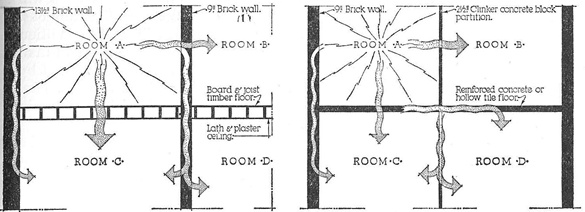
In buildings, sound energy can be transmitted directly or indirectly from one side of a wall or floor to the other. Indirect transmission is where sound travels by alternative pathways through separating or flanking walls or floors or along service pipes or conduits that circulate through a building. The diagram overleaf illustrates the various routes sound can take through a building structure. It can be seen that the shortest direct line of travel between the source and receptor does not necessarily create the loudest noise.
Alternative pathways for sound transmission should always be carefully considered as there is little point in raising the sound insulation in one part significantly beyond the level of the insulation value in an adjacent part.
BUILDING REGULATIONS
The Building Regulations comprise a series of technical documents that relate to various aspects of construction work in different disciplines. The majority of the Approved Documents that apply in England and Wales deal with health and safety matters. Approved Document Part E, however, is an exception: it gives practical advice and guidance on the welfare and convenience of building users and deals specifically with ‘Resistance to the Passage of Sound’.
In Approved Document Part E, the following areas of sound transmission are considered:
1. protection against sound from other parts of the building or adjoining buildings
2. protection of sound within a dwelling
3. reverberation in the common internal parts of buildings containing flats or rooms for residential purposes
4. acoustic conditions in schools.
Part E gives a minimum performance standard for acceptable noise transmission through separating structures (walls, floors and stairs etc) in terms of dB (decibel) level for both airborne sounds and impact sounds.
The ideal for airborne sound is 40-43dB, while the ideal for impact sound is 62-64dB for residential conversions or refurbishments.
The issue of sound transmission is brought into sharp focus when historic buildings are refurbished, subdivided or converted for a new use, such as for residential apartments, offices or hotel accommodation. Sound level requirements for different types of use vary widely, and the ability to meet current standards will be affected by the type of structure; converting a redundant or abandoned factory is likely to present very different challenges to those posed by the subdivision of a country mansion, for example.
 |
|
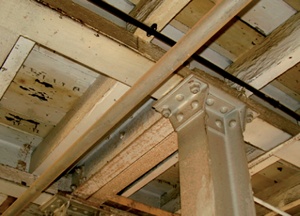
| Old industrial-type buildings normally have a robust construction with generous headroom sufficient to provide a suspended ceiling system able to accommodate new service installations and insulation. |
Part E recognises the difficulties associated with adapting historic buildings which are undergoing material change of use and the need to conserve special characteristics, and allows special dispensation as follows: ‘the aim should be to improve sound insulation to the extent that it is practically possible, always provided that the work does not prejudice the character of the historic building, or increase the risk of long-term deterioration to the building fabric or fittings’. This does, nevertheless, impose significant requirements: you must be able to demonstrate that consideration has been given to the exclusion of noise, and you must also provide a record of sound insulation values achieved through site testing undertaken by a UKAS accredited testing company.
Part E provides the following definition of a ‘historic building’:
- listed building
- building situated in a conservation area
- building referred to in a local authority’s development plan as of architectural or historical interest
- building within a national park, area of outstanding natural beauty or world heritage site
- vernacular building of traditional form and construction.
The conversion or adaptation of historic buildings can present a range of challenges and the issue of sound insulation should not be considered in isolation. There are several other aspects that have equal or greater weighting in terms of the performance and working of a building, namely: fire protection, thermal insulation, heating and ventilation, and loading. Moreover, these concerns impact on each other.
SOUND INSULATION PERFORMANCE
Sound insulation performance is a measurement of a material’s ability to reduce the amount of sound transmitted from one side of a panel element to the other.
A simple rule of thumb is that the thicker or more dense a material, the better its sound insulating performance. This is basically because the heavier or stiffer a material, the more difficult it is to set up vibrations within it and the sound waves simply rebound. Heavy concrete floors and walls therefore have very good sound insulation properties, whereas thin single-glazed windows and lightweight timber walls are comparatively poor. Conversely, the more resilient or flexible the fixing used in composite and layered systems, the better the insulation performance for absorbing impact sounds.
Sound is quickly dissipated in high humidity environments and can be absorbed by soft furnishings, clothing or people. Prime examples of good sound absorbing materials are mineral wool, upholstered furniture, thick carpeting, curtains and porous fibreboards. All these have open, air-filled pores which allow friction between the air and the material, converting the kinetic energy in the air particles into heat energy in the material.
The weighted sound reduction index, Rw, is a number value given in decibels which describes the sound insulation performance of a material as determined by laboratory testing. This value is often adjusted to include a material’s ability to reduce transmission of low frequency (hum) sound such as that generated by traffic with a Ctr term added. The higher the Rw + Ctr value, the better the airborne sound insulation performance.
 |
|
| Sound transmission paths: arrows indicate paths of sound in roughly relative amounts; the broadest arrow in each case shows the path offering least resistance to the transmission of sound. (Extract taken from Principles of Modern Building, see Recommended Reading section.) |
There is a second material sound characteristic value of Lwn, usually relating to floors, which aims to describe the material’s ability to dampen or soften impact noise. This value is sometimes adjusted to cater for typical footstep noise with a term CI added. The lower the Lwn + CI value, the better the sound impact performance.
Technical data sheets for manufactured or processed material will normally give a sound performance rating. British Gypsum, for example, has various plaster-based products in their Gypfloor and Gypwall range of boarding systems that are soundproof rated dependent on the overall panel thickness and fixing method. Many suppliers offer special acoustic quilts, foams, or lagging products that can reduce sound transfer.
SOUND INSULATION FOR WALLS
A lazy-man’s belt and braces approach for improving sound insulation is to simply over-board internally to increase the overall wall thickness and weight of material. However, wall lining systems are likely to impact significantly on the important internal features found in historic buildings, such as architraves, plaster cornices and other mouldings, and are therefore contentious.
As an alternative, small well-targeted measures can make a big difference. Installing draught-proof strips to gaps under doors and skirtings is a good starting point, while open letterboxes and keyholes can easily be fitted with covers.
Consideration should be given to the fitting of baffles within airbricks and redundant chimney flues. The baffles or diffusers allow the passage of air but reflect and dissipate noise.
Care must always be taken not to overly restrict the free flow of air within rooms as this could encourage condensation and mould growth on cold surfaces. It may sometimes be appropriate to apply sound proofing measures in rooms at the front (noisier side) of a house and not at the rear.
The weakest part of external walls in terms of sound resistance will be the window units, but these are often the most important features in the facades of historic buildings. From a conservation perspective it is unacceptable to remove and replace original window units unless the frames are seriously defective and beyond reasonable repair. Small enhancements can however be made quickly and easily to raise the sound insulation value by fitting a proprietary draught-proofing strip to the opening lights, and by providing beading or caulking to seal around the frame. In extremely noisy environments the fitting of secondary glazing units or demountable shutters may be advantageous. However, in most cases, the best measure is simply to hang heavy curtains set close to the wall which can be drawn as necessary. It should be kept in mind that on hot summer days windows are often left open to allow in fresh air.
Weaknesses in party walls and separating compartment walls allowing indirect transmission of noise can be a major problem. Open cavities within the flanking walls and in roof spaces can be stopped off with an inert fibrous material such as Rockwool. This acts as an effective barrier to both sound and fire spread.
SOUND INSULATION FOR FLOORS
 |
||
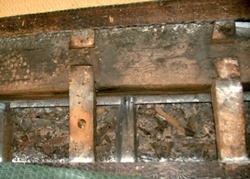
| Double joist floor construction often found in stately homes. The inner floor void can be filled with sound-absorbent material, although consideration should be given to maintaining ‘breathability’ within the closed space to minimise the risk of dry rot. |
Suspended wooden floors are likely to have an existing Rw rating of between 36 and 40dB for airborne sound and a Lwn rating of between 76 and 82dB for impact sound depending on the form of construction and ceiling type.
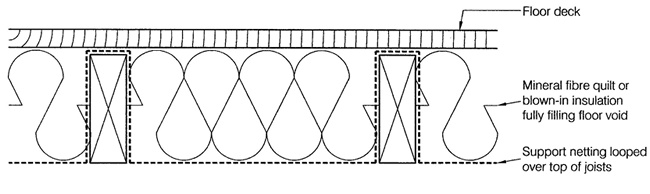
The double joist or fully framed deep floors which are often found in larger dwellings will inherently provide better soundproofing characteristics. Even so, the sound insulation performance can be improved by introducing infill to the hidden floor void. Traditionally the infill would have been any readily available material such as sawdust, sand or lime pugging. However, many of these materials are now considered a fire hazard and they can initiate rot as they trap moisture. The preferred choice is an inert silicate cotton (glass wool) material in loose fibre or mat form. Insulation can be installed from above by lifting the floor boards, which will negate the need to disturb any fragile ceilings beneath, and then supported by netting or carried on battens nailed to the side face of joists.
Increasing the dead weight of floors will not, on its own, significantly improve the impact sound insulation properties. A better solution is to provide a resilient layer that is isolated from and not fixed to the base structural floor and which incorporates a sound and shock absorbing material such as rubber composite or cellular foam.
A floating floor will improve both airborne and impact sound insulation qualities. A standard timber raft floating floor would comprise floor boarding nailed to 50 x 50mm battens at 400mm centres, which rests on a resilient quilt placed over the structural floor. A heavier floating floor screed would normally comprise a 1:4 sand cement mix up to 62mm thick and may include wire reinforcement to reduce shrinkage curl and cracking.
A problem associated with all floating floor systems, however, is that they can raise the finished floor level significantly, resulting in the need to then raise skirting boards and to trim the base of doors and architraves.
Sound insulation measures may also increase the floor loads significantly. Checks may be necessary to verify that an old floor structure, which may have deteriorated or suffered damage over time, has the reserve strength capacity to carry any increased loading and not deflect significantly.
The introduction of service routes, conduits and pipe runs will always create pathways for sound transmission. It is necessary, therefore, to ensure that workmanship is to a high standard, with penetrating holes fully masked and sealed tight with a flexible grommet or filler prior to concealment.
 |
|||||
| Internal sound proofing provided to suspended timber floor | |||||
|
|||||
| Options for sound insulation in floors, assuming minimum 100mm (4”) flanking brick walls |
A QUESTION OF BALANCE
A sensible, balanced approach needs to be made in the conversion or upgrading of historic buildings. New occupants expect a reasonable level of sound insulation and privacy, but it is of paramount importance to think through the repercussions of actions that could be disruptive and permanently damaging to historic fabric, especially when the noise disturbance may be transitory.
In many cases the best option is to employ a professional consultant to carry out a detailed appraisal of the mechanics of the sound transmission within a building to determine the most vulnerable areas and to compile a list of options for targeted sound insulation.
~~~
Recommended Reading
- Approved Document E relating to Part E of Schedule 1 to the Building Regulations, as amended, HMSO, London, 2000
- James Douglas, Building Adaptation, 2nd edition, Butterworth-Heinemann, London, 2006
- Building Research Station, Principles of Modern Building, vols 1 and 2, 3rd edition, HMSO, London, 1959 and 1961
- Communities Scotland Precis No 78, Improving Sound Insulation in Dwellings, Edinburgh, 2006