
Street Trees in Historic Town Centres
Jim Smith
 |
|
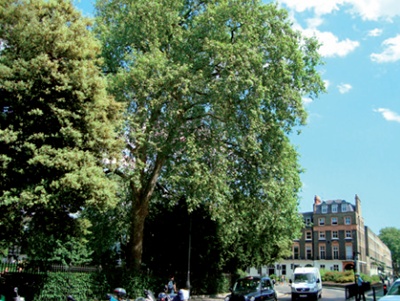
| The west side of Russell Square, London, facing due south (All photos: Forestry Commission, except Kingsway c1950) |
Where climate and circumstances permit, almost all communities in the world plant and preserve trees in the centre of their towns and cities. The earliest written evidence of a tradition of legally protecting urban trees is found in Hammurabi’s Code of Laws, an ancient Babylonian text. The practice of planting trees in cities probably predates even this reference, however, which details the imposing of a fine of half a mina for removing a tree without the owner’s permission.
In ancient China successive dynasties routinely destroyed the previous dynasty’s literary and cultural works with the notable exception of texts on agriculture and arboriculture. Across cultures and historical periods, we find evidence of urban trees being valued for both economic and aesthetic reasons.
Closer to home, and more recently, within the last 300 years trees have been an increasingly visible aspect of the streetscape of towns and cities in the UK. Illustrations of Britain’s town centres from the 18th-century show that street trees were not common at that time. They were predominantly planted in garden squares and in the formal gardens of large houses.
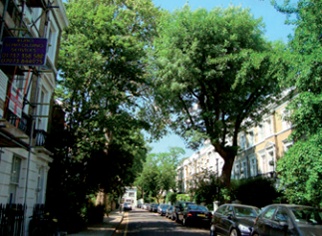
Georgian squares, which were originally treeless, came to be shaped by the new English picturesque style. The first example of this type of development was Russell Square in London designed by Humphry Repton at the beginning of the 19th century. Formal street tree planting started in London in the mid 1850s with a housing development along Margaretta Terrace in Chelsea and thereafter the new vogue for planting street trees began to spread across London and then to other British cities.
Street tree planting really came of age during the inter- and post-war periods when large residential suburban estates around London were developed in response to the extension of the Northern, Piccadilly, Central and Metropolitan Lines. Similar suburban development took place south of the Thames and popular street names like Acacia Avenue, Hawthorn Road, Cherry Tree Avenue and Lime Grove became synonymous with suburban development all over the country.
This new wave of development encroached on and engulfed many historic town centres where individual trees had been growing, either by accident or design, for generations. These trees were sometimes growing on streets, on village squares or the edges of commons. Often they were remnants of larger woodlands or field boundary trees that had been allowed to grow to maturity largely because they happened not to be in anyone’s way.
 |
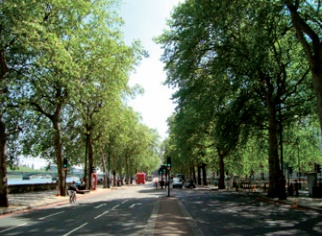 |
| Margaretta Terrace, the first street in London to be planted with street trees in the 1850s | Victoria Embankment, London, south of Horse Guards Avenue |
Historic town centres such as Hampstead, Bath, St Albans and Ely have always incorporated trees, usually as part of formal squares and gardens or churchyards, but not generally as street trees. The Ely plane in Ely, Cambridgeshire, planted within the garden of the Bishop’s Palace, is reputed to be the oldest plane tree in England and has a girth of over nine metres. Its survival is undoubtedly a result of its enhanced protection – it was planted by Bishop Gunning within the Bishop’s Palace rather than in the street beyond.
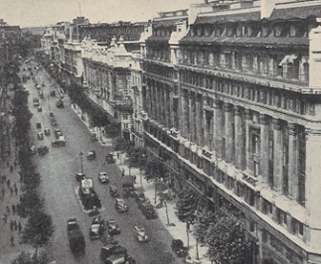
Some street trees were planted to create avenues adjacent to historic buildings, as at Pall Mall, the Victoria Embankment or Kingsway in Central London but they are the exception rather than the rule.
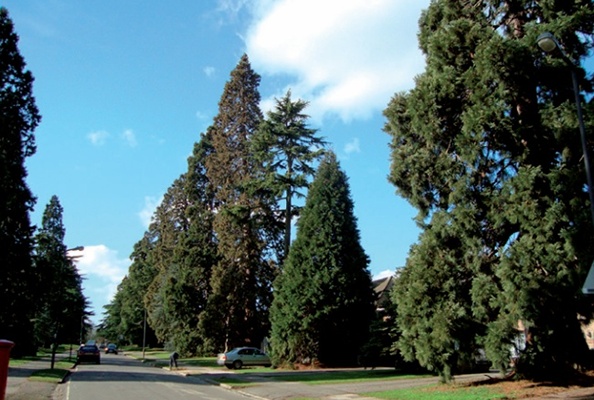
Another interesting exception is Canon’s Drive in Edgware, North London. Here, a remarkable avenue of Sequoias (Californian Redwoods) that were planted as part of the grand entrance to the 1st Duke of Chandos’ country estate remain as de facto street trees, now owned and maintained by local residents.
STREET TREES AND CLIMATE CHANGE
As a response to climate change, the planting of street trees is increasingly being promoted as a mechanism for dealing with the expected future increases in temperature. Recent research by Professor John Handley at Manchester University (1) shows that a 10 per cent increase in green infrastructure (or tree canopy cover) in a heavily urbanised area can reduce ambient temperatures by 4-5°. This is equivalent to the expected temperature increases parts of the UK will experience in the medium to high emissions scenarios envisaged by the UKCP09 climate projections (2). These temperature increases will be exacerbated by the mass of the built environment in our towns and cities. Central London is already some nine degrees warmer than its rural hinterland on very hot summer days. Many of our oldest historic buildings are likely to be particularly vulnerable to this urban heat island effect due to their materials and design.
Street trees have the potential to make a significant contribution to improving and ameliorating the worst impacts of climate change in historic town centres, but they will only be able to fulfil this function if the benefits they bring outweigh the disadvantages that providing for their presence may cause. In particular, the nature of the historic built environment makes it especially difficult to retro-fit trees where previously there were none.
 |
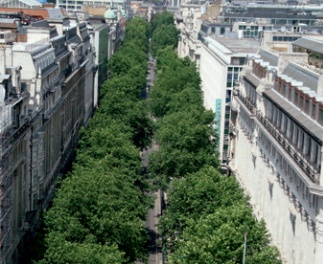 |
| Kingsway, London circa 1950 (Photo: London County Council) | Kingsway as it is today |
TREES AND HISTORIC FABRIC
There are many examples of trees surviving in historic environments in which they would not be planted today, given our current knowledge of how trees interact with buildings and historic infrastructure. Such examples include the Tower of London, where a large plane tree contributed to part of the moat wall collapsing; the large plane tree by St Peter’s, Westcheap immortalised by William Wordsworth in his poem ‘The Reverie of Poor Susan’ (selected following public nominations as a Great Tree of London in 2008); and the very large plane trees adjacent to Westminster Abbey. They are all indicative of the potential for trees of great landscape importance and value to potentially adversely affect the historic environment purely as a result of their proximity.
With a growing need to provide cooling mechanisms in urban areas, street tree planting in previously unplanted areas, however that is achieved, is likely to become much more prevalent in the future. The challenge with respect to the historic environment will be to achieve this without compromising the integrity of its built fabric. This will not be easy, but it is possible. Trees, historic buildings and structures such as paving, walls and kerb edging can coexist; the evidence is all around us that they have done so for generations. Traditional building techniques often allow for better integration of trees and the issues they create than modern building techniques. This is because traditional techniques, such as the use of lime mortar, alongside a philosophy of working with the grain of nature, are more flexible and structures can be repaired more easily when problems do occur.
Essentially, the twin objectives of preserving and enhancing the historic built environment while at the same time facilitating a healthy and full canopied street tree population are not mutually exclusive but they will require detailed planning and adequate maintenance of both to be successful.
 |
|
| Californian redwoods on a residential road in Edgware, North London |
TREE MANAGEMENT
Local authorities are increasingly seeing their street tree stock as assets of value. The maintenance and care of this asset following the principles of asset management will see a much more proactive approach to tree management designed specifically to achieve increased levels of canopy cover in the future.
This asset management approach will also see a more considered and sustainable approach to the issues that trees create when they interact with any built environment:
- direct damage in the form of wall, pavement and kerb disturbance from buttress and supporting roots
- indirect subsidence damage to buildings and walls through foundation movement on shrinkable soils
- problems associated with higher branches touching or over-sailing buildings, roofs and rain water gutters
- leaf litter and falling deadwood.
All the above issues may be addressed, ameliorated and otherwise dealt with by adequate maintenance of the tree, together with routine maintenance and repair to the historic built environment.
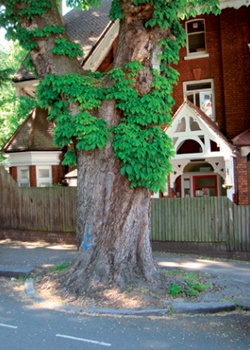
The use of root pruning around the base of the tree is an acceptable and effective way of reducing pavement and kerb disturbance. Alternatively, realignment of kerb edging using kerbside build-outs may also be an acceptable method of permitting the retention of an important landscape tree.
 |
|
| Sympathetic kerbside build-out created between parking bays, Crouch End, London |
In terms of the above ground parts of the tree, regular management in the form of expert pruning can achieve a resolution to the tree’s influence on nearby foundations and proximity of branches to roofs, brickwork and rainwater goods. The value of expert pruning in this regard cannot be overstated as incorrect pruning, particularly with respect to the species of the tree being worked on, may actually create more problems in the future.
Poor pruning of either root systems or branches can have adverse consequences for the health of the tree, particularly if undertaken by untrained operatives. Anyone contemplating root pruning a tree should obtain expert arboricultural advice and at the very least ensure that the work is carried out to the standards detailed in BS 3998 Recommendations for Tree Work (3), BS 5837 Trees in Relation to Construction (4) and, where services are involved, to the guidance in National Joint Utilities Group’s Guidelines for the Planning, Installation and Maintenance of Utility Apparatus in Proximity to Trees (5). Pruning techniques are varied but common ones include crown thinning, crown reduction and crown lifting. The London Tree Officers Association document A Risk Limitation Strategy for Tree Root Claims (6) provides guidance on cyclical pruning and the different techniques building conservation professionals should be aware of when asking for arboricultural advice. Local authority tree officers will also be able to advise on appropriate pruning solutions in local contexts.
There will be situations where there is no alternative but to contemplate the removal of the tree. This may be because it has outgrown its position and regular pruning is no longer viable or because the tree’s health has declined to the point at which it is no longer a visual amenity or it has become a hazard to the public. Decisions on tree removal in these circumstances should be taken by arboricultural experts because some of the most valuable veteran trees may fall into these categories and veteran trees are often themselves intrinsically linked to local historic town centres and their history.
‘NO TREES NO FUTURE’
The trees in our historic town centres, especially ancient or veteran trees, are living links to the past. They bear witness to events in these special places and the protection and retention of both trees and the historic environment have never been more important, not just for our generation but for future generations as well. It is our generation, however, that has been tasked with being effective custodians of this heritage, while at the same time dealing with the impacts of climate change. So it is critical that historic environment professionals work more closely with tree professionals along the lines of the principles espoused by The Trees and Design Action Group document, No Trees No Future (7). By doing so, the two sectors can work more effectively towards achieving historic town centres which are resilient to climate change and its impacts.
~~~
Recommended Reading
- C Baines (ed), Trees Matter! National Urban Forestry Unit, Wolverhampton, 2005
- C Britt and M Johnston, Trees in Towns II: A New Survey of Urban Trees in England and their Condition and Management, Department for Communities and Local Government, London, 2008
- An Introductory Guide to Valuing Ecosystem Services, defra, London, 2007
- Land Use Consultants, Trees in Towns, Research for Amenity Trees Series No 1, Department of the Environment, London, 1993
- London Assembly, Chainsaw Massacre: A Review of London’s Street Trees, London, 2007
- The London Trees and Woodlands Framework, the Forestry Commission and the Greater London Authority under the steerage of The London Woodland Advisory Group, London, 2005
- JK Morris, Woodland Archaeology in London, Forestry Commission, 2010
- R Shaw et al, Climate Change Adaptation by Design: A Guide to Sustainable Communities, Town and Country Planning Association, 2007
- J Stokes et al, Trees in Your Ground, The Tree Council, London, 2005
- A Strategy for England’s Trees, Woods and Forests, defra, London, 2007
- A Strategy for Urban Forestry, National Urban Forestry Unit, Wolverhampton, 2004
- S Vivian et al, Climate Change Risks in Building: An Introduction, CIRIA, London, 2005
- R Watson, Trees: Their Use, Management, Cultivation and Biology, Crowood, Ramsbury, 2006
Notes
(1) SE Gill et al, ‘Adapting Cities for Climate Change: The Role of the Green Infrastructure’, Built Environment, Vol 33, No 1, 2007
(2) UK Climate Projections (UKCP09) (available online at ukclimateprojections.defra.gov.uk)
(3) British Standards Institute, British Standard 3998, Recommendations for Tree Work
(4) British Standards Institute, British Standard 5837, Trees in Relation to Construction
(5) National Joint Utilities Group, Volume 4: Guidelines for the Planning, Installation and Maintenance of Utility Apparatus in Proximity to Trees, 2007 (click title to view this document on the NJUG website)
(6) London Tree Officers Association, A Risk Limitation Strategy for Tree Root Claims, 2007 (click title to view this document on the LTOA website)
(7) Trees and Design Action Group, No Trees, No Future: Trees in the Urban Realm, 2008 (click title to view this document on the Forestry Commission website)