
The Conservation of Banners at St Andrew's Church, Grafham
Lisa Townsend
|  |
Many old churches and chapels contain fine textiles such as church banners, altar frontals and religious vestments, as well as secular textiles such as regimental colours. Often these works of art are of considerable historical significance, and proper care and conservation is most important. However, conservation almost invariably poses some difficult questions for both owners and conservators. In the internal environment of most churches and chapels, textiles in particular are at the mercy of a variety of insects, fungi and micro-organisms, wide fluctuations in relative humidity, as well as the harmful effects of sunlight. Some textiles may be used frequently or just occasionally, compounding the problems of conservation, while others may be simply on display.
The treatment of a magnificent series of seven banners from St Andrew's Church, Grafham, Surrey by a team of conservators at The National Trust Textile Conservation Studio illustrates the issues.
HISTORICAL BACKGROUND
St Andrew's Church, Grafham
was designed as a total unity between 1861 and 1864 by Henry Woodyer
in memory of his wife. He enlisted the help of his friend Thomas Gambier
Parry, who is perhaps better known for his work at Highnam and Ely Cathedral.
It is thought that Gambier Parry executed the painted decoration within
St Andrew's and may also have designed the banners and painted the detail
on the figures. The design of each is known from early photographs to
have been repeated as part of the wall paintings of the nave, although
unfortunately the wall paintings are no longer visible.
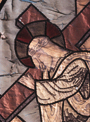
The seven banners depict the following subjects: St Andrew; Christ the King; St Michael of All Angels; Christ Carrying the Cross; The Resurrected Christ Carrying the Flag; The Baptism of Christ; and The Risen Christ.
Because they were an integral part of the total decoration of the church, it was particularly important that these banners were preserved.
By the 1980s all seven banners were in need of both cleaning and stabilisation. Their silk embroidered panels were in a particularly fragile state, and fragments of silk had been seen falling off by the congregation. It was clear that they required urgent attention. As a result, the Council for the Care of Churches agreed to consider grant aid and the church was instructed to apply for assistance on the basis of a conservation survey undertaken by the Textile Conservation Studio.
The banners were removed from their hanging position beneath the roof of the nave, and were brought to the Studio in 1988. Each banner was photographed and thoroughly examined to establish the type of conservation treatment required and the number of hours of work involved.
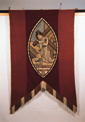
Each banner comprises of two separate parts; the main embroidered central panel and the banner backing to which it is fixed. They are also fully lined with a glazed plain weave linen. The technique used for the construction of the banners involved appliqué (italicised terms are defined in the glossary at the foot of this page), where sections of the design were outlined with black thread or velvet ribbon, making them reminiscent of stained glass. The religious images which form the central decoration of each banner were constructed from coloured silks, velvet, cloth of gold, embroidery silks, metal and chenille threads and they were also decorated with coloured cut glass jewels, parchment lettering, velvet ribbons and woven silk braid. The materials are all worked through to the linen foundation fabric which is oval in shape. The technique is simple and could conceivably have been worked by family members who were competent needlewomen rather than professional embroiderers.
CONDITION
The banner backings are
made up of three vertical panels which are machine stitched together.
The two outer fabrics are a deep orange coloured wool rep,
whilst the central fabric is an orange red wool plush. The embroidered
panels are fixed with various metal fastenings to the wool plush. An
orange and white bullion
fringe of wool and cotton is attached along the lower shaped edge of
each banner backing, whilst the sides of the banners are finished with
a thick orange wool twisted cord. The banners are hung from five pole
loops spaced along the top edge.
All of the banner backings were extremely soiled and covered with a thick layer of particulate matter and paint flakes. There was evidence of insect attack in the form of holes and grazing of the wool fabrics and there were corrosion marks caused by the metal fastenings. The glazed linen linings were generally weak with holes and tears, as well as being very soiled and discoloured. The spaced hanging loops had caused the upper edge of all the banners to pull into scallops and hang in undulations.
The embroidered panels were also dirty and extremely fragile. The linen foundation fabric was ingrained with dust. The appliquéd fabrics appeared wrinkled in places, suggesting that the foundation linen had shrunk due to the environment of the church. A layer of dust and textile fibres covered the embroidered and appliquéd components. Many of the stitches used to hold down the various components were broken, and several of the silk appliqué fabrics were brittle and shattering with some areas suffering complete loss. The pile on the velvet ribbons powdered to the touch and the parchment letters had become hard and distorted with much of their gilding being lost.
The wooden poles used for hanging were once painted gold but this finish had also been lost.
CONSERVATION
Once the construction and condition of the banners had been established, a detailed treatment proposal and subsequent estimate was presented to the Council for the Care of Churches. After close discussion with the council and the church it was decided that, due to funding limitations, the banners would have to be treated at a rate of approximately one per year. This was agreed and work commenced on the first banner, 'Christ the King' in January 1989. The final banner was subsequently completed in March 1998.
Even though the banners were treated separately over a period of ten years, they were all conserved using the same procedure to ensure a consistent end result. The standard treatment involved the following procedures:
- The front of the embroidered panel was carefully vacuumed using a micro vacuum and a combination of a soft brush and needle tools, as these were the only cleaning methods suitable for the materials involved and the method of construction. They proved very successful in removing the surface layer of dust.
- The weak and shattered areas of silk were stabilised by applying an overlay of adhesive coated silk crepeline, dyed to a sympathetic colour. The overlay technique was used as the linen prevented access to the silk from the reverse, and the silk was far too fragile to withstand the insertion of patches behind the weak areas from the front. The crepeline was heat sealed down onto the fragile silk and the edges of each patch were neatly tucked under the velvet ribbon and embroidered borders so as to become virtually invisible. Where complete loss of the silk had occurred a matching coloured silk patch was first inserted to fill the loss, the silk crepeline overlay then held it in place.
- Loose velvet ribbon and embroidered borders were re-secured.
- The hardened and distorted parchment letters were gently humidified and weighted in order to flatten them.
- Once stabilised, the embroidered panel was turned over for cleaning and lining the reverse with cotton cambric. Velcro was sewn around the edge of the cambric as a means of reattachment to the banner backing instead of metal fastenings.
- The construction and condition of the banner backing was carefully recorded before any work commenced. The lining and trimmings were then removed for separate treatment. All of these components were wet-cleaned individually in a non-ionic detergent and blocked out to dry over templates to avoid any shrinkage or distortion during drying.
- Before reconstruction of the banner backing any necessary repairs were undertaken.
- The rep fabric had proved to be extremely stretchy when hung, and in order to avoid future distortions occurring, they were sewn to a backing of linen scrim and the shaped lower edge was supported onto pre-shrunk linen tape.
- Reassembly of all the components of the banner then took place, referring to the documentation taken at the beginning of treatment to ensure correct positioning of all components. This is where it is essential to have thorough documentation to ensure successful treatment.
- Finally, Velcro was attached to scoured cotton webbing and stitched to the centre of the wool plush to mirror that on the embroidered panel, thus providing the attachment mechanism. Another strip of Velcro attached to cotton webbing was stitched along the top edge of the reverse of the banner backing to provide a means of hanging the banner.
DISPLAY
Several issues for future display of the banners had to be considered and these were discussed with all interested parties. The banners had hung on open display within the church for over 100 years. They had been exposed to the ravages of light and the generally poor environmental conditions that most churches suffer. Also, it had become obvious during conservation that repairs had been carried out in the past and that attempts had been made to rectify damages caused by the hanging method. Their one saving grace had been the fact that they had been hung high enough in the church to avoid unnecessary handling.
From an art historical point of view it was preferable to see the banners displayed in the original manner, and this approach was favoured initially. However, the aim of conservation was to ensure the survival of the banners for at least another hundred years, so some improvements on the original display method had to be considered. From a conservation perspective the preferred method was to mount each banner in a glazed frame to be hung from the walls of the nave. This would enable the banners to be better seen and enjoyed by the congregation, they would be safe from handling, dust pollution and insect attack, and a suitably designed frame would protect them from the changes of temperature and humidity within the church.
To verify whether it was necessary to protect the banners in frames, an attempt was made to monitor the environmental conditions within the church over a period of a year prior to the first banner being returned. However, there were difficulties with running and maintaining monitoring equipment and no useful results were produced.
Environmental monitoring is an extremely important aspect of conservation when considering the expenditure of large sums of money. It can provide key information which can be used to make informed decisions. For example it may be found that the relative humidity of a church can be reduced by some simple means to prevent corrosion of metal artefacts or decorations, rather then spending a great deal of money on conservation only to return the artefact to unfavourable conditions.
In the case of St Andrew's Church it was finally decided that glazed framing was the best option for the display of the banners, despite the lack of any confirmative data.
The frames were constructed of oak sealed with an archival sealant against acid emissions and glazed with Perspex. Perspex was chosen instead of glass to minimise the weight of an already large frame. The inner edges of the frame were lined with acid-free linen tape. The backboard was prepared by first applying a protective layer of Melinex polyester film, followed by a layer of bumph interlining fabric. A tightly woven cotton lining fabric in a neutral cream colour was placed over the soft bumph. The reverse of the backboard was covered with Moistop, a barrier material known to be effective against the ingress of moisture. Spacers were added to the back of the frame to keep it away from the wall surface and to allow air circulation behind.
A strip of Velcro corresponding to that on the back of the banner was sewn onto the fabric covered backboard. The banner was then fixed to the board by means of the Velcro. The pole loops at the top of the banner were stitched to the fabric covered board to hold them in position. Then the whole back board was carefully inserted into the frame and sealed using archival frame-sealing tape.
All seven banners have now been completed and hang on the nave walls of St Andrew's Church, Grafham.
~~~
Acknowledgements
Ksynia Marko, Head of
Studio for her help and encouragement with the compilation of this article;
The Reverend Canon Godwin, Vicar to St Andrew's and Peter Burman, formerly
of the Council for the Care of Churches, both of whose enthusiasm initiated
and sustained the project; and the conservators involved in the Grafham
Banner conservation project over the course of the ten years (Ksynia
Marko, Zenzie Tinker, Frances Hartog, Lisa Townsend, Rachel Langley
and Aleksandra Kaminska).
The project was funded by grants administered by the Council for the Care of Churches on behalf of certain charitable trusts.
Glossary
- appliqué The addition of fabrics or embroidered motifs to the surface of a ground material to form a design
- bullion Twisted cord
- bumph A plain-weave brushed cotton fabric
- cambric A close-woven down-proof fabric
- chenille A round furry thread made of wool, cotton or silk
- crepeline A very fine transparent silk fabric
- plush A cut velvet, normally wool with very long pile
- rep Textile with a ribbed effect
- scrim Fine open-weave unbleached canvas made of linen or cotton