
The Archaeology of Historic Timber-Framed Buildings
Richard Harris
Historic timber frames exert a powerful fascination and have attracted a great deal of attention over the last 30 or 40 years. The pioneering work of researchers such as Freddie Charles, John Smith and Cecil Hewett has been taken forward by a host of enthusiasts and innumerable publications. Dendrochronology has given speculation and deduction a backbone of fact. The Carpenters' Fellowship has provided a meeting place for young carpenters to swap ideas and pool their research.
Charles was an architect, Smith an RCHM investigator, and Hewett a teacher, and in those days professional archaeologists had very little to do with standing buildings. When the Council for British Archaeology (CBA) was founded in 1943 one of its aims was to promote the archaeological study of buildings, but that was not achieved until the 1980s: arguably, between the formation of the CBA's Historic Buildings Committee in 1978 and the Institute of Field Archaeologists' 1993 conference, Archaeology and Standing Buildings.
Architectural historians and archaeologists made uneasy bedfellows, historians accusing archaeologists of amassing expensive and useless detail, archaeologists in turn showing how their painstakingly detailed studies had turned many an established history on its head. Architects, meanwhile, went their own sweet way, blissfully unaware of the standards established by professionals in the parallel disciplines of archaeology and conservation; and builders, by and large, couldn't understand what all the fuss was about - as craftsmen they felt they had sufficient understanding through empathy with their forebears. Today, things have improved considerably. The building industry has taken on board the fact that there are people called archaeologists and specialist conservators, and good teams have been assembled for important projects.
The study of timber-framed buildings developed along its own distinctive path. In the early days of vernacular architecture - the 1950s, when the Vernacular Architecture Group was formed and some formidable intelligence was brought to bear on what was effectively a brand new subject - the analysis of vernacular architecture was almost wholly conducted in terms of forms of timber framing. Stone was only interesting insofar as it reflected the natural geology of a region, and brick was, well, brick, but timber framing was somehow alive! Hewett stunned everyone with his focus on joints and the resulting revision (mostly backwards) of established dates, JT Smith single-handedly laid down an entire foundation for the subject, and in the annus mirabilis of 1975 Eric Mercer and Peter Smith produced their magisterial works English Vernacular Architecture and Houses of the Welsh Countryside.
 |
|
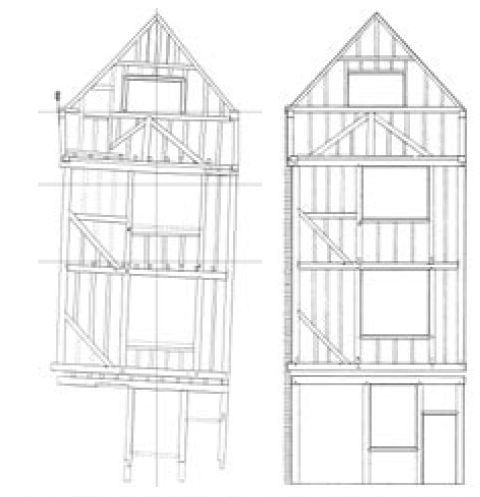
| Rear gable frame of the Hoop and Grapes, Aldgate, dismantled in 1991 Left: the frame as found, related to horizontal and vertical datum lines; right: the original pattern of framing reconstructed |
METHOD OF INVESTIGATION
In the survey and interpretation of a timber-framed building, the choice of recording method and level of detail always depends on the purposes for which the record is being made. Timbers retain in their mortices extensive information about the design of the building, and this makes it easy to restore the missing parts of fragmentary timber-framed buildings either on paper or in physical reconstruction. Drawings can use survey evidence to portray the original appearance of timber-framed buildings.
It is important to analyse timber-framed buildings in terms of their component two-dimensional frames. Each frame was pre-fabricated by the carpenter, and a carpenter's eye would see the component frames distinctly within the three-dimensional building after all, the frames were pre-fabricated, with all their joints cut and trial-fitted. Most buildings were assembled piece-by-piece, not pre-assembled and reared into position.
The first step in understanding a building is to 'parse' it against the 'grammar' of traditional timber-framed construction. First, the lap dovetail assembly between tiebeam and wall plate (see illustration) is an almost universal component of framed buildings in England and Wales (other than cruck buildings), and in analysis it defines the 'direction' of the building: that is, which is the cross, or tying member, and which is the longitudinal plate. Usually, of course, that is obvious from the pitched roof, but where the roof has been removed or altered the tiebeam lap dovetail is the best indicator. It also reveals the eaves level, which can be useful if the building has been heightened. Conversely, its absence should set alarm bells ringing and prompt immediate investigation.
Second, and equally important, is the bay system. Bays are the main link between structure and plan: they have a structural function in collecting loads, and a plan function in dividing or articulating the space. In its classic form, the plan determines bay lengths, while the bay divisions articulate the plan, so identifying the bay divisions and measuring the bay lengths is the first step in laying out the bare bones of the building's system. There are exceptions, of course - in some buildings, for instance, the roof has a different bay rhythm from the floors below - but by and large the bays are the key to plan.
 |
|
 |
|
 |
|
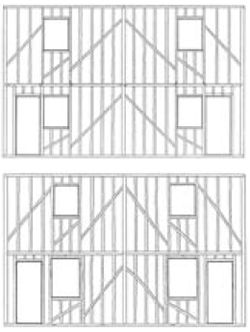
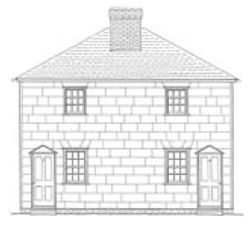
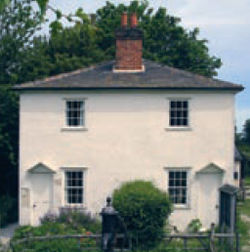
| The front wall of a pair of semi-detached cottages built in Ashtead, Surrey, in the 1860s and now reconstructed at the Weald & Downland Open Air Museum. From top: The frame as originally fabricated; the frame altered before erection to change the window positions; front elevation showing the design of the plastered front, lined to imitate ashlar stonework; and the front of the cottages as reconstructed at the museum |
The third feature to look for is the 'upper faces' of the cross frames: which way do they face? (The 'upper face' is the face used by the carpenter as the reference face during framing). Where a frame divides a heated from an unheated room (a very common occurrence), the upper face of the dividing frame will face the heated room; and in barns the upper face of each internal cross frames faces the threshing floor. But while these are the simplest rules, the varieties and subtleties of the arrangement of the upper face in various building types are of enduring interest and repay close attention. The upper face is the face the carpenter 'looks at' in his mind's eye, so that for us to pay attention to the upper face is a way of getting closer to his perceptions.
Finally, look at the timber, and in particular the way it is converted: the tool marks and methods of conversion form a pattern which confirms and amplifies observations of the bays and frames. Using a powerful torch shining along the surface, look for saw marks and axe marks: axe hewing marks indicate the outside surfaces of the tree, and saw marks result either from a cut through the heart or, for smaller members, from slabbing. Surprisingly often, inconsistencies in the tool marks are the first indication of well-hidden alterations.
ESTABLISHING BASIC GEOMETRY
'Parsing' the building in this way will give a pretty good idea of its interpretation, and the next step is to establish the geometry of the building. British carpentry is 'scribe-rule' carpentry, in that the surfaces of timbers at mortices are accepted as imperfect, and the shoulders of tenons are scribed to fit. However, the three-dimensional discipline demands that each two-dimensional frame must possess a 'nominal' plane, which can be related (usually at right angles) to the 'nominal' planes of its neighbours. These planes are embodied physically in reference marks called 'plumb and level marks' which the carpenter created on the upper face of each frame. However, these marks are often not now visible, and in any case movement of the timber over the centuries will have destroyed their accuracy, and it is reasonable to assume that the upper face of each frame represents the true plane of that frame for the purposes of survey.
The surveyor's job is to ensure that the overall setting-out measurements of the frames in each of the three dimensions are accurately established; longitudinal bay lengths, transverse spans and vertical heights and roof pitch. Bay lengths should be measured between upper faces of cross frames, and it is important to measure them on both sides of the building: all too often a surveyor assumes a building is square, when in fact it was designed and framed at irregular angles. Similarly it is important to check that the overall span of the building is constant. Many buildings taper, if only slightly, from one end to the other.
DRAWING CONCLUSIONS
Where timbers are missing, their previous existence can be established by looking for empty mortices or their accompanying pegholes. 'Looking for pegholes' may caricature the study of vernacular buildings, but it is not a foolproof method: pegholes can be inserted, and sometimes original joints were not pegged. Another way is to shine a torch along the surface to detect the carpenter's setting-out lines, usually found on the face of the timber, where the pegholes are seen, or on the adjacent surface in which the mortice was dug. These lines can be particularly important around window positions, betraying not only the former existence of a window but also some of its details. In the end, of course, no one feature ever gives the full story, and it is the consistency of the overall pattern that is the most powerful interpretative tool.
As well as investigating the original frame we may also be interested in later phases of alteration, depending on the particular circumstances. General rules are not easy to formulate, but the important thing is to proceed methodically from step to step. At each stage find a pattern that you can recognise and rely on, and follow it as far as you can around the building. For the purposes of explanation, keep your hypothesis simple: things not known to exist should not, unless it is absolutely necessary, be postulated as existing.
Having done all this, the information may be brought together on paper. The first drawing produced can be a diagrammatic plan, showing the bays, principal posts and upper faces, dimensioned with bay lengths and span. Such a diagram forms a good summary of a timberframed building.
Following this, the component frames of the building can be drawn. It is often best to tackle the cross frames first, followed by wall frames and floor frames. Door, window, and stair positions are the basic keys to interpreting the building. The frames should be drawn as self-contained objects, rather than as the background to a cross section, an important difference from the normal disciplines of architectural drawing.
Having established the main outlines, filling in the secondary framing members, such as studs, braces, joists, and rafters presents few problems: the work can speed up because a high level of accuracy is not usually critical once the overall geometry of the building has been established. This is not to say that accuracy is unimportant: indeed it is critical for establishing the overall geometry in the first place. Minor differences in the size or position of members, even the setting out of joints, can give crucial information about the building, and accuracy can still be important for interpretation.
To draw is an essential step towards understanding: I have to draw in order to see. Of course it is possible to look round a building and suggest an interpretation without making drawings, but I never see the building clearly until my observations have been tempered with the discipline of making a drawing on paper. Interpretations not based on drawings tend to become inaccurate as soon as the building becomes tricky; as a general rule, drawing a building carefully is a discipline that assists interpretation.
And is there any experience more enjoyable than sitting quietly in the roof space of a house, drawing medieval timbers that have hardly been seen, let alone touched, for two or three centuries, while the busy world goes on its way outside?