
Going with the Grain
Varnishes and polishes used to enhance the appearance of fine joinery
Jonathan Taylor
 |
|
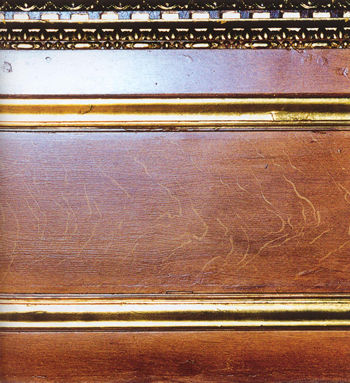
| 18th century graining at the Draper's Hall, London |
In the past, oak, mahogany and other fine hardwoods were valued for their natural colour and their figuring; softwoods were not. The fine hardwoods were often left bare but they could also be enhanced by polishing or varnishing, while softwoods such as deal (pine) were more usually painted over, often in the colour of mahogany or other more expensive wood, and sometimes grained to create a more convincing effect. Externally, fine joinery such as windows and doors had to be protected from the weather and tended to be painted or, at times, varnished. This general approach to the use of timber can be seen in houses in the UK from the 17th century until relatively recently, when our attitude to the appearance of pine suddenly changed.
Prior to the development of modern synthetic varnishes, the natural appearance of fine timber was usually enhanced by the application of either beeswax dissolved in turpentine or a varnish composed of resin dissolved in either alcohol (‘spirit’ varnishes), turpentine, or oil.
Varnish has the advantage over wax that it presents an even finish. Wax impregnates the surface of the wood and although it fills in the crevices to some degree, light reflecting off the waxed surface is scattered by the tiny imperfections of even the best sanded surface. Varnish, however, was usually applied in several coats which were sanded or rubbed smooth between each one, building up a fine surface which reflects light more evenly, presenting a brighter, glossier finish, as well as providing a much thicker and tougher coating to protect the timber beneath from knocks and abrasion.
WAXBeeswax has been used as a finish since ancient times and in this county it has been in common use certainly since the Middle Ages. It is made into a polish simply by shredding the beeswax into a solvent, usually turpentine, and gently heating it over a bath of hot water until the wax is dissolved.
Other waxes used later included Carnauba wax which is obtained from leaves of a Brazilian palm. It was added to an equal weight of beeswax to produce a much harder finish.
Waxes and drying oils such as linseed oil dry by a complex chemical reaction involving oxidation and a change in the molecular structure. A film forms as they dry which is tough and resilient. The change is not reversible.
RESIN VARNISHESAccording to Theodore Penn (see Recommended Reading), resin varnishes came into their own towards the end of the 17th century as close grained hardwoods began to be used more widely for architectural features and for furniture in the houses of the wealthy. This was partly the result of changing fashion in a period of enormous social, economic and political change, but it was also driven by necessity: the supply of good quality native hardwoods was dwindling and could no longer meet demand.
Resin is the exudation of various trees and shrubs. It has been harvested for the production of varnishes since ancient times. One of the earliest of these was mastic, the resin exuded by Pistacia lentiscus, a small tree which grew on the shores of the Mediterranean. Some of the best types of resin were fossilised such as amber, and semi-fossilised, such as copal. Both amber and copal were widely used throughout the 18th and 19th centuries in the preparation of clear, durable varnishes for architectural fittings. However, these hard resins had to be melted before they would dissolve in the solvent.
Resin varnishes fall into three classes according to the solvent used to dissolve the resin. Those made with alcohol as the solvent were known as ‘spirit’ varnishes and tended to have the best lustre but were not suitable for external use. Those made with turpentine had least lustre and were mainly used for pictures. The third class, oil varnishes, weathered much better and these were suitable for outside use.
Spirit varnishes consisted of a resin such as shellac, mastic or sandarac dissolved in the purest spirit (alcohol) which, prior to the 19th century, was distilled from fermented fruit or grain and ‘rectified’ by repeated distillations so that it contained little or no water. After applying the varnish, the alcohol evaporated quickly, leaving a coating of almost pure resin.
Turpentine varnishes, which were also known as essential oil varnishes, consisted of resins dissolved in turpentine, an essential oil distilled from the balsam of larch and pine trees in particular. Balsam, which is the resinous exudation of coniferous trees, is itself composed mainly of resin dissolved in an essential oil, and Venice turpentine is the distillate of larch balsam, which was considered to be among the best for making paints and varnishes because it had relatively little colour. The resin left behind in the distillation of Venice turpentine was one of those used for making this type of varnish. Other resins commonly used included copal, amber and dammar. As in spirit varnishes, turpentine evaporates from the varnish when first applied, albeit more slowly than the spirit, leaving behind the resin.
Oil varnishes, which were also known as fixed oil varnishes (as opposed to essential oil varnishes), consisted of resins such as amber and copal dissolved in oil, usually linseed oil. Other types included nut oil and poppy seed oil, both of which had less colour but were more expensive and their use was reserved for the very finest work. As oil varnishes dried very slowly, certain metal oxides known as driers were added, such as litharge (an oxide of lead, Pb3O4). These chemicals acted as catalysts causing the oil to dry by oxidisation and polymerisation. The result was an extremely tough, durable varnish.
GENERAL USEOak did not take varnish well and the traditional practice of polishing oak with wax continued throughout the 18th and 19th centuries. However, the introduction of cheaper softwoods from Scandinavia and the Baltic timber in particular by the start of the 18th century meant that for most ordinary work, deal predominated. Panelling, staircase balustrades, doors and windows were almost invariably painted, and varnished hardwoods were largely confined to grand buildings and stately homes. From the limited evidence available it seems that floor boards were either stained or scrubbed. John Wood, the architect of Georgian Bath, describes the floors of older houses coloured brown ‘with soot and small beer to hide the dirt’. One contemporary author, Hannah Glass in 1760 instructs the housemaid to first strew handfuls of damp sand over the floor before sweeping it to gather the dust, then scrubbing the boards with the herbs ‘tanzy, mint and balm’ to make them ‘look like mahogony’ and to make the room smell nice. In some houses the floorboards may have been limewashed to keep them looking clean and fresh.
In the early 19th century, fine hardwoods began to be used much more widely. Interior doors of varnished timber became fashionable in the Regency period, and as the century progressed, the use of varnish extended to toilet seats and the panelling around baths, timber staircase balustrades, shop fronts and, perhaps most commonly, flooring. Polished parquet flooring, which had first appeared in the 17th century, became common again. Floorboards of hardwood can also be found, but pine boarding predominated, usually coated with a layer of stained oil varnish where not hidden by the floor covering to resemble mahogany or other more expensive hardwoods.
APPLICATION AND CONSERVATIONBefore varnishing, the timber surface had to be carefully prepared by cleaning it and then filling the cracks and other defects with a stained putty or size. When revarnishing older work, the original had to be free from grease and dirt, and had to be sanded down before applying the first coat.
Resins generally dissolved in spirit quite easily, but for oil varnishes, resins such as copal had to be heated first to melt them before they would dissolve in the oil, which was a tricky operation and occasionally explosive. They were applied in several coats rubbed down between each one using various types of abrasive including tripoli, rottenstone and pumice. They could only be applied in a warm room (over 70°C) and had to be left to dry for two days or more between each coat.
Today a limited number of traditional resin varnishes are available ready-made. AP Fitzpatrick, London, for example, supplies all of the materials required for most common resin varnishes used in the past, including copal and Venice turpentine for example, although industrial methylated spirits is now used in place of more traditional forms of alcohol. However, where restoration work is proposed, the preparation and the application of these traditional resin varnishes requires considerable experience and should be left to conservators who specialise in this field. Not only will non-specialists find the original resin varnish difficult to match, but the new material may be incompatible with the original, causing further problems.
Where the restoration of an original oil varnish is not required, the simplest solution is to apply a protective layer of wax polish over the original surface, using a traditional formula containing either pure beeswax or a 50/50 mix of carnauba and beeswax in turpentine for a harder, more durable finish. Alternately a modern microcrystalline wax may be used, such as Paralloid H80. This type of finish will alter the appearance of the original, but unlike modern varnishes such as polyurethane, wax is a traditional finish which is not incompatible with historic interiors, it is reversible, and it is easy to maintain, helping to protect the original finish for future generations to discover and enjoy.
Recommended Reading
- Ian Bristow, Interior House-Painting Colours and Technology 1615-1840, Yale University Press, London, 1996
- Stephen Calloway (Ed), The Elements of Style: an encyclopaedia of architectural details, Mitchell Beazley, London, 1991
- Roger Moss (Ed), Paint in America: the colours of historic buildings, National Trust for Historic Preservation, Washington DC, 1994
- Theodore Zuk Penn, ‘Decorative and Protective Finishes, 1750-1850’ published in APT Bulletin, Vol XVI:1, The Association of Preservation Technology, Ottawa, 1984