Basic HTML Version


1 0 4
t h e b u i l d i n g c o n s e r v a t i o n d i r e c t o r y 2 0 1 2
3.2
Guidance on
MatchingTerracotta
Steven Handforth
B
ritish Standard
8221-2: 2000
makes clear that in conservation work
replacement units must match the
originals as closely as possible in terms of
surface colour, texture and finish. This article
explores the problems and potential resolutions
associated with meeting this standard where
architectural terracotta is concerned.
Replacing historic fabric is always a
contentious issue and should be the last
resort. When necessary, with naturally
occurring vernacular materials such as wood
or stone, accurate replacements can often be
readily sourced and, although the difference
in material will be noticeable, structural
integrity will not have been compromised by
the material. However, with the increasing
standardisation of manufacture, difficulties
in implementing this advice for man-made
materials are far more complex.
Repair or replace?
In England, statutory guidance advocates
that ‘original materials normally only need
to be replaced when they have failed in their
structural purpose’ (PPS5 Planning for the
Historic Environment: Historic Environment
Planning Practice Guide, Section 6, para 149).
Repair is always the preferred option but
terracotta can be very difficult to repair
adequately. Mortar repairs are often found
on terracotta structures due to their relative
ease of application. However, the surface
texture will rarely match that of the smooth
terracotta and although colour matches can be
achieved, over a period of time this colour will
be bleached through exposure to ultraviolet
light and erosion. Another common ‘repair’
technique is the use of paint, which is often
applied to obscure discoloured terracotta. This
presents a homogenous appearance that is
often conspicuous when compared to existing
blocks. Newly developed filler materials and
consolidants which include polymeric binders
are becoming increasingly common, although
their longevity is unproven.
There is a widespread misconception
that once the fire-skin of a terracotta block
has been eroded, either through natural
weathering or insensitive cleaning, the
integrity of the block beneath is compromised
and it should be replaced. Although this is
true for certain types of terracotta, such as
the under-fired pink Doulton pieces, most
Victorian and Edwardian terracotta was fired
at such high temperatures and consistently
enough that the removal of the skin has little
effect on durability.
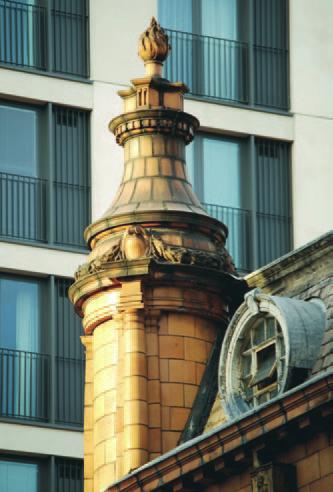
A finial on the London Road Fire Station, a Grade II* listed building in Manchester which is on the Buildings at Risk Register
(Photo: Jonathan Taylor)
Terracotta is susceptible to a multitude
of failure mechanisms that stem from its
method of manufacture and how it is fixed
to a building. The problem with repairing
terracotta units is that deficiencies in
the wares are often internal, caused by
rusting cramps or dowels, expanding fills,
freeze-thaw damage or salt crystallisation
(cryptoflorescence) for example. Such
problems can compromise the entire unit
and often repairs cannot be carried out
without damaging or destroying the originals.