Basic HTML Version


1 0 6
t h e b u i l d i n g c o n s e r v a t i o n d i r e c t o r y 2 0 1 2
3.2
the chances of obtaining the original clays
and manipulating them in the same way are
extremely low. Units produced using modern
methods would almost certainly appear
very different to the units they are trying to
replicate. There is also evidence that chemical
additives were used in the late 19th century,
providing a precedent for their use today.
Moulding
Historically, methods of terracotta
manufacture varied. Early 16th century
wares were produced using timber moulds,
while Victorian wares were often made
using plaster casts. Modern manufacturers
can replicate these techniques, with the
clay being hand pressed into the moulds
to a depth of approximately 25mm–50mm.
Another modern technique is the slip casting
method, where a liquidised clay mix (or ‘slip’)
is poured into a porous mould and left to
set, providing a uniform depth to the body.
Of the two methods, slip casting is the most
recent although its origins are over 100 years
old. There are slight differences between the
two processes with slip casting often giving
a more smooth and sharp appearance. Other
benefits of this method are that it creates a
more uniform depth to the terracotta block
and reduces the risk of air pockets, which are
more common with hand-pressed wares and
often lead to later laminations. It is therefore
important for the conservation professional
to sample the different types of ware to get an
accurate match to existing units depending on
their requirements. Undulations are also still
possible in both techniques, often caused by
slumping during the manufacturing process.
Finish
Matching the finish of terracotta is normally
the most straightforward part of the process.
In the early 19th century terracotta was used
to imitate stone and would often incorporate
tool marks on its surface. This can still be
achieved through similar methods and is
undertaken prior to firing.
Firing
Historically, terracottas would be fired in
down-draught, muffle or Hoffman kilns,
none of which produced particularly even
firing temperatures. As the colour of natural
clays changes substantially with firing
temperature, the appearance of the wares
would vary depending on their position in
the kiln. However, modern demands for
uniform, regular and reliable products have
resulted in better kilns. The most common
method of firing is now the shuttle kiln, which
is an intermittent, low thermal mass, gas-
fired structure. This creates a uniform heat
removing any variations in the appearance of
the terracotta blocks. To create a match for
less evenly fired originals, in addition to using
colourants, colour variation between batches
can be achieved by using slightly different
firing temperatures.
There are benefits to using these modern
kilns in terms of the structural stability of the
terracotta produced. The higher uniform firing
temperatures dictated by EN 771-1 remove
all the sulphates from the clay, reducing the
risk of efflorescence appearing on the surface
of the ware. Higher firing temperatures also
result in a denser body, which in turn makes
the block more resilient to weathering and
freeze-thaw damage. While in the Victorian
period it might have been necessary to make
two to three pieces of a unique unit in case of
defects, modern manufacturers benefit from
low wastage and high yields.
The best available solution
Although there are only a few manufacturers
left, and despite their reliance on significantly
different production processes, the modern
architectural terracotta manufacturing
industry has never had better conservation
credentials. Its output in terms of matching is
often of a high quality, with detailed research
undertaken to ensure accuracy. Ironically, if
original techniques were used, the chances
of producing accurate replicas would be far
slimmer because of the many variables that
influence the appearance of Victorian and
Edwardian terracotta. Modern regulations
and production techniques may have ruled
out the use of truly accurate replica materials,
but they have enabled us to produce accurate
visual matches using durable materials that
are more resilient to weathering.
Although the process used in terracotta
manufacture today is not in keeping with
conservation best practice in terms of its
sourcing and integrity, the products being
made today are far superior to those of recent
decades. Problems with identifying the
provenance of the unfired material combined
with financial and regulatory constraints
mean that the process currently employed is
the best available.
Recommended Reading
J Ashurst and N Ashurst, Practical Building
Conservation, Volume 2: Brick, Terracotta
and Earth, Gower Technical Press,
Aldershot, 1988
British Standard 8221-2:2000, Code of practice
for cleaning and surface repair of buildings
Part 2: Surface repair of natural stones,
brick and terracotta, 2000
J Fidler, ‘Fragile Remains: An International
Review of Conservation Problems in the
Decay and Treatment of Architectural
Terracotta and Faience’, in Architectural
Ceramics; Their History, Manufacture
and Conservation, James and James Ltd,
London, 1996
GR Hollis, ‘Manufacturing Faience and
Terracotta’, in Context, Issue 52, 1996
PPS5 Planning for the Historic Environment:
Historic Environment Planning Practice
Guide, EH/DCLG/DCMS, London, 2010
M Stratton, The Terracotta Revival, Victor
Gollancz, London, 1993
Steven Handforth
MSc is estate manager
of the Victoria and Albert Museum and
oversees large-scale conservation projects
at the museum along with day-to-day fabric
issues. Email steven.handforth@gmail.com
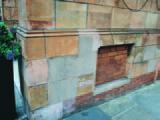
Sandblasting of terracotta units often leads to a pitted surface. Due to the temperature and duration of firing, the internal
body of the block is still resilient to weathering. (All photos on this page: Steven Handforth)
This modern slip-cast example shows natural imperfections
in the block.
Mortar repairs often become unsightly as their pigments are
bleached by exposure to ultraviolet light.