Basic HTML Version


t h e b u i l d i n g c o n s e r v a t i o n d i r e c t o r y 2 0 1 2
1 2 3
3.3
3.3 Structure & Fabric :
metal, wood & Glass
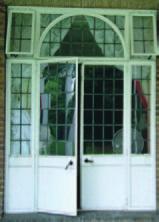
Neo-Georgian glazed metal doors at Elizabeth House
Workshop repairs
In cases of severe deterioration, the window
can be removed to the workshop. As noted
above in relation to wrought iron windows,
dismantling and re-housing will involve
disturbing the surrounding fabric, although
it may still be possible to repair sub-frames
in situ.
Once in the workshop, removal of
flaking paint and corrosion can be carried
out in a chemical bath of phosphoric acid.
Unevenly distributed rust may have to
be grit blasted. Test areas should always
be carried out to determine the correct
air pressure and size of grit, starting at a
pressure of 40psi with a fine grit (usually
copper slag) and not exceed 60–70psi. It is
important that BS standards for abrasive
cleaning should be carefully interpreted
before applying to historic steel sections.
As with in situ work the stripped metal
should be primed with a rust inhibitor
immediately to avoid the re-formation of rust
on exposed surfaces. Then realignment can
be carried out as necessary using heat and
pressure. Any perished metal sections may
then be cut out and replacement matching
metal sections welded in. Replacement
metal can either be taken from matching
salvaged windows or suitably adjusted,
currently available sections. Matching
replacements can be specially fabricated
but this will be more expensive.
Where appropriate, the repaired window
can be powder-coated to the required colour
over hot-dip galvanising, a zinc-coating
process which improves rust and corrosion
resistance reducing the requirement for
regular maintenance.
Repair versus replacement
In situ repairs, where possible, are likely
to be the most economical option.
When replacement is inevitable, the
appearance of the steel window can be
matched reasonably closely with currently
available sections, which include SMW
or F sections (both introduced in 1920)
and W20 sections (introduced in 1956).
Severely deteriorated windows are more
expensive to repair than to replace so it
may be appropriate to reserve repair in the
workshop for the most significant windows.
Replacement windows have the
advantage of hot-dip galvanising and
powder-coated finishes which make them
nearly maintenance free, whereas inter-war
windows require regular maintenance and
repainting to prevent rusting. It is possible
to treat inter-war windows that are in the
workshop for repair by powder-coating over
hot-dip galvanising. However, the cost of
this may not be justified given the lower
performance specification of inter-war
windows when compared to contemporary
upgrades, which include double glazing
and jamb linings that can partially design
out an inherent problem of cold bridging.
Pre-1918 sections are unique to a
particular manufacturer and so are
exceptionally important. Hot-dip galvanising
and powder-coating are not suitable for
these sections, which should be repaired and
refinished as per the original window.
Finally, it should be noted that currently
available steel sections provide an option
which is both acceptable – in conservation
terms and aesthetically – and financially
realistic when it comes to the replacement of
wrought iron and cast iron windows which
are beyond repair.
Acknowledgements
This article is based on research carried
out for the chapter on metal windows in
Windows: History, Repair and Conservation
(see recommended reading). The author
wishes to thank Charles Brooking for
allowing her to photograph the collection
at Cranleigh and for his assistance with the
illustration captions, and Chris Topp for
providing useful research documents on
wrought iron.
Recommended Reading
E Makri and R Harris, ‘Metal’, in Windows:
History, Repair and Conservation,
Michael Tutton and Elizabeth Hirst (eds),
Donhead, Shaftesbury, 2007
SC Park, ‘The Repair and Thermal
Upgrading of Historic Steel Windows’,
Old House Journal, Active Interest Media,
Washington DC, 1984
Eleni Makri
MArch BArch RIBA IHBC AABC
is the founder and managing director of
Conservation PD (Planning + Design) (see
page 22). Her previous roles include head of
the heritage team at the Halpern Partnership
(now Formation Architects) and local
authority conservation officer.
Elizabeth House, Highgate, London, Richardson and Gill, 1930