Basic HTML Version


1 6 0
t h e b u i l d i n g c o n s e r v a t i o n d i r e c t o r y 2 0 1 2
4.2
Intumescent Products
Andrew Forecast
F
ire protection
within our built
environment has always been of
vital importance, not only for
life safety but also for property and
heritage protection, including business
continuity. Fire protection, used for
whatever reason, typically falls into
two categories, active and passive.
Active fire protection
generally means
those installations that will actively respond
to a fire event, including detection, sprinklers
and smoke venting for example.
Passive fire protection
refers to those
products that remain robust enough to resist
the passage of hot gases and fire for a given
duration, and includes architectural elements
such as doors, floors and walls as well as
proprietary sealing systems such as collars,
wraps and dampers.
Although the term passive might not
be expected to apply to products which
react to the application of heat, it is also
used to describe elements which include
intumescing materials. Such materials
react to heat, usually by expanding, to
enhance the resistance of a component to
the passage of heat, smoke and flame.
Active and passive methods of fire
protection will typically be used in
conjunction with one another to ensure that
escape routes remain tenable for a duration
suitable for firstly effective evacuation (to
comply with life safety requirements in
The Building Regulations) and secondly for
property protection (including salvage).
The determination of where escape routes
are needed and for what period they need
to be protected, stems from the Building
Regulations 2010. Recommendations on how
to achieve those minimum expectations
are given in the Communities and Local
Government (CLG) guidance, Approved
Document B (ADB).
Compartmentation
Compartmentation is the vertical and
horizontal division of the building into spaces
and suites of spaces that can be isolated from
each other in the event of a fire. In historic
buildings, ensuring that fire cannot spread
rapidly from one part or ‘compartment’ of the
building to another can be complex since the
integrity of walls and floors cannot always
be relied on. Furthermore, during the life of
the building its use may vary considerably,
and even minor changes to the structure
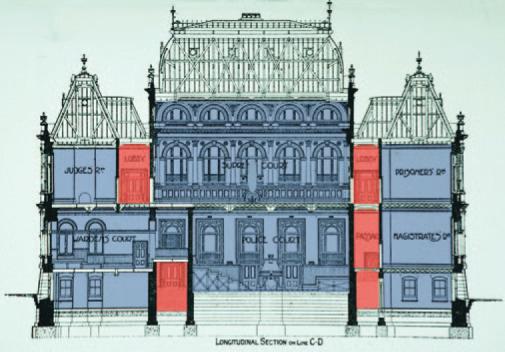
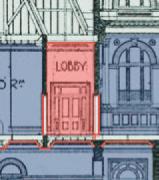
Compartmentation: the diagram and the detail below illustrates the complexity of ensuring that fire cannot spread rapidly from one part or 'compartment' of a building to another. All openings
must be taken into consideration, including those like underfloor spaces which can be permanenly protected, and those like doorways, ducts and pipework which must be sealed in an emergency.