Basic HTML Version


1 6 2
t h e b u i l d i n g c o n s e r v a t i o n d i r e c t o r y 2 0 1 2
4.2
upgrades, size does matter. Test data will
demonstrate performance but only for what
was tested, which would include the specimen
size. If a tested panel measured 350mm x
350mm, it would not necessarily work on a
panel where one of the dimensions exceeded
350mm. In some instances, the self-weight of
the large expanse of reacted intumescent is
enough to pull it off the door it is protecting.
Therefore, care should be taken to ensure that
the test data supports the size (and thickness)
of panel that is to be upgraded.
As with the board fixing option, panel
upgrades that use intumescent papers are
relatively easy to reverse, albeit requiring the
potential remake of beads.
Painted coatings
Paints and varnishes are available which offer
improvements to the fire performance of
existing doors and panels. Their performance
is based on a reactive coating that protects
the underlying door/panel construction.
The paints would require several coats, in
thicknesses stipulated by the manufacturer,
which would be applied to both sides of the
door/panel. Their end appearance is varied
depending on application and would be
reversible if water based. However, their
performance would again be linked to
dimension and door/panel construction.
Small tested specimens would not necessarily
support the products use on a large expanse
of panel due to increased heat experienced by
the centre of large panels, which do not benefit
from the shadowing of the perimeter beads
and stiles and rails. Similarly the existing
substrate would need to be identical to that
tested in order to ensure good adhesion of the
reactive coatings. This would certainly require
the removal of any existing paint or varnish
finish to the underlying door-set/panel.
Whole door upgrades
If a door leaf is solid with no panels, but its
thickness is not consistent with that expected
for suitable integrity duration, can it be
upgraded? The answer is ‘possibly’.
Boards
Boards (plasterboards, calcium based boards
etc) could be applied if they have correct test
data to support their use as an upgrade to
thin doors. But this is again dependent on
the size of the door to be upgraded. Typically
test data will support fairly standard sized
door-sets (1,982mm x 762mm) with an existing
thickness of 35mm or more if used in single
leaf configurations. In most instances, the full
boards would be located on both sides of the
door, either notched to go over the door stop
or, the leaf re-hung and the door stop moved
to accommodate the increased thickness. This
is a robust and reversible method of upgrade
but again, has size limitations.
Intumescent papers
Intumescent sheets are not really appropriate
for such full size upgrades, and paints and
varnishes have limitations in terms of base
material (removing existing paints and
ensuring similar timber base to test data) and
of leaf size.
With all intumescent and board upgrades,
it is essential to understand the test data and
how it can ultimately limit the end application.
A product seen to work in one instance on a
pre-prepared specimen of limited dimensions
will not necessarily work on a much larger
scale. Care should be taken when reviewing
test data. Always remember, test evidence
is valid for exactly what was tested on the
day of test. Its extrapolation to other uses
(including size and material) can only be given
by carrying out either many tests to cover the
range, or by having an assessment produced by
a reputable fire engineer.
Ironmongery protection
Intumescent materials are also used
underneath items of ironmongery, more often
for the higher integrity door-sets (60 minutes
and above) but also for lower integrity door-
sets when items are large and/or invasive to
a door construction. Unusually large hinges
blades, for example, which cross the frame
reveal, act as a path for heat to be transferred
past the perimeter intumescent seals (usually
bisected at half-hour performance). This has
the potential to char timber deep into the
frame reveal and ignite the framing on the
non-fire side.
Bedding hinge blades on an intumescent
gasket helps in two ways, firstly the material
will cool the blade by taking heat in order to
react and secondly, to fill local fissures within
the timber to help slow down the passage
of hot gases. Bedding hinges on ‘old’ timber
where grain patterns are prominent is also
useful as a matter of course.
Alternative approach
The provisions above are driven by
recommendations in ADB. However,
ADB is a functional document which also
enables fire engineering to be developed
to demonstrate comparable conditions.
Taking the geometry of the existing building
into consideration, it may be possible for
a qualified fire engineer to demonstrate
that the instant flashover conditions of a
BS476 (BSEN 1634) fire test would either
not be reached or would be significantly
delayed. If this is considered in conjunction
with the speed for a fire to be detected and
grow, it could be possible to demonstrate
that a full 30 or 60 minutes fire resistance
to the British Standard, is not needed. This
provides the opportunity to reduce the extent
of upgrades needed, with obvious benefits
not only in terms of costs and timescales,
but also by limiting the need for potentially
damaging alterations to historic fabric.
Surface spread of flame
Notwithstanding fire resistance, escape
routes, defined by either ADB or a prepared
fire strategy, would be expected to have
a certain level of performance to the wall
linings. This does not relate to fire resistance
(although most escape routes would also need
fire resisting properties) but to the surface
spread of flame. This relates to the speed at
which fire will propagate and spread across the
surface of a product. Typically escape routes
would need to be classified to a National
Class 1(European Class C-s3, d2). Timber has
a general surface spread of flame rating of
National Class 3 (European Class D-s3, d2).
The exposed surfaces may be treated to change
the inherent classification, enhanced to meet
the Class 1 needed. This may be achieved
by the use of suitable paints and varnishes.
There are many available and unlike the
intumescent paints/varnishes, will not have
a size restriction. It only becomes necessary
to ensure that the base timber is suitable to
receive the applied paint finish.
In retrospect
As with all fire rated products, be it for integrity
or for surface spread of flame, test evidence
is key, as is making sure that the product
itself is sufficiently suitable and robust for the
application in question. In historic buildings,
demonstrating fire resistance retrospectively
(that is to say, for pre-existing fabric) is
therefore quite a complex issue, and should
only really be confirmed by those with suitable
experience who are able to take account of
evidence from the product manufacturer and
apply suitable determination.
Andrew Forecast
is Senior Fire
Engineer at Trenton Fire Ltd (see page 163)
and has worked in the Fire Engineering
and Consultancy profession for over
16 years. His expertise has been derived
from fire testing research through to the
preparation of fire engineered strategies
for a wide range of new build and heritage
projects. He is an active member on the
IFE Heritage Special Interest Group.
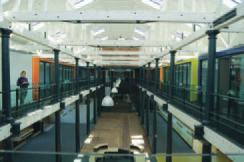
Intumescent paints
are often used to
enable the retention
of structural elements
such as these cast
iron columns where
industrial buildings
are converted. The
coating must ensure
that structural
integrity is maintained
for long enough to
evacuate the building.