Basic HTML Version



1 7 8
t h e b u i l d i n g c o n s e r v a t i o n d i r e c t o r y 2 0 1 2
5
■
■
A T CRONIN WORKSHOP
62A Valetta Road, London W3 7TN
Tel 020 8749 2995 Fax 020 8740 0508
Email ianblock@atcronin.co.uk www.atcronin.co.uk
TEXTILES AND UPHOLSTERY
: See also: display entry in Textiles &
Upholstery section, page 171.
■
■
ANTHONY BEECH ACR FURNITURE CONSERVATION
AND RESTORATION
The Stable Courtyard, Burghley House, Stamford,
Lincolnshire PE9 3JY
Tel 01780 481199 www.furnitureconservation.co.uk
CONSERVATION OF HISTORIC HOUSE INTERIORS AND FURNITURE COLLECTIONS
:
Anthony Beech, accredited in conservation, has been responsible for
restoring and conserving many historically important collections and
interiors. His remit includes conservation and restoration of furniture,
bookcases and panelling. Furniture including boulle and giltwood
decoration, carving and upholstery conservation. Clients include museums,
historic houses and churches. See Shellac by Anthony Beech, page 176.
■
■
CLIVE BEARDALL RESTORATIONS LTD
WorkshopandShowroom, 104bHighStreet,Maldon, EssexCM95ET
Tel 01621 857890 Fax 01621 850753
Email info@clivebeardall.co.uk www.clivebeardall.co.uk
ANTIQUE FURNITURE RESTORATION AND TRADITIONAL HAND FRENCH
POLISHING
: Established 1982, Clive Beardall’s attention to detail and
authenticity of restoration and materials have earned him and his skilled
team of craftsmen many prestigious commissions and a first class
reputation. The team is experienced in all aspects of the antique furniture
trade including furniture restoration and conservation, traditional hand
French polishing, re-upholstery, marquetry, carving, gilding, leather desk
lining, rush and cane seating, decorative finishes, valuations and made-
to-order furniture, interior polishing, including panelling, staircases,
floors etc. Clive Beardall is an accredited member of The British Antique
Furniture Restorers Association and his workshops are included on the
Conservation Register. See also: display entry on this page.
ANTIQUE & FURNITURE RESTORERS
must be exercised. Although less invasive than full re-polishing, this
technique does remove some of the shellac surface and it is possible
to burnish through. This will be indicated by a matt patch where the
shellac has been removed to an earlier finish layer or to the bare wood
surface. This will then require the polish to be re-built and may mean
that the surface has to be completely re-polished to achieve an even
finish. The other pitfall of this approach is that it can leave a brighter
patch in the worked area compared to the surrounding aged surface.
This can be avoided by working over the entire surface and then
matting down to the desired level.
Apart from handling damage or water damage the most common
reason for the failure of shellac finishes is exposure to unfiltered
ultraviolet light, which gradually breaks down the finish until it
reverts to a white powder on the surface. Infrared light can also cause
damage by heating the surface until it becomes unstable. Unmodified
shellac is sensitive to heat and can be damaged by hot cups and plates,
which are responsible for a great deal of damage to shellac-finished
side tables and dining tables. Alcohol in the form of wine or spirits
will also soften shellac causing damage.
When it is necessary to re-polish because the shellac finish
has broken down beyond repair, it is often possible to remove
much of the damaged finish but retain the shellac which has
filled the grain. This means that the subsequent re-polishing
takes less time. This approach often allows the retention of much
of the patina – the evidence of use and subtle surface colour-
changes that make period polished wood so appealing.
The traditional method of removing shellac finishes was to
saturate a pad of fine ‘0000’ wire wool with a mix of methylated
spirit and raw linseed oil, working this over the surface to soften and
remove the shellac. The raw linseed is introduced to slow down the
evaporation of the methylated spirit and lubricate the cut of the wire
wool. The wire wool becomes clogged with shellac during use and
must be replaced periodically. Finally, neat methylated spirit is used
on a cotton wool pad to remove any remaining residue. This method
has drawbacks, not least the potential risk of contaminating the wood
surface with fibres from the wire wool. It is also rather uncontrolled
and solvent gels or swabs provide a cleaner, more controlled method
of removal.
It is important when carrying out tests on the polished surface
to establish the nature of previous finishes and how they may change
during cleaning and preparation for re-finishing. Many oxidised
finishes which have degraded badly can be revived or repaired. Under
no circumstances should ‘sanding down’ be considered as this can
remove not only the shellac finish but also all surface patina and
the hand-worked surface, which is of historical value. Marquetry-
decorated and veneered objects have suffered heavily from this
invasive approach and the thinning of the veneer often reaches the
point where ground work is visible. The damage caused by sanding
down period surfaces is irreversible and should never be considered
for period furniture or historic interior woodwork.
Once the damaged layer has been cleaned back to a sound surface
it is possible to rebuild a shellac finish using traditional techniques.
The long-term reversibility and stability of unmodified shellac makes
it suitable for use by conservators on historic wood surfaces which
were originally shellac-finished and from which it can be removed
again. Shellac is not suitable for the in-painting of shellac-bound
finishes such as a Japanned or painted finishes because the method of
removal for the new shellac would interfere with the original binding.
When re-finishing period furniture and interior woodwork
it is important to try to achieve the correct finish for the period.
The piece’s place of origin should also be taken into account
because a shellac finish may be appropriate for continental
furniture from an earlier date than would be appropriate for
British-made pieces. Thorough research should be the starting
point for any project involving period wood finishing.
Anthony Beech
ACR runs Anthony Beech ACR Furniture
Conservation and Restoration (see entry on this page), an Icon-
accredited workshop based at Burghley House, Lincolnshire. The
company provides services ranging from the conservation and
restoration of individual pieces to the ongoing conservation of
complete collections and interiors.
Accredited Member of
the British Antique Furniture Restorers’ Association
Listed in the Conservation register
104B High Street Maldon Essex CM9 5ET
TEL (01621) 857890 FAX (01621) 850753
info@clivebeardall.co.uk www.clivebeardall.co.uk
WE SPECIALISE IN THE RESTORATION and
conservation OF FINE PERIOD FURNITURE
T
H
E
B
R
I
T
I
S
H
A
N
T
I
Q
U
E
F
U
R
N
I
T
U
R
E
R
E
S
T
O
R
E
R
S
'
A
S
S
O
C
I
A
T
I
O
N
–
• Traditional Hand French Polishing
• Wax Polishing
• Re-upholstery
• Marquetry
• Carving
• Gilding
• Leather Desk Lining
• Rush and Cane Seating
• Bespoke Cabinet Making
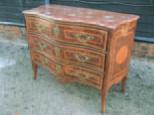
shown here a fine quality mid-18th century
italian serpentine fronted kingwood commode