Basic HTML Version


1 8 2
t h e b u i l d i n g c o n s e r v a t i o n d i r e c t o r y 2 0 1 2
5
18th Century British
Floor Coverings
Heather Tetley
L
ooking at
the Georgian period, with its
classical Palladian design, its light rooms,
elegant furniture and glorious hand-
knotted carpets, is rather like watching the sun
emerge from storm clouds. The architectural
and decorative ideals of plainness and
structure are in such strong contrast to the
previous century’s dark colours and stylised
decoration, which so neatly reflected its
convoluted, intrigue-ridden politics.
In the new Palladian style of the early
18th century, exact proportions, smaller
fireplaces and light colours give the general
tone of the lifestyle. Although carpets with
stylised and rather oriental designs were
being woven in Britain in the late 16th and
early 17th centuries, there is no record of
hand-knotted carpets being made during the
second half of the 17th century or the first half
of the 18th. The only records of carpets made
before around 1750 describe flat-woven ‘Fote
cloth’ carpets, which were narrow strips of
plainweave cloth made from coarse wool or
plaited from rushes.
Depending on the homeowner’s social
status, floors were often limewashed in
servants’ quarters and in the houses of poorer
folk. Painted floor cloths, which echoed
the geometric designs of expensive Italian
ceramic tiles, were popular in the houses of
the moderately well-off and in many of the
great houses of Britain and in Protestant
America. The latter shared the British taste for
the Palladian style rather than the very ornate
high rococo or baroque decorative style of
Catholic Europe.
Ingrain, or Scotch carpets, also known
as Kidderminster carpets, were also popular.
These were woven double sided and employed
more colour and design, rather like a coarser
version of the Welsh blankets of today.
As Britain’s economy expanded, so the
demand for carpets grew and new machines
were invented to keep up with the demand.
Foot-operated treadle looms were superseded
by water-powered looms, which not only
increased production but also allowed for
more complex weaving techniques. Loop-pile
Brussels and cut-velvet Wilton carpets began
to be made in 1740. Their pile was created by
adding extra backing material. The looping of
the Brussels pile was formed by the use of a
pile wire which was shot in with the weft (the
yarns which are woven horizontally on the
loom, passing through the vertical warp yarns)
before being drawn out to create the loop.
Later, a small blade was added to the end of
the pile wire to cut the looped pile when it was
withdrawn, creating ‘cut Wilton’.
There is plenty of documentation and
many good illustrations of these early looms,
but few surviving early power-loom carpets.
However, examples of later 18th-century
Brussels carpets and 19th-century ingrain
carpets can be found at Audley End and there
are replica Brussels carpets at Kew Palace
which were made for the bedrooms in 2006.
Although the colours still apparent in the
surface of the fragments and in the replication
may not exactly represent the original strong
palette, the construction and materials show
the fine weaving of the early machines.
The development of the glorious hand-
knotted British carpets relied on the foresight
and creativity of a few men as well as the
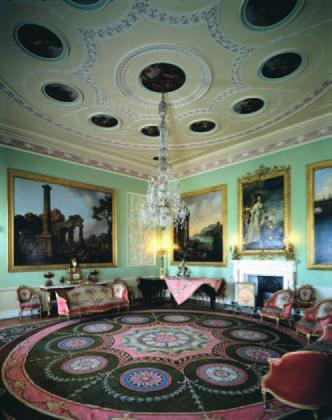
The 18th century Robert Adam carpet in the Music Room at Harewood House near Leeds (Reproduced by the kind permission
of the Earl and Countess of Harewood and Trustees of the Harewood House Trust)