Basic HTML Version


1 8 4
t h e b u i l d i n g c o n s e r v a t i o n d i r e c t o r y 2 0 1 2
5
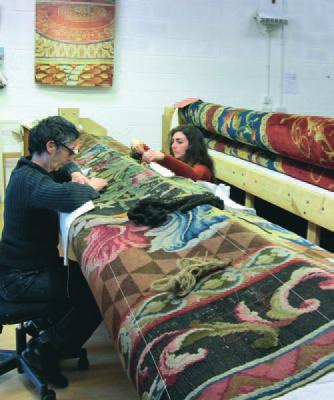
Conservators working on the Blue Drawing Room carpet from Dumfries House
those in museum collections, has driven
the development of a range of treatments.
Carpet treatments have been developed using
the basic techniques of tapestry and textile
conservation and certain of the less invasive
treatments from restoration, for the cleaning
and repair of carpets.
The Blue Drawing Room
carpet, Dumfries House
The conservation treatment of the 1858
Axminster carpet in the Blue Drawing Room
at Dumfries House was undertaken for most
usual types of carpet damage, especially the
deterioration of the black ground in the border
and in the central medallion. It was relevant
to note, after the carpet was re-laid and while
the blinds were still open, that it was exactly
in the path of the sunlight’s journey across the
room that the black areas (coloured by black
iron tannin mordant dyes) had disintegrated
to leave exposed warps and wefts.
This carpet also suffered from low pH and
high conductivity due to a heavy impregnation
of coal dust and soot. A wash solution was
developed after testing that would remove
acid pollution and grime while preventing dye
run and leaving the piece at a pH that favoured
both the wool and the cellulosic foundation
and a conductivity that discouraged further
uptake of atmospheric pollutants. It was
wet-cleaned in a shallow wash tank in three
sections using a non-ionic detergent that
works well with wool at low temperatures.
The damaged areas were supported
onto large coarse linen (or ‘linen holland’)
patches, which were sewn to the underside
before the carpet was mounted on a large
tapestry frame. In areas where the carpet
was missing, the broken and fragile warps
and wefts were couched to the linen. New
warps and wefts were introduced and
secured into the linen support fabric. These
missing areas were infilled with new knots,
where the surrounding pile was long and,
where the surrounding pile was short, with
a flat needlework stitch. Infill of this sort is
undertaken for visual integrity, but more
importantly to protect the carpet because
even the lightest use, twice yearly vacuuming
and daily opening of shutters, will gradually
cause wear. Exposed areas, which are already
weak, can suffer badly.
Conservation treatments for early power-
loom carpets are slightly different. Because of
their construction and the introduction of jute
into carpet manufacture from the early 19th
century, it is not advisable to fully immerse
power-loom carpets. In general, where wet-
cleaning is possible, it is preferable to use
conservation detergents through wet vacuum
extraction machines and hand-held upholstery
heads, which allow for good control of vacuum
suction and quantity of water used.
Conservation treatment specifications are
primarily to do with the safety of the carpet,
its future use and current environment, as
well as curatorial decisions as to the levels of
intervention needed. A recent controversial
treatment was undertaken to infill a large
hole in a 15th-century rug with a photo
replication canvas plug. This is very useful
for museum display, but is unsuitable for
historic houses or domestic use. Although
dyed linen, even photo replication plugs,
may work well on walls or beneath furniture
where the carpet may be seen but not
walked on, the fabrics available for infilling
missing areas that are still in use not only
wear badly but are visually intrusive.
Those responsible for historic houses
and their contents face many challenges as
they strive to balance the often conflicting
requirements of access and preservation.
Dealing with the problems caused by tens of
thousands of visitors per year (or per week
at Windsor Castle) while continuing to
encourage visitor engagement, is an area in
which conservators and curators are pushing
the frontiers of preventive conservation and
effective display. The process of conserving a
historic carpet doesn’t end once it has been re-
laid; deciding how best to protect and care for
it thereafter is very much a part of the process.
Recommended Reading
J Ayres, Domestic Interiors: The British
Tradition 1500–1850, Yale University Press,
New Haven, 2003
‘Case Study: Wilton carpets for Kew Palace,
London’, The Grosvenor Wilton Company
Limited (available online at www.
grosvenorwilton.co.uk)
V Habib, ‘Scotch Carpets at Stirling:
Thomas Gilfillan’s Cash Book and Ledger
1764–1770’, Proceedings of the Society of
Antiquaries of Scotland,130, 2000
F Hartog, ‘Digital In-fills for a Carpet’, V&A
Conservation Journal, Issue 58, 2009
(available online at www.vam.ac.uk)
B Jacobs, The Story of British Carpets, 2nd ed,
Carpet Review, London, 1972
S Parissien, Interiors: The Home since 1700,
2nd ed, Laurence King, London, 2009
S Sarin, ‘The Floorcloth and Other Floor
Coverings in the London Domestic Interior
1700–1800’, Journal of Design History, Vol
18, No 2, 2005 (available online at www.
sarinfloorcloths.com)
MThompson, Woven in Kidderminster: An
Illustrated History of the Carpet Industry in
the Kidderminster Area 1735–2000, David
Voice Associates, Kidderminster, 2002
Heather Tetley
ACR is an accredited
conservator with 25 years of conservation
experience. She is the proprietor and a
co-founder of carpet and tapestry
conservation company The Tetley Workshop
(see page 180), which has been granted
a Royal Warrant for the conservation of
carpets. Website www.tetleyworkshop.co.uk