Basic HTML Version


1 8
t h e b u i l d i n g c o n s e r v a t i o n d i r e c t o r y 2 0 1 2
1
unimpaired condition’ or the ‘restoration
of some material thing or structure by the
renewal of decayed or worn out parts, by
refixing what has become loose or detached’.
While most if not all conservation officers
would require LBC for the replacement
of a decayed 19th-century single-glazed
sash window by a double-glazed timber
equivalent, some would also require LBC for
its replacement by a single-glazed replica. It
is unlikely, however, that many would insist
on an application for LBC for repair of such
a window, even though this could involve
the loss of original material by cutting out
decayed timber and splicing in new.
The situation would probably be different
in the case of a 17th-century timber-mullioned
window. Here, the replacement of a substantial
section of timber with matching new timber
might be considered to constitute a repair
affecting the character of the listed building
and would therefore need LBC.
The more extensive the work the clearer
the situation becomes. Thus, in the case of a
timber-framed listed building now rendered
over (and rendered at the time of listing),
no respectable conservation professional
would dispute that replacing a section of
decayed timber-frame with blockwork or
brickwork and then re-rendering to the same
specification would require LBC (and would
almost certainly not obtain it).
But what would be the case if like-for-
like materials were used? For example, would
LBC be required to cut out a single decayed
corner post made of elm in such a building,
replacing it with a new one of exactly the
same dimensions but in ‘new’ oak and then
re-rendering the area affected? In the case of
a Grade II listed building in Dorchester-in-
Thames some years ago the answer was ‘yes’.
Would this also have been the case had it been
possible to obtain a suitable section of elm
to carry out the repair/replacement? Possibly
not, but if the elm itself was ‘new’ would this
actually be significantly different to using
‘new’ oak?
In this case the owner of the building was
particularly conscious of his responsibilities
as the guardian of what we must now call a
‘heritage asset’. He was clearly anxious to do
the right thing, but would a local authority have
prosecuted or served an enforcement notice on
him had he carried out this work without first
obtaining LBC? This may seem to be entirely
academic and surely any local authority would
think hard before going down such a route.
However, this question goes right to the heart
of the matter, that is: does repair work that
is completely compatible with the character
of a listed building require LBC or could it
instead be carried out following submission
of a detailed specification of works to, and
agreement in writing from, the local planning
authority that the works are acceptable?
In the past this was often considered an
appropriate method of proceeding. A written
copy of the agreement and the details of the
works would be placed on file as a record of
what had been done. Today, matters are not
always so simple. Many conservation officers
now seem to take the view that an LBC
application must be submitted for any work
to a listed building, regardless of whether
the work is a repair or an alteration. This is
not, however, necessarily correct and while
some conservation officers appear to think
that PPS5 requires them to take this position,
PPS5 does not advocate this at all. First, there
is no specific policy in PPS5 covering repairs
to a listed building, while paragraph 147
of the accompanying Practice Guide states
that ‘minor repairs [to a heritage asset] are
unlikely to require planning permission or
listed building consent (where relevant) if the
works are carried out using the same materials
and techniques and they do not affect the
significance of the asset’. This is arguably little
different in thrust to paragraph 3.2 of PPG15,
which stated that ‘Consent is not normally
required for repairs, but, where repairs involve
alterations which would affect the character of
the listed building, consent is required’.
However, the Practice Guide does take a
different and seemingly more robust attitude
to restoration, a topic only obliquely referred
to in PPG15 (in paragraph C.6 of Annex C).
Paragraph 158 of the Practice Guide states
that ‘Restoration of a listed building requires
its alteration and is almost always likely to
need listed building consent and may require
planning permission’. Intriguingly, though,
the words ‘almost always likely to’ still leave
some room for doubt.
Works of repair or restoration are not
the only grey areas where LBC is concerned.
Another, which has caused much controversy,
is the subject of painting the exterior of a
listed building. It is now commonly accepted
that painting or rendering the surface of a wall
that was originally intended to be left (and
has remained) untreated is likely to be both
physically and visually damaging. Such work is
strongly discouraged and would require LBC,
which it would almost certainly not obtain.
But what of a wall that is already painted
and where the owner simply wishes to change
the colour? PPG15 was relatively relaxed
on this, stating in paragraph 3.2 and C.17
of Annex C that LBC would be required
where the ‘character’ of the building would
be affected but significantly softening this
by adding: ‘In many cases the colour of the
paint may be less important than the first
application of an unsuitable covering which
could be damaging to remove’. This sensible
and pragmatic approach made it clear that
conservation officers should not (as they are
sometimes accused of doing) act as ‘taste
police’, dictating which colours they feel are
appropriate and which are not.
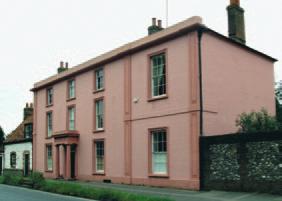
This was certainly the attitude South
Oxfordshire District Council took to the
repainting of the long-painted facade and
return elevation of a prominently sited
Grade II listed building in Wallingford some
years ago (above left). The previous colour
was a light green, the new colour (depending
on one’s view) was a vibrant or lurid dark
pink. This was primarily a matter of personal
taste. Certainly, there was no evidence to
suggest that replacing one modern proprietary
paint with another had in any way affected
the character of the listed building and (to
the dismay of some in the town who clearly
disliked the colour) the council therefore
declined to require that the owner submit an
application for LBC.
Some 12 years on, the colour remains,
probably to the chagrin of some but not, in
my opinion, to the detriment of the building’s
character as a listed building.
Finally, and most importantly, it
should be stressed that if an owner is in any
doubt over whether the works they intend
require LBC, the best advice is to ask his or
her local conservation officer first and to
ensure that a written response is received
and retained. Under PPS5 this must extend
even to paint colour in situations like that
described above as paragraph 150 of the
Practice Guide simply (but not particularly
helpfully) comments that a change in
external paint colour ‘may’ require LBC.
Nicholas Doggett
BA PhD Cert Archaeol
IHBC MIfA is managing director of Asset
Heritage Consulting Ltd, an Oxford-
based heritage consultancy which works
throughout the UK. From 1991 to 2002 he
was principal conservation officer at South
Oxfordshire District Council. Most of the
cases referred to in this article are drawn
from his experience there.
51 High Street,
Wallingford:
the facade and
return elevation
of this already
painted Grade II
listed building
were repainted
without listed
building consent