Basic HTML Version


t h e b u i l d i n g c o n s e r v a t i o n d i r e c t o r y 2 0 1 2
1 9 9
6
Useful Information
conservators from Nimbus Conservation,
the trainees are gaining hands-on experience
in the practicalities of conservation.
The scheme was the idea of the National
Trust. From the outset the aim was to integrate
training into a programme of restoration
and repair, and an education officer was
appointed to see how this could be achieved.
The orangery provided the ideal vehicle both
for short courses aimed at the public, schools
and, if possible, professional conservators
too. By good fortune the proposal coincided
with the development of a new course in
masonry conservation at City of Bath College.
Stonemasonry was already well established at
the college with courses to NVQ level 3, and
for the previous three years trainees on its
courses had regularly worked with the Bath
Building Preservation Trust to gain practical
experience. The conservation course was a
natural development, and the prospect of
offering it in conjunction with work for the
National Trust on a Grade II* listed building
was unprecedented.
When the National Trust invited
tenders for the restoration of the orangery,
conservation companies were required to
allow for the provision of on-site training
as part of their bid. Nimbus Conservation,
a specialist stonemasonry company with a
long track record of training its own masonry
conservators, won the contract for the three-
year programme of conservation, restoration
and training.
The architectural stone conservation
course commenced in September 2010 and
is open to stonemasons with NVQ to level
2 or an equivalent qualification. The NVQ
level 3 is awarded by the National Heritage
Training Group. The syllabus is designed to
provide the specialist skills and understanding
required to work on historic masonry projects,
and assessment is based on the ability of the
trainees to demonstrate the key competencies
covered by the course, including:
• conservation ethics
• lime technologies
• mortar repairs
• stone decay
• cleaning techniques
• stone carving and replacement
• taking details, model making and casting
• compiling and writing conservation reports
• health and safety.
The course includes areas not
specifically required for the NVQ such
as poulticing, lime shelter coats, and
resin technology, including the use of
resins for dot fixing broken fragments.
The course lasts 30 weeks, with one day
each week spent at Tyntesfield and one day at
the college, either in the workshop or attending
seminars. The project was supported by the
National Trust’s on-site skills supervisor
working closely with the building surveyor.
Assessment is continuous, with on-site
competencies judged by the three parties
involved; the National Trust’s surveyor for the
project, Nimbus Conservation’s site manager
and the NVQ assessor.
The programme is the first of its kind in
the UK and has successfully completed its first
year, with all but one of its students attaining
their architectural stone conservation NVQ
in Heritage Skills level 3. In October 2011 the
programme won the first English Heritage
Angel Award.
NHIG at Hampton Court Palace
Eight trainee blacksmiths have been working
on the conservation of one of the most famous
examples of Baroque wrought ironwork
in Britain, Tijou’s screen in the gardens of
Hampton Court Palace.
Like traditional masonry, historic
wrought ironwork is quite unlike any modern
equivalent, requiring a very distinct skill set
for its conservation. In recent years the supply
of skills has largely relied on one blacksmithing
course, at Hereford College of Technology,
which provides block release training and
works closely with the few specialist firms
with the resources to train their craftspeople.
Chris Topp and Co for example has regularly
sent trainees from its Yorkshire base to train
in Hereford.
Despite the strategic importance of
the block release course at Hereford to the
maintenance of the craft skills required,
funding for the course was withdrawn by the
Skills Funding Agency in 2010 because the
craft skill requirements had not been officially
recognised by a ‘national occupational
standard’. Spurred by the imminent threat of
closure, two key developments followed.
Firstly, working closely with the newly
formed National Heritage Ironwork Group
(NHIG), ConstructionSkills stepped in
to help assess the skill requirements,
paving the way for developing a Heritage
Skills NVQ level 3 in blacksmithing.
Secondly, the NHIG set about the task
of establishing a new course which would
qualify for funding under the present regime.
With the support of Historic Royal Palaces
and Hereford College of Technology, NHIG
submitted a bid to the Heritage Lottery
Fund (HLF) under it’s Skills for the Future
programme. The result was the Heritage
Blacksmithing Bursary which commenced
in May 2011 and is to run for two years.
The bursary enables eight trainee
blacksmiths each year to broaden their skills
and develop a better understanding of the
philosophy and ethics of conservation. The
programme provides one year of full time
training and includes a five week block release
course at Hereford College of Technology
and a series of work placements, the first of
which is at Hampton Court Palace. Here they
are gaining practical experience of ironwork
conservation and holding repair work under
the supervision of a specialist conservator
from Hall Conservation. Further placements
include working in museum environments and
in selected blacksmiths’ workshops.
On completion of the bursary programme,
trainees who are able to demonstrate
the competency standards required are
awarded the NHIG Award for Blacksmithing
Conservation. As the competencies are based
on the ‘national occupational standards’
defined by ConstructionSkills for Heritage
skills level 3 blacksmithing, the award
represents a substantial proportion of the
NVQ level 3 model.
Currently NHIG is working with other
organisations to develop a sustainable funding
model for work-based training at NVQ level 3
and above which will provide the traditional
blacksmithing skills required.
WHAT NEXT?
The idea of using conservation projects as
vehicles for specialist craft training is not
new. What makes the Tyntesfield programme
unique is that it is essentially an ordinary
restoration project with a small but extremely
effective training element. Each year, just 30
days are given over to training, and even then
conservation work continues. Yet out of this
small commitment, 10 stonemasons make the
transition to specialists in conservation as a
result of the liaison with Bath City College.
Many more specialists could benefit from
this type of project. A quick leaf through the
pages of The Building Conservation Directory
illustrates the huge variety of specialist skills
required for the conservation and repair
of the UK’s historic buildings. Specialist
blacksmithing may have been plucked from the
brink, but many other crafts are under threat.
Any conservation project which is likely to
qualify for an HLF grant, and which involves
significant elements of stone roofing, leaded
light windows, or any type of earth walling for
example, should be considered as potential
training grounds for specialist trainees.
HLF’s Skills for the Future programme
is now closed, although its trustees have
indicated they will make further strategic
investment; meanwhile, the principal source
of HLF assistance for the conservation
of historic buildings is through Heritage
Grants. To qualify for this type of assistance,
proposals are required to ‘help people to learn
about their own and other people’s heritage’.
This is the only requirement applying to all
proposals, and it is an extremely important
one. Introducing a training element can satisfy
this requirement and make a vital contribution
to the survival of key skills.
The author:
this article was prepared by
the editor Jonathan Taylor with the help of
Nigel Bryant of City of Bath College, Bethan
Griffiths of the National Heritage Ironwork
Group, Jo Reilly of the Heritage Lottery Fund,
and the National Trust.
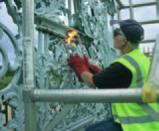
Adrian Wolfe, an NHIG student, flame cleaning a section
of the Hampton Court screen to expose the condition of the
underlying metalwork (Photo: Bethan Griffiths)