Basic HTML Version


3 4
t h e b u i l d i n g c o n s e r v a t i o n d i r e c t o r y 2 0 1 2
1
most problematic aspects of flooding are
managing the drying out process and
the effective removal of contaminants.
Where properties are insured, the
insurer will often appoint a ‘disaster-recovery
contractor’, who will first make a hazard and
risk assessment. This assessment will cover
a whole range of potential risks, including
the stability of the building. They will also
look at priorities for minimising any primary
damage, and assess the potential for secondary
damage and how this can be avoided. Some
independent expert advice from an architect
or other specialist may be necessary to agree
the best way to save as much of the historic
fabric as possible and to agree methods of
opening up voids, removal of finishes and
cleaning and drying out.
The clean-up operation should start as
soon as the waters have receded, the flood
risk has passed and access to the building
is deemed safe. It is easier to remove mud
when wet, and cleaning with plastic shovels,
vacuum cleaners and soft-bristled brushes to
gently remove the silty deposits is usually the
best method. A neutral detergent and water
solution should be used to clean floors and
walls, which should then be rinsed with clean
water, dried with cloths and then allowed to
air dry before being sprayed with a sanitising
mist to kill any remaining bacteria. Some
materials will need to be sent to specialist
cleaners for removal of contaminants.
The clean-up operation will be followed
by a planned programme of drying out.
Old buildings must not be dried out too
quickly. As EH guidance points out: ‘thin
timber elements, including floors, doors and
panelling, may warp, twist or split; salts will
migrate through old stone and plasterwork,
causing them to blister, powder and exfoliate;
[and] many painted surfaces will peel and
flake’ if dried out too quickly (‘Flooding and
Historic Buildings’, EH, 2010).
Temperatures above 18°C may also
encourage mould growth. Conversely,
temperatures below 4°C allow the formation
of ice crystals in moisture-laden materials,
leading to spalling and de-lamination.
‘Forced’ drying of walls can produce
a dry surface while the wall mass remains
wet. This can lead to secondary damage,
often appearing later as the repair works
are completed. According to EH: ‘the best
general advice is to dry the building gently
and slowly, first through natural ventilation,
and then with the aid of dehumidifiers’ (EH,
2010). Cross-ventilation is greatly aided by air
movement, which can be natural or controlled
through the use of fans.
Drying is a two-stage process: the
first stage is drying by liquid transfer
to the surface and the second is drying
by vapour transfer. The first stage is
fast and effective and governed by
ambient conditions of evaporation, the
second stage is much slower and almost
independent of the ambient conditions.
Air temperature needs to be maintained,
preferably below 20°C. The relative humidity
should be monitored and maintained
at 40–50 per cent. Dehumidifiers with
humidity sensors can provide better
controlled drying conditions.
Independent experts will give advice on
drying and treating woodwork to prevent
decay. They can carry out surveys to assess the
potential risks of fungal and other infestations
and they have the equipment to monitor the
condition of inaccessible timbers over time.
Independent experts may also be required
for advice on drying wall paintings and
the use of chemical cleaners to remove oil
contaminants.
Damage to historic fabric
Historic building materials typically
require careful and specialist treatment
during cleaning and drying out in order
to prevent damage and it is important
to agree with the loss adjustors and
emergency contractors on appropriate
methods of cleaning and drying out.
As EH’s guidance warns: ‘organic
materials such as timber swell and distort
when wet, and suffer fungal and insect
infestations if left damp. If dried too quickly
and at temperatures that are too high, organic
materials shrink and split, or twist if they
are restrained in panels. Inorganic porous
materials do not generally suffer directly from
biological attack. However, enormous damage
can be caused when inherent salt and water
(frost) crystals, carried through the substrate,
are released through inappropriate drying or
very cold conditions’ (EH, 2010).
Concealed cavities will also require
cleaning out and drying, and in historic
buildings it is important to agree how
these areas are opened up. Water trapped
behind panelling can be allowed to drain
out by drilling tiny holes. It may then be
possible to dry behind the panelling with
‘injection drying’, by pumping warm air
into the voids. In some cases the panelling
may need to be removed and dried properly
by specialist joiners, who will number
the panels and stack, turn and load them
properly to counteract warping. The removal
of historic lime plaster from a surface is
rarely necessary, as the lime is very porous
and helps underlying fabric to breathe.
Floorboards can buckle if they become
saturated as a result of prolonged immersion
in water and some may never regain their
previous profile. Saving historic fabric should
always be attempted first. Removing a number
of intermediate boards can help to allow some
expansion without causing permanent damage
and buckled boards can be taken up and
carefully stacked to allow them to dry slowly.
Wall and ceiling plaster finishes have
different chemical and physical responses
to water saturation. Modern gypsum-based
plasters are hygroscopic and water-sensitive as
the calcium sulphate in the plaster is partially
soluble in cold water, so they are likely to need
remedial treatment or replacement. Older
lime-based plasters, on the other hand, may
soften and swell when wet, but usually without
collapsing, and they harden again once dry.
De-bonding of lime plaster can occur if the
underlying laths swell and then shrink, causing
the plaster nibs to break, but they can usually
be re-anchored using resins and screws.
Some metal objects which are subject to
corrosion if temporarily immersed in water
will not come to harm once dried. However,
where water is retained around metal ties,
cramps, pipes and conduits embedded in
masonry walls or floors, ferrous metals can
continue to corrode and expand leading
to cracking and spalling of surfaces and to
localised de-bonding. Serious structural
problems can emerge, particularly in maritime
environments. Signs of problems such as rust
staining, cracks and movement may require
investigation and invasive repairs.
Paint finishes and varnishes are
vulnerable to staining, flaking, blooming
and dissolution of binders. Permeable
traditional paint finishes such as limewash
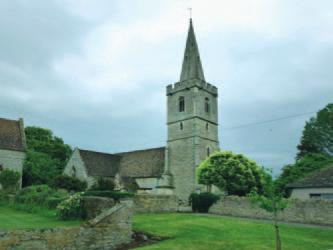
The Grade I listed Church of St Andrew and St Bartholomew, founded in the 12th century