Basic HTML Version


t h e b u i l d i n g c o n s e r v a t i o n d i r e c t o r y 2 0 1 2
3 5
1
Professional services
and distemper that allow moisture to
evaporate through their surfaces from
the substrate, can be cleaned, disinfected
and left to air dry or repainted to match.
Relatively impermeable modern paints such
as alkyd oil-based paints or acrylic emulsions
cannot be reapplied until completely dry
and may require stripping off completely to
allow the substrate to dry out effectively.
Historic painted decorations should
be treated by a specialist conservator.
Dehumidifiers and heaters should not be used
in interiors that have historic wall paintings
on plaster or timber. Slow drying supervised
by a conservator is essential to avoid salt
crystallisation, paint flaking and mould growth.
Remedial work and repairs
Debris that gets swept up by fast moving
waters can cause mechanical damage.
After the initial cleaning, decontamination
and drying, a survey of the condition of
the property will be required, including
potential structural and material damage.
The degree of moisture content of the various
elements of the buildings will also need to be
assessed including the condition of external
walls, internal walls, floors, basements and
cellars, and floor cavities, building services,
appliances and fittings.
Flood planning
The Environment Agency has produced
guidance on how to plan for and respond to
a flood. Templates can be downloaded from
the EA website and tailored to prepare a flood
plan for a particular historic building. English
Heritage’s ‘Flooding and Historic Buildings’
also provides guidance on issues ranging from
flood resistance measures to monitoring a
flood-damaged building after remedial works
have been completed.
St Andrew’s and St Bartholomew’s
Church, Ashleworth, Gloucestershire
The Grade I listed church of St Andrew and
St Bartholomew was founded in the 12th
century and lies alongside the river Severn
below the level of the bank that has been built
up as flood defence. The church is part of a
group of 15th-century buildings including a
tithe barn. The rest of the village is built on
higher ground to the west.
At Ashleworth the river Severn is in
its last stage in a wide flat valley through
which it meanders down to the Severn
estuary and out into the Bristol Channel.
The tidal reach is a few miles downstream
at Maisemore. According to the EA flood
map, the church is at risk of extreme
flooding described as a 1 in 1,000 chance
of occurring each year. Without the river
defences this risk would rise to 1 in 100.
Periodic flooding of the church includes
significant floods in 1772, 1896 and 1897.
Before 2007, the most recent significant flood
was in 1947 and was recorded at 1,219mm
above the floor level of the south aisle. The
major flood of July 2007 was of similar
proportions to that recorded in 1947.
Shortly before the church flooded in
July 2007 the owners of a historic manor
house upstream from the church received
an automated warning from the EA advising
them of the risk of flooding, which they
relayed to a churchwarden. A group of
villagers moved the loose and soft furnishings
to higher levels in the church.
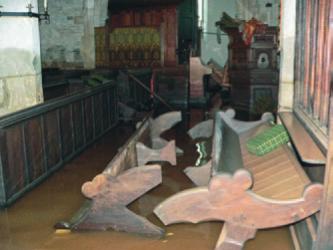
Unlike previous floods, the July 2007 flood
came up very quickly and entered the church
sometime in the morning. As can be seen
from the aerial photograph (see page 33), the
water cut off the approach to the church. The
churchwardens could not get in until a week
later when the waters had receded.
Cleaning and drying
As a result of periodic flooding the interior
of the church was already reasonably flood
resilient. When the 2007 floodwaters subsided
it was found that the church had not sustained
any structural damage. The major casualty
was the organ, despite the fact that it was
raised on a platform.
The clean-up was carried out by the
emergency contractors and involved the
following operations:
• muddy water and contaminants from
the neighbouring farm’s pig unit were
removed. The only hidden cavity
was behind some 19th-century and
modern panelling in the base of the
tower; the panelling was dismantled,
cleaned and set aside for re-fixing
• loose furnishings such as the altar frontals
and hassocks were saved from saturation
but had to be sent to specialist cleaners
• all the furniture was decontaminated
and removed, with only the font and the
pulpit left in the church. The furniture
and fittings were transported to a barn
and left under cover. The barn was
partly open which allowed plenty of
air circulation. Security was a concern
so a full inventory was made by the
churchwardens (no losses were sustained)
• the organ was dismantled and
sent away for cleaning and repair
by a specialist organ builder
• the under-pew heaters and low-level
electrics, which were all damaged
irretrievably, were removed
• the power was isolated and a temporary
supply was arranged by the emergency
contractors to allow them to use
mechanical fans. Air circulation was
improved by opening the doors to the
south, west and south east. Assisted drying
with extract fans took two months to
reduce the moisture levels to acceptable
levels that would provide an equilibrium
of 10–15 per cent moisture content in
the timber (anything above 15 per cent
starts to enable rot and insect attack).
Repair work
The flooding occurred early on Friday 20 July
2007 but the remedial works didn’t begin until
April 2008, after all the necessary approvals
and tenders had been obtained.
Part of the approvals process included
negotiation with the insurers as to how the
insurance money would be spent. It was
agreed that the value of like-for-like repairs
could be used to carry out repairs and
reordering, provided these alterations would
improve the flood resilience of the building.
The parochial church council (PCC) was
keen to carry out flood protection measures as
part of the remedial works and it was agreed
that the organ platform would be raised
further and enlarged to fill the north transept.
All socket outlets were rewired and
fixed 1,220mm above floor level. The
under-pew heaters were replaced with
high level quartz ray heaters to augment
the existing radiant bar heaters.
Remaining sections of wall panel were
removed and incorporated into the new front
to the organ platform. The platform front
was fixed so that it can easily be removed for
future cleaning and drying.
The church interior as the waters receded with the high water mark clearly visible on the wall