Basic HTML Version


t h e b u i l d i n g c o n s e r v a t i o n d i r e c t o r y 2 0 1 2
5 1
1
Professional services
After the Fire
Tim Hutton
F
ire is
the most destructive and
alarming thing that can happen to a
historic building and has resulted in
the destruction of many listed buildings,
from terraces to palace apartments. Recent
examples have been widely studied and well
publicised. Based on this work, a number of
useful observations can be made that should
promote cost-effective early refurbishment of
fire-damaged buildings with the maximum
retention of original fabric.
Immediate measures after fire
In the UK, fires brought under control by the
local fire brigade may be treated as a potential
crime scene. Access to the affected building
may therefore be strictly controlled until the
authorities have completed their work, but a
number of measures can be taken.
Obviously the insurer should be contacted
as a matter of urgency so that a loss adjuster
can be appointed, but uncertainty over
insurance cover can result in delays in this
critical period, postponing refurbishment and
re-occupancy, and resulting in further loss
of historic fabric. It is therefore important
for the building owner or manager to take all
reasonable measures to mitigate these losses
ahead of any final settlement. Consideration
should be given to obtaining independent
specialist advice as soon as possible, and the
insurers should be advised of all measures
being undertaken ahead of any settlement.
It is important to keep all key information
on site, from the contact details of the
fire brigade and local authorities, to the
contacts with insurers or loss adjusters and
the condition of structures and materials.
Fortunately the general availability of digital
cameras and email will help in this. Backup
records should also be rigorously maintained
and stored off site.
The factors to be considered in planning
remedial measures include structural stability,
safe access, electrical safety, contamination
by hazardous materials such as asbestos, and
water penetration. It is also important to
contact the local planning and conservation
authorities as soon as possible for advice.
Keeping them informed will help to ease the
process of obtaining listed building consent
when necessary.
Water penetration
Far more damage is caused to a historic
building by water penetration into the
building during and after a fire than is
caused by the fire alone. Not only does this
water cause physical and chemical damage
to materials, it also provides the conditions
for decay and mould growth during and
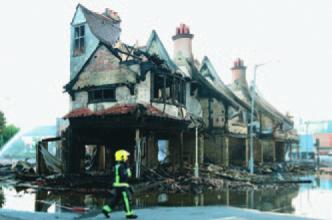
The burnt out and saturated remains of the House of Reeves’ furniture store in Croydon after the riots in August 2011,
surrounded by the water from the fire hoses (Photo: Press Association Images)
Measures to reduce water penetration
• Establish effective ground and surface drainage, including
checking and clearing existing drains
• clear surviving roof drains, including those of any adjoining structures, and
provide effective temporary roofing and roof drainage as soon as possible
• disconnect and drain down any water pipes on site.
Measures to promote ventilation and drying
• Remove saturated materials and contents from the building as soon as
possible to prevent moisture migrating into other materials, including all
damp furnishings, fittings, carpets, rubbish, damp infill and collapsed building
materials (listed building consent may be required for this work)
• demolish or otherwise remove all parts of the structure not to be
retained on refurbishment, including masonry masses and floor
in-fills in particular (again, consent may be required)
• provide through-ventilation to all parts of the structure, including all
structural cavities such as sub-floor voids, chimney stacks and wall cavities
and fix all doors, windows, cupboards, etc in a partially open position
• identify all residual moisture in the structure using specialist
moisture profiling of representative structures
• wherever possible, remove all impermeable finishes from structures
containing residual moisture and strip all water and salt damaged
plaster and finishes to expose structures behind
• detail refurbishment of the building to include moisture sinks such as
through-ventilated dry-lining systems, permeable or microporous finishes
and structural heating systems so as to allow continued drying during and
after refurbishment (this will require specialist advice on detailing)
• if required, consider the installation of accelerated-drying machinery (the use of indirect
heaters, high capacity desiccant dehumidifiers, tenting and fans is recommended but
should be specified by an independent specialist); and consider the use of mechanical
ventilation systems (the cost of both electrical power and the specialist on-site
supervision required to accelerate drying successfully is always a limiting factor).