Basic HTML Version


6
t h e b u i l d i n g c o n s e r v a t i o n d i r e c t o r y 2 0 1 2
Conservation
an Evolving Concept
Paul Drury
B
uilding conservation
is distinctly
different from the physical processes of
repair and adaptation. It is an attitude
of mind, a philosophical approach, that seeks
first to understand what people value about a
historic building or place beyond its practical
utility and then to use that understanding to
ensure that any work undertaken does as little
harm as possible to the characteristics that
hold or express those values. Conservation
now needs to be explained in such terms,
rather than by technical directives (that is to
say, to be operative rather than prescriptive),
because of the diversity of the buildings and
places that people have come to value and
wish to hand on to future generations.
Practising conservation involves
judgement guided by professional ethics and
public policy. It is based on an understanding
of the relative importance of the heritage
values attached to a building or structure,
how they are represented in its fabric and
the effects on them of different approaches
to repair. The intellectual arguments for
conservation originally put forward by
antiquaries and critics, often prompted by the
threatened destruction of valued buildings,
have gradually developed into professional
statements of ethics and good practice. The
concept has evolved over a long time, but the
language used to articulate it is changing. As
conservation becomes a more complex and
public activity, approaches to the conservation
of buildings are seen as being closely linked
not only to the conservation of objects but also
to sustaining cultural values in the historic
environment as a whole.
Throughout Europe, the cultural
significance of historic buildings and places
is now generally recognised as a public
interest in property, regardless of who owns
it, justifying the use of law, public policy and
public investment to protect that interest.
There are differences, however, about which
buildings and areas are valued sufficiently to
warrant legal protection, both quantitatively
(the number of buildings and areas) and
qualitatively (the values ascribed to them).
Although the values of some places have
long been recognised and tend to become
more clearly established over time, attitudes
to others (often of more recent date) may
change, sometimes quite rapidly, within an
evolving culture. Conservation thus requires
an awareness of the mutability of heritage
values. Policies and good practice about what
should be conserved and how that should
be done therefore represent a snapshot of
contemporary understanding and approach,
rather than a set of unchangeable truths.
From minimum intervention
to conservation planning
The intellectual position of building
conservation at the end of the 19th century
was expressed with poetic force in William
Morris’ 1877 Manifesto of the Society for the
Protection of Ancient Buildings. Its emphasis
on the primary importance of sustaining
inherited fabric and its opposition to
restoration are still highly influential in British
conservation. It is worth bearing in mind,
however, that the manifesto’s primary subject
matter was medieval buildings, by then at least
three centuries old. A huge expansion in the
type, age range and number of buildings and
areas recognised as having cultural heritage
value during the 20th century has made their
conservation a much more complex activity,
which now needs to take into account public
as well as professional opinion.
Buildings of the 16th and 17th centuries,
mostly still in everyday use, were included in
the remit of the royal commissions established
from 1908 to record them; the terminal
date was soon extended to 1714. Statutory
protection, effectively introduced in 1947 ¹ by
the Town and Country Planning Act and Town
and Country Planning (Scotland) Act, included
Georgian buildings from the outset, soon
adding a small number of Victorian buildings.
While remaining highly selective of more
recent buildings, inter-war and finally post-
war buildings have been added to the lists.
A ‘30-year rule’ was set, and soon reduced
to ten years for buildings deemed to be of
‘outstanding’ importance and under threat.
This closing of the gap between (present)
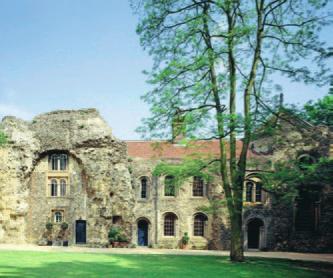
Changing attitudes:
English Heritage oversaw the conservation and regeneration of derelict 18th-century houses that infill the
ruins of the West Front, Bury St Edmunds Abbey, which the Ministry of Works had once proposed stripping away. (Photo: Fisher
Hart Architectural and Interiors Photography)