Basic HTML Version


t h e b u i l d i n g c o n s e r v a t i o n d i r e c t o r y 2 0 1 2
9 1
3.2
3.2 Structure & Fabric :
Masonry
Tudor Brickwork
Gerard Lynch
T
he Tudor
period (1485–1603), which
is often considered in the two broad
phases ‘Early Tudor’ and ‘Elizabethan’,
witnessed the decline of the Gothic style,
symbolised in brickwork by the low-rise, ‘four-
centred’ or ‘depressed’ arch. The Gothic was
gradually displaced by Renaissance elements
with a marked Classical influence.
A newly rich gentry, courtesy of land
and assets taken from the Church after
the Dissolution of the Monasteries (1536),
instigated a frenetic period of secular building,
creating fine mansions in brick. Brickwork was
reserved for the privileged and received the
royal seal of approval when Henry VIII took
ownership of Hampton Court Palace (1514)
from a disgraced Cardinal Wolsey in 1528.
Brickmaking
Although commercial brickyards with
permanent up-draught kilns existed, most
bricks were made by itinerant brickmakers.
They were hired by wealthy clients to locate
suitable ‘topmost’ clay, frequently found
on the site of the proposed building, and to
excavate, mould, dry, fire and deliver bricks.
Ideally, clay was excavated in the autumn
and over-wintered to break it down and help
remove soluble salts, ready for moulding from
springtime onwards.
Preparing the clay for moulding resulted
in clay with a high water content. This made
it difficult to fully fill the mould, which is why
Tudor bricks are shallow in gauge (height)
with rounded arisses (the right-angled edges).
Sizes are typically found to range from
210–250mm x 100–120mm x 40–50mm.
The mould was a simple frame, open
top and bottom. The clay was thrown in,
the excess struck off with a timber ‘strike’
and the frame lifted and removed. The best
bricks would have been made at a bench,
resulting in an even gauge. However, Tudor
mansions demanded huge numbers of bricks,
and judging by the irregular variation in
dimensions between what should be parallel
faces, it seems that some moulds may
have been placed directly on the ground.
Although unevenness of the ground might
explain an undulating bedding face, the
difference in gauge of some Tudor bricks
is most likely to be because the mould
moved or tipped when the excess clay was
struck off. Essentially the same moulding
process can still be seen in use today in
developing countries such as Iran, Iraq,
India and Pakistan, and in much of Africa.
Once moulded, the bricks were first laid
out flat, on bed, to dry until strong enough to
be placed on edge, being turned daily until
fully dried and ready for firing.
Rather than using limited capacity kilns,
bricks were usually fired in huge temporary
open clamps that were capable of firing in
excess of 100,000 bricks. Both clamps and
kilns were designed with ‘fire-tunnels’ on the
longest, opposing sides into which the fuel,
mainly timber, was fed. Low-fired by modern
standards, brick colours were dependent on
clay mineralogy, ranging from pale pinks
through to dark reds and buffs. The faces of the
bricks that lined the fire-tunnels were exposed
to the highest temperatures and the effects of
hot flue gasses. These bricks were darkened
or ‘flared’ in the process and were commonly
used as headers for decorative effect (that is,
they were laid at right-angles to the wall face).
All fired bricks were graded for use within
a structure with the best quality reserved
for face work. Under-fired ‘semels’ (meaning
‘semi-fired’) were usually re-fired, although
builders might, wrongly, use some, especially
for internal walling, despite being forbidden to
do so under the terms of their engagement.
Brickwork
Tudor brickwork exudes confidence,
being used for both utility and show.
Bonding was mainly based on variations
of English bond, with English cross-bond
being particularly popular as it allowed
the bricklayers to create regular quarter-
bond offsets in every course that facilitated
patterns, or diapers, utilising the flared
headers to create a polychromatic effect.
Specially shaped bricks could be made by
one of three methods. They could be cast using
a suitably shaped mould or, less commonly,
when three-parts dry, the ‘green’ clay could
be cut to shape with a knife. However, with
these two methods the resultant profile could
distort during drying and firing. The most
common method, therefore, was to ‘cut and
rub’ the fired bricks to produce a wide variety
of ornate shapes using a brick axe, a saw, a
hammer and chisel, and various abrasives.
Called ‘hewing’, this practice was introduced
by Flemish craftsmen during the 15th century
and required great skill. The results can be
seen in cut-mouldings for plinths, reveals,
tracery, label mouldings over openings and in
the highly decorative chimney stacks which
define the brickwork of the period.
Tudor brickwork is characterised by
thick joints of lime-rich mortar that served
as a flexible gasket. This was necessary for
laying the typically irregular bricks to the
line, level and overall gauge required to fit the
dimensions of the architectural elements of a
facade. The faces of the joints were finished, or
‘ jointed’, using the trowel as work progressed
to create either a flush face, or more usually
a ‘struck’, or a ‘double-struck’ profile (see
illustrations above).
To overcome the unavoidable variations
in brick tones characteristic of up-draught
firing, and to highlight the diapering, the
predominantly red brick, premier, facades
were usually colour-washed (not lime-
washed). Washes were based on preparations
primarily consisting of red ochre as the
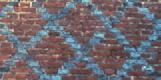
An example of Tudor polychromatic brickwork built of
orange-red bricks laid in English Cross-bond to display
‘diapers’ of flared headers, at Farnham Castle, Surrey, d 1508
(Photo: Gerard Lynch)
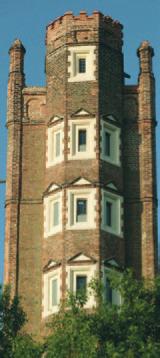
The six-storey Tudor folly Freston Tower (c1550), which
overlooks the estuary of the River Orwell in Suffolk
(Photo: The Landmark Trust)