Basic HTML Version



9 2
t h e b u i l d i n g c o n s e r v a t i o n d i r e c t o r y 2 0 1 2
3.2
pigment, glue size and ‘small ale’ (a readily
available form of weak beer) to help it adhere
to the masonry, and alum to ‘fix’ the colour.
The wash was brush-applied over both bricks
and joints once construction was completed.
This finish also provided a small degree of
protection to new brickwork laid in slow-
setting lime-mortar.
Once the colour-wash had dried, the
joints were selectively highlighted, but to
a lesser scale, with regular narrow lines of
white, or occasionally pigmented, distemper
(a mix of glue size and crushed chalk, or
‘whiting’) using a thin paintbrush in a process
termed ‘pencilling’. These techniques added
refinement to brickwork facades but some
modern observers, used to a more weathered
and rustic appearance, find the results garish.
Decay, conservation and repair
Before deciding on the most appropriate
method of conserving or repairing historic
brickwork, it is very important that a full
assessment and accurate diagnosis of all
failures is undertaken to correctly determine
the causes.
Decay is often found to affect individual
bricks and mortar joints in specific areas to
varying degrees. Failures may be related to
structural problems but they are often simply
the result of the normal effects of exposure
to the aggressive, cyclical weather-action of
rain and frost. Water, in its different forms,
is the main agent of decay and the original
construction and detailing of the brickwork
will largely determine its ability to minimise
the impact of driving rain and reduce the
potential of damaging saturation.
The measures taken to prevent damage
associated with water – the maintenance of
all rainwater goods, flashings, gullies, cills,
copings and cappings, and ensuring good
drainage – are at the heart of good brickwork
conservation.
Inspection and survey
Perhaps the most common indications of
defective brickwork are:
• spalling (erosion or de-
lamination of brick faces)
• surface staining from air-borne
pollutants and organic growth
• excessive algae or un-
controlled plant growth
• eroded, soft, crumbling or loosened mortar
• crystallisation of soluble salts
on or within bricks
• loosened or dislodged bricks
• bulges, misalignment or
cracks in the brickwork
• poor bonding or inadequately
tied-in corbelling
• failure of arches and lintels due to
inadequate abutments or bearings
• leaning chimney stacks.
To determine the cause of the failure and
specify the best method of conservative repair,
it is essential to record accurate information
on the defective materials or constructional
elements. It is necessary to understand the
building’s history and original construction
methods and materials used to develop a
sympathetic repair strategy.
Conservative repair
Everyone involved in the repair of historic
brickwork should be aware of and strive to
adhere to the philosophy of repair set out in the
Society for the Protection Ancient Building’s
Principles and Philosophy and within relevant
national guidance, such as English Heritage’s
Principles of Repair. These documents provide
clear guidelines promoting respect for the
historical integrity of a building by emphasising
a minimum intervention approach.
It is beyond the scope of this article to
deal with each and every problem or failure
associated with Tudor brickwork. It is
important, however, to briefly examine the
main issues surrounding replacement bricks
and mortars.
Replacement bricks
When the faces of Tudor bricks have spalled
sufficiently to warrant intervention to arrest
decay, there are two main options:
• carefully cut out the full brick, clean
it and the resultant indent of debris
and reverse the brick so that the
decayed face is placed to the rear
• where the decay is too severe, carefully
cut out and remove the brick for
replacement with another Tudor brick
or an appropriate modern alternative.
All replacement bricks, whether reclaimed
or modern, must match the original in size,
shape, colour, texture, porosity and, as far as
can be determined, durability.
Reclaimed bricks
Authentic 16th century bricks are
understandably rare. In the unlikely event
that a suitable supply is available for re-use,
it is vital to establish their provenance both
to ensure that they originate from a traceable
source rather than from the unauthorised
destruction of another historic building, and
that they were originally used externally. It
is sometimes possible to source replacement
bricks from elsewhere within the structure or
contemporary structures within the curtilage.
However, an expert assessment should be
sought on the various implications of this
(including structural, ethical and legal issues)
ahead of official authorisation.
Most reclamation companies do not
accept liability for faults and, unlike new
bricks, reclaims do not have to meet test
regulations to determine their performance. It
is important, therefore, that all the reclaimed
bricks are carefully inspected to ensure they
are ‘fit for purpose’. A pallet of reclaimed
bricks may contain various grades, including
bricks that were only ever intended for
internal walling and which would quickly
deteriorate if exposed to the weather. Here,
the experience and judgement of a good
craftsman is vital.
Modern replacement bricks
If the decision is taken to use modern bricks
to match Tudor originals, it is important
to locate a traditional brickyard excavating
similar topmost clays and a commitment, as
far as is practical, to manufacturing the bricks
required as closely as possible to the original
methods. Unfortunately, replacement bricks
are sometimes moulded too accurately so
that their uniform texture and sharp arrises
lack the all-important irregularities of the
surrounding originals. The bricks produced
by more efficient modern kilns and fuel types
can also be too regular in colour, lacking the
subtle tones and shades associated with up-
draught kilns.
To produce the most authentic period
bricks, it is necessary to mould with less
precision and to recreate the historic method
of firing by using the kind of kiln or open
clamp that any Tudor brickmaker would
recognise. Modern fuels achieve much higher
temperatures than were possible in the 16th
century so it is preferable to go back to timber
Tudor brickwork at Chenies Manor, Buckinghamshire, dated 1520,
jointed with a ‘struck’ profile, and displaying traces of the original
red ochre colour wash and narrow, white ‘pencilling’.
(Photos and diagrams: Gerard Lynch)
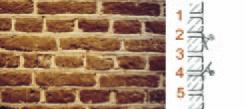
An original example of Tudor ‘Double-Struck’ jointing from a wall in the great
kitchens at Hampton Court Palace, c 1540. It was uncovered in the early 1980s below
plaster appled soon after the wall was completed, when design alterations ordered by
King Henry VIII, made the wall internal. The diagram shows the stages of execution:
1) bed joint from trowel, 2) joint ‘struck in a weathered fashion by trowel, 3) 1st stage
completed, 4) joint struck by trowel, bottom up to middle line, 5) the finished profile.