
The Anatomy of Theory
James Simpson
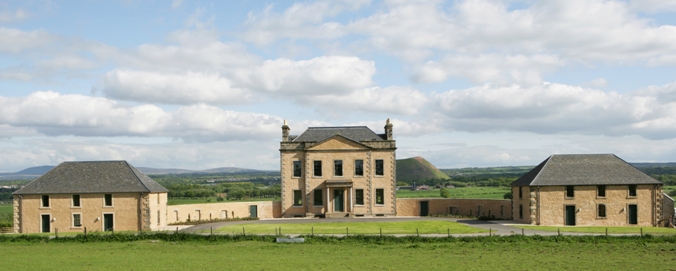 |
| Blackburn House, the category A-listed country house in West Lothian which was saved by the Cockburn Trust from dereliction |
'I'm so glad you teach conservation, it’s something for those students who can’t design!’ This was said to me by a big-name architect in the staff room of the Edinburgh College of Art in the late 1970s. Stewart Brown and I had just started our practice and I was a part-time lecturer on the pioneering conservation course begun by Peter Whiston and developed by my own teacher, the historian and writer Colin McWilliam. I was so angry I could have hit him! The moment took me back to my own student days when I struggled in the studio system, not I believe because I lacked the potential to be a good architect, but because my graphic skills were so inadequate.
‘Why do you want to be an architect?’ was the first question put to me at my interview for a place at the college in 1963. ‘Because I want to work with old buildings’ was my reply. There was silence, then a gentle titter went round the table. ‘We’ll soon broaden your mind’, was the gentle response from Ralph Cowan, the head of the school. They gave me a deferred place, they did broaden my mind and I like to think that, eventually, in the final quarter of the 20th century, their own minds broadened a little, too.
Struggles with the D-word have recurred from time to time. I have always believed that architecture is what architects do and that design, and drawing, is just a small part of that great discipline which is sometimes referred to as the ‘mistress of the arts’. ‘Form follows function’, the modernist mantra of my student days, was never adequate it seemed to me, and, as time goes on, I find myself returning again and again to the Vitruvian precepts of ‘commodity, firmness and delight’. Wotton’s 17th century translation may be archaic, but these three words seem to encapsulate all that really matters about architecture: ‘function’, of course, but ‘construction’ too, for architecture is nothing if it is not building, and that elusive thing ‘beauty’.
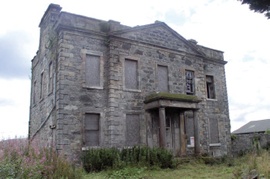 |
| Blackburn House before work began |
But what has this to do with conservation, another great discipline for which that new word ‘cross-cutting’ seems particularly apt? Conservation is itself a fairly new word, although the phrase ‘conservative surgery’ was coined in the early 20th century by Sir Patrick Geddes, the man we should now recognise as the father of urban conservation as well as of town planning. As a botanist by background, Geddes saw cities and societies in organic terms and was one of the first to perceive the natural and the cultural environment in a holistic way. Those of us who are focussed on building conservation tend to forget that conservation is a term also used by ecologists, museum conservators and many others. I see my own professional life in terms of two overlapping circles: an architecture circle and a conservation circle. The area of overlap, I call conservation architecture.
The essential task of any professional person is to make decisions, or at least to help others to make decisions. In architecture, the design process is based on a logical sequence of decisions: should the building be large or small, here or there, high or low, of concrete, brick or steel and so on: progressing always from the general to the particular and from concept to detail. Each individual decision will have regard to aspects of function, construction and beauty, not separately but together. The process will move forward, back and forward again in what is sometimes said to be an ‘iterative’ way. Similarly in conservation, whether the subject is a Chippendale chair, fish stocks, a tower house or a world heritage city, there must be a body of theory, a consistent language, a logical process and a recognised sequence of decision-making.
When, in 1996, I was commissioned by the British Standards Institution to work with a committee chaired by Bob Chitham to draft a ‘British Standard Guide to the Principles of the Conservation of Historic Buildings’ (published as BS 7913:1998) I saw this as an opportunity to try to establish a concise theoretical framework for conservation architecture. Two thoughts were foremost in my mind: the first, since the definition of terms is the first part of any British Standard, was to establish a language which would facilitate clear intellectual discussion of the subject; the second was to establish objectives which recognised that, while historic buildings were listed for their ‘historic and architectural interest’, these were not the only reasons for preserving them. In order to make sound decisions, it seemed to me, it was first necessary to understand what one was trying to achieve, and why.
The definitions in BS 7913 are more than a list of useful terms with meanings attached. They make a conscious attempt to acknowledge the cross-cutting nature of conservation as a discipline: this is explicit in the definition of conservation (‘action to secure the survival or preservation of buildings, cultural artefacts, natural resources, energy or any other thing of acknowledged value for the future’). An updating of this definition might replace the first word ‘action’ with the now commonly-used phrase ‘management of change’. They are an interdependent system of definitions. Fundamental, for example, are definitions of design (‘abstract concept of a building or artefact…’) and fabric (‘physical material of which a building or artefact is made’).
These may seem obvious, but they are essential to support useful, modern definitions for those difficult R-words:
repair work beyond the scope of regular maintenance… to return a building or artefact to good order without alteration or restoration
reconstruction re-establishment of the design of a building or artefact, or of what existed or occurred in the past, on the basis of documentary or physical evidence
restoration alteration of the fabric of a building… or artefact… to make it conform again to its design or appearance at a previous date.
Discussion of the theory of conservation architecture continues to be over-reliant on the writings of Ruskin and Morris. While these are of great historical importance, they were written with passion in circumstances which were very different to our own. We use words differently today and the intention in BS 7913 was to produce a system of definitions fit for the 21st century, one which would facilitate intelligent discussion of the subject.
The BS committee concluded that historic buildings, as opposed to monuments, were rarely conserved purely because of their historic and architectural merit: there were nearly always other factors. A historic house might be a highly desirable property with a substantial market value, the economy of a historic town might be strongly dependent on the quality of its townscape, to which a church spire was a major contributor, and recent evidence has shown that traditional buildings are among the most environmentally sustainable.
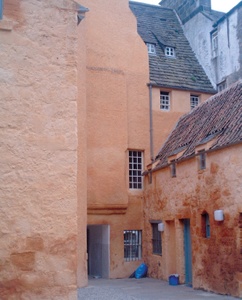 |
| Law’s Close, Kirkcaldy after it was rescued by the Scottish Historic Buildings Trust |
BS 7913 concluded that good decision-making was dependent on proper analysis of the particular circumstances and an integrated approach to the objectives of conservation in any particular case. These could be categorised as a mixture of cultural, economic and environmental objectives, and the appropriate approach, whether conservative repair, scholarly restoration or creative reuse, would depend on the nature and balance of the objectives being pursued. Within each type of objective, moreover, there would always be different strands or components: there would be buildings whose value was primarily evidential – manuals, log books and quinquennial professional inspections – and BS 7913 attempted to provide a logical framework for the decision-making process. Conservation architecture being both architecture and conservation, the analysis should have regard to the architectural considerations of function, construction and aesthetics (‘commodity, firmness and delight’) and to the cultural, economic and environmental objectives of conservation. What the BS committee, myself (as commissioned author) included, failed to appreciate in 1997 was the imminent arrival on the UK scene of the Burra Charter and the ‘significance-based approach’, founded on conservation plans and conservation statements. The conservation plan method was promoted by the Heritage Lottery Fund and launched at a major conference in Oxford in 1999.
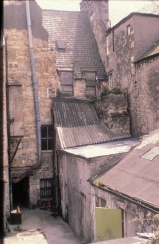 |
| Law’s Close before restoration |
As things have turned out, the Burra Charter and conservation plans have been far more influential than BS 7913. Happily, both documents reflected current thinking and both followed Patrick Geddes in supporting the need for proper research, analysis and the preparation of plans – establishing standing documentation as the basis for sound decision-making – so there is much common ground between the two. However, the conservation manuals, log books and the quinquennial inspections, prescribed to ensure good ongoing care, have been subsumed by the success of the conservation plan. Conservation plan practice continues to evolve though and there may be some prospect that the prescription of the sort of good everyday practice that was the aspiration of BS 7913 can be encouraged to a greater extent than it now is through the vehicle of conservation plans.
There is no doubt in my mind that, in 2008, a good conservation plan or conservation statement is a desirable basis for good conservation. It is, nevertheless, time to ask questions about the methodology. There is always the risk that this ceases to be a means to an end, as was the original intention, and becomes an end in itself and that those who are its champions become more concerned with the process than with the product, which is sound, well informed decision making and good conservation practice.
Too many plans are over-weighty, jargon-ridden, unreadable and, in the end, not particularly useful. I recall a conversation with James Semple Kerr, inventor of the conservation plan, in 1999, during which he said: ‘You can write a conservation plan on the back of an envelope if necessary!’ He went back on that slightly, when I met him in Sydney in 2004, but he reiterated his view then that ‘a conservation plan doesn’t have to be long: it’s just a way of thinking!’ More use should be made of conservation statements, the concise form which might be no more than a few pages long, to support grant and consent applications, for example.
So what should a good conservation plan, or conservation statement, be like? The basic process is similar to that of virtually all report and plan formulation: (1) information gathering, (2) analysis and (3) conclusions. The purpose is to build up a sufficient understanding of the site, structure or object to enable a reasonable consensus to be established as to its significance in heritage terms, from a range of viewpoints, and to sort out complex and sometimes conflicting issues. This information then becomes the basis for a set of policies to inform future treatment and management. These policies should lead to conclusions on possible approaches, and often to a preferred approach, to the conservation of the site, structure or object. A conservation plan is not a management plan and the alternative term conservation management plan promoted by the Heritage Lottery Fund should be discouraged. Policies might well, however, include recommendations that there should be a conservation manual, not dissimilar to a car manual, containing relevant technical information and guidance on routine maintenance, that a log book should be kept and that a system of quinquennial professional inspections should be established.
Conservation plans should be written in plain, non-technical language and should be accessible and jargon-free. Endless repetition of words like ‘place’ and ‘significance’ does nothing to enhance the credibility of the document. Words like ‘site’ and ‘structure’, ‘value’ and ‘importance’ have their uses and should be deployed as the context dictates. Conservation plans should be digestible and easy to read, well illustrated and no longer or more wordy than they need to be. A good conservation plan should be a practical, working document, not permanently lodged on a shelf, but in active use, regularly annotated and updated.
There is now a need to rehabilitate
BS 7913:1998 and to turn conservation plans
and conservation statements into the everyday
working tools of the conservation professional.
I look forward to the day when conservation
planning is so widely understood and accepted
that all applications for funding or consent for
culturally significant sites, structures or objects
will be supported by conservation plans or
conservation statements, not as mere exercises
in box-ticking but as a means of establishing
understanding and consensus. Conservation
plans should neither be feared nor seen as
ends in themselves, but should represent a
means of establishing confidence, minimising
bureaucratic oversight and, above all, raising
the general standard of conservation work.